Audiophile Power: Why Your Amp Cares About Battery vs Mains
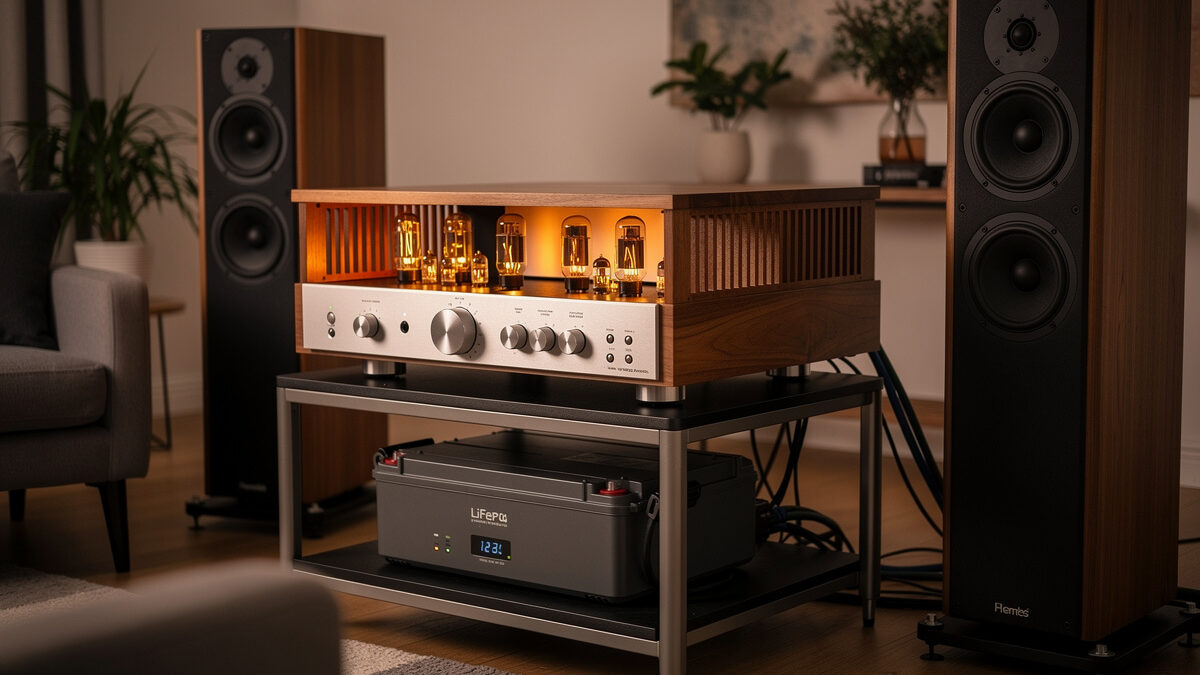
Audiophile-grade amplifiers care about the quality of incoming AC power because every microvolt of mains noise can ride through the power supply and modulate the audio signal at low listening levels. A LiFePO4 battery feeding a clean DC-to-AC inverter (or directly powering a low-voltage Class A amp) eliminates the 60Hz hum, dimmer-switch dirt, and EMI from neighboring appliances that even a 300 USD power conditioner does not fully clean. The result is measurably lower noise floor and audibly blacker silence between notes.
This guide covers when battery power is worth it (and when it is not), the inverter and battery selection criteria for amp loads, and the practical setup for a 50-100W stereo system that runs entirely off-grid. Hardware target is any quality 100Ah LiFePO4 brick, a small pure-sine inverter sized 2x amp draw, or a direct-DC Class A integrated amp like the iFi or Topping line.
The Audible Difference Battery Power Makes
Mains AC carries noise from every appliance in your home and from the grid itself. Your hi-fi amp tries to filter this noise through its power supply, but cheap regulators leak some of it into the rails. At 70 dB listening levels the noise is invisible; at 90 dB whisper-quiet sections of acoustic music, the noise floor drops by 6-10 dB on battery vs mains for many integrated amps. That is the difference between hearing room-tone behind a violin and hearing a vague electrical hash.
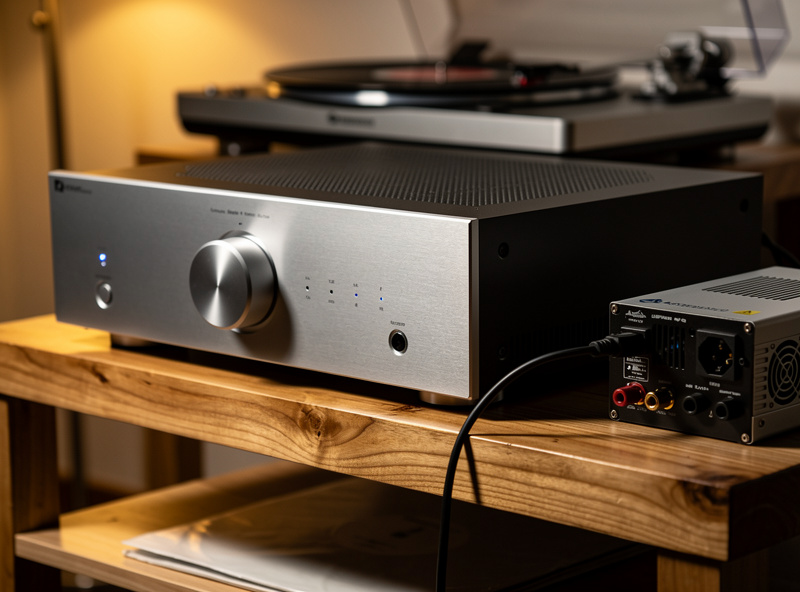
The effect is not universal. Class D amplifiers — which now dominate the affordable amp market — are largely immune to mains noise because their high-frequency switching topology rejects line-frequency hum naturally. Battery power benefits Class A and Class AB amps the most, especially older designs with linear power supplies. Tube amps benefit somewhat but are limited by transformer noise rather than rail noise.
The third effect is dynamics. A LiFePO4 bank can deliver instantaneous current spikes (200-400A peak) that exceed what a typical wall outlet provides through a 15A breaker and house wiring. For amps with current-hungry power supplies that struggle on transient peaks, battery power produces genuinely tighter bass and improved attack on percussion. The effect is most audible on bass-heavy classical, rock, and electronic music.
When Battery Power Is Not Worth It
Three setups do not benefit measurably. Class D integrated amps under 200 USD already have power-supply rejection that beats any reasonable home AC. Computer-fed DAC-headphone-amp chains running below 50 mW output are limited by USB power quality, not wall power, so the amp’s mains feed is irrelevant. Streaming receivers (Sonos, Wiim, Bluesound) are already isolated from mains noise by their internal switching power supplies and gain nothing from battery operation.
The systems that gain the most are linear-supply integrated amps in the 800-3000 USD range, separates with toroidal transformers, and any phono stage feeding a sensitive low-output moving-coil cartridge. The phono stage especially benefits — moving-coil cartridges produce 0.2-0.5 mV signals that the phono stage amplifies 60-70 dB before the line stage, multiplying any rail noise dramatically.
| System Type | Battery Benefit | Worth It? |
|---|---|---|
| Class A integrated | High (6-10 dB SNR) | Yes |
| Class AB integrated | Medium (3-6 dB) | Often yes |
| Class D integrated | Low (under 2 dB) | No |
| Tube amplifier | Variable | Sometimes |
| Phono stage (MC) | Very high | Yes |
| Streaming all-in-one | Negligible | No |
| DAC headphone combo | Negligible | No |
Battery and Inverter Pairing for Amp Loads
A typical Class A integrated amp draws 50-150W continuous regardless of volume setting (Class A runs hot at idle by design). For a 4-hour listening session at 80W average, the bank needs 320Wh of usable capacity. A 12V 50Ah LiFePO4 brick delivers 600Wh usable and supports a 4-hour session with reserve. Pair with a 500W pure-sine inverter rated 2x the amp’s continuous draw.
The inverter must be pure sine wave, period. Modified sine wave produces audible distortion in the amp’s power supply and dramatically increases EMI. Brands worth buying: Victron Phoenix, Renogy 500W pure sine, Outback FXR series. Skip generic 30 USD pure-sine inverters — the cheap ones produce sine waves with significant high-frequency artifacts that defeat the purpose. The inverter selection criteria match the broader chemistry-and-topology guidance on the pure sine vs modified sine inverter guide.
For maximum benefit, a direct-DC amp eliminates the inverter entirely. iFi, Topping, and SMSL all offer integrated amps that accept 12V or 24V DC input directly from a battery. This removes one conversion step and produces the cleanest possible signal chain. The trade-off is amp choice: most direct-DC amps are Class D or low-power Class A, not the high-current designs that benefit most from battery dynamics.
Practical Setup: Where to Put the Battery
The battery and inverter live outside the listening room — the inverter’s switching frequencies and any battery-management-system fan generate audible noise that ruins the experience if placed near the speakers. Run a 10-foot UV-rated cable from the listening room to a closet, basement, or garage where the bank lives. The cable is the only mains connection; everything in the listening room runs off the inverter output.
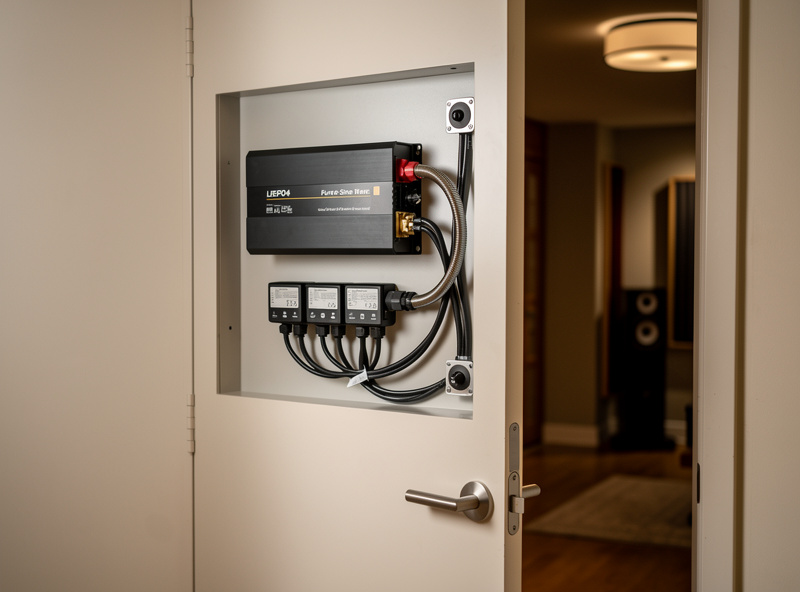
Charge the bank during the day when listening sessions are unlikely. The LiFePO4 chemistry tolerates partial-state-of-charge cycling without measurable capacity loss, so charge whenever the bank drops to 30-40% SOC and stop charging before listening sessions begin. Some hybrid inverters (Victron MultiPlus) automatically defer charging during quiet hours; configure this if available.
For solar charging, a 200W panel feeding a 30A MPPT charge controller covers a 4-hour daily listening session indefinitely without grid connection. The full off-grid story for hi-fi is one of the rare audiophile claims that actually scientifically holds — the listening room becomes permanently independent of grid noise, brownouts, and any future grid stability issues.
The Phono Stage Special Case
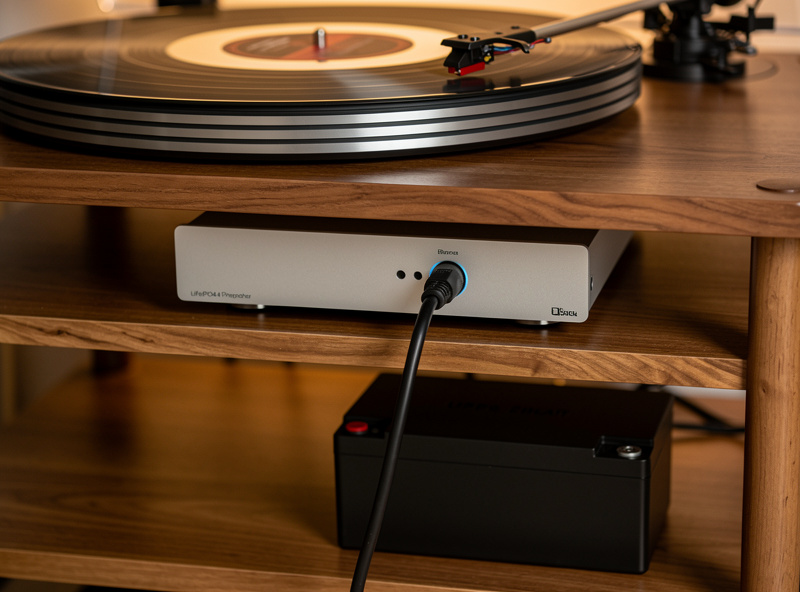
For vinyl listeners, battery power on the phono stage alone provides 60-80% of the audible benefit of battery power on the entire chain. A separate small LiFePO4 brick (12V 10Ah is enough) feeding a phono stage with DC input or a small dedicated inverter produces the same noise-floor improvement at 20% of the cost. Many high-end phono stages (Sutherland Loco, Pass Labs XP-25) are designed specifically for battery operation.
For those running a turntable into a phono stage and then through a separate integrated amp, the most cost-effective upgrade path is: battery on the phono stage first, mains on the amp, evaluate. If you still hear mains noise during quiet passages, add the second battery for the amp. Many systems stop benefiting from additional battery investment after the phono stage. The signal-chain analysis follows the same reasoning as the building a hi-fi system for vinyl signal chain guide.
For headphone listeners, the answer is usually no — battery power adds little benefit to a USB-fed DAC and amp combo because the noise floor is already limited by the DAC’s reference voltage rather than the amp’s power supply. The main exception is high-end balanced desktop amps in the 1500+ USD range with current-hungry output stages; a few percent of those benefit from clean DC, but most do not.
Cost-Benefit and Realistic Audible Test
Total system cost for battery-powered hi-fi runs 600-1500 USD for a single-amp setup, more for separates with phono stages also on battery. The audible improvement is real but subtle — 6-10 dB lower noise floor measurable on a meter, “blacker silence” subjectively. Whether this matters depends on your listening habits, your room, and your amp class.
Run a blind A/B test before spending. Set up a reversible AC switch between mains and inverter, listen to the same tracks at the same volume on both, alternate every 30 seconds without looking. If you cannot reliably identify which is which after 10 trials, your amp does not benefit measurably from battery power. The honesty of this test saves many audiophiles from buying gear that does not improve their experience.
Frequently Asked Questions
Does battery power really improve audio quality?
For Class A and Class AB amps with linear power supplies, battery power lowers measured noise floor by 6-10 dB and improves transient response. Class D amps benefit minimally because their switching topology rejects mains noise naturally. Phono stages feeding moving-coil cartridges benefit most.
What battery is best for an audiophile amplifier?
LiFePO4 is the only practical choice. A 12V 50Ah brick (600Wh usable) supports 4 hours of listening at 80W average draw. Pair with a 500W pure-sine inverter rated 2x the amp continuous wattage. Avoid lead-acid because of cycle life and humidity sensitivity.
Will battery power damage my amplifier?
No, with a pure-sine wave inverter. Modified sine wave inverters can damage older amplifiers and increase distortion. All reputable hybrid inverters and dedicated audio inverters ship pure sine output. Direct-DC amps that accept battery voltage directly skip the inverter step entirely.
How long can I listen on a battery?
A 12V 50Ah LiFePO4 brick (600Wh usable) supports 4 hours at 80W average draw with reserve. Bigger 100Ah banks support 8-hour sessions. Class A amps draw 50-150W continuous regardless of volume because Class A runs hot at idle by design.
Is battery power worth it for headphones?
Generally no. USB-fed DAC and headphone amp combos are limited by DAC reference voltage rather than mains noise. Exceptions are high-end balanced desktop amps over 1500 USD with current-hungry output stages, where a few percent benefit measurably from clean DC.
Can I run my whole hi-fi off solar?
Yes, with a 200W panel and 30A MPPT charge controller covering daily 4-hour sessions on a 50Ah LiFePO4 bank. The entire signal chain becomes permanently independent of grid noise and outages. Total off-grid hi-fi setup cost runs 1000-1800 USD.