Speaker Placement Guide for Best Sound
Speaker placement determines up to 50% of your system’s sound quality, yet most listeners position speakers based on furniture layout rather than acoustics. Proper placement — distance from walls, toe-in angle, listener position, and height — transforms mediocre sound into detailed, immersive reproduction. These placement principles apply to bookshelf and floor-standing speakers, powered and passive, in any room size.
The Equilateral Triangle Rule
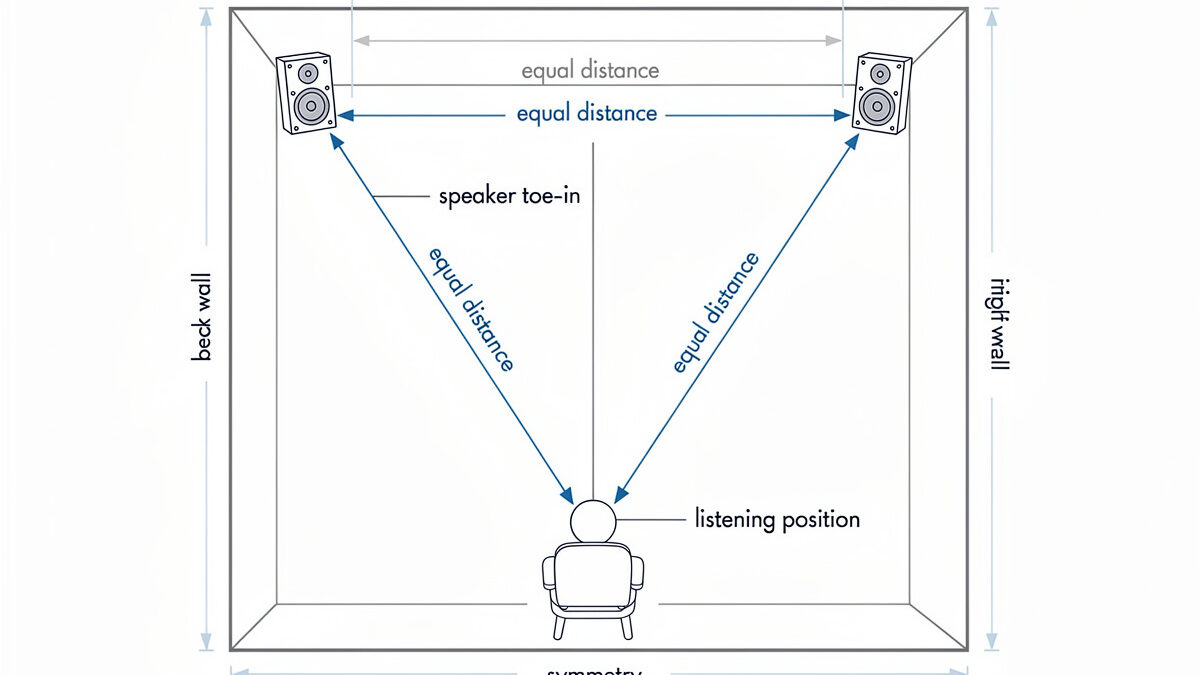
The fundamental rule of stereo speaker placement positions speakers and the listener at three points of an equilateral triangle. Each speaker sits equal distance from the listener, and the distance between speakers equals the distance from each speaker to the listener. This geometry creates a centered soundstage where vocals appear directly between the speakers and instruments occupy distinct positions left and right.
Start by placing speakers 4-8 feet apart depending on room width. Sit at the apex of the triangle, roughly 1.5 times the distance between speakers. If speakers sit 6 feet apart, the listening position should be approximately 9 feet from each speaker. Adjust by ear from this baseline — narrower spacing improves center imaging, wider spacing expands the soundstage at the cost of a potential center hole.
Distance from Rear and Side Walls
Speaker distance from walls dramatically affects bass response. Rear-ported speakers produce excessive, boomy bass when placed against walls because the rear port reinforces low frequencies through boundary loading. Pull rear-ported speakers at least 12 inches from the rear wall. Front-ported and sealed speakers tolerate closer placement but still benefit from 6+ inches of clearance.
Side wall distance affects stereo imaging and early reflections. Speakers too close to side walls produce smeared imaging because reflections arrive at the listener too soon after the direct sound. Keep speakers at least 3 feet from side walls when possible. Asymmetric placement — closer to one side wall than the other — creates imbalanced sound that favors one channel.
Toe-In Angle
Toe-in refers to angling speakers inward toward the listening position. Zero toe-in points speakers straight ahead, creating a wider but potentially unfocused soundstage. Full toe-in points speakers directly at the listener, maximizing detail and treble energy at the expense of soundstage width.
Most speakers perform best with moderate toe-in — aimed to cross slightly behind the listener’s head. This balances imaging precision with soundstage width. Experiment by starting with speakers pointed straight ahead and gradually angling them inward until vocals center precisely and treble sounds natural rather than bright or dull.
Listening Position
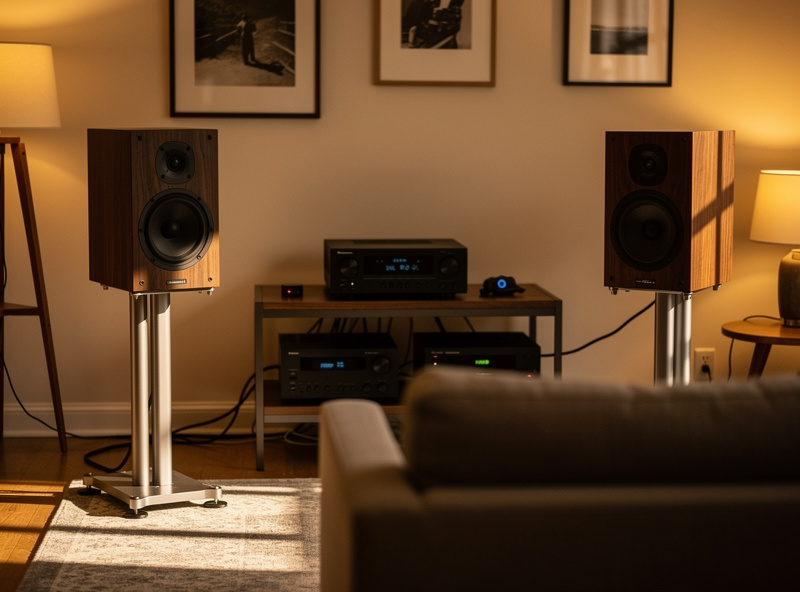
Your seat position matters as much as speaker placement. Avoid sitting against the rear wall — this position experiences the worst bass reinforcement and the most smeared imaging due to reflections. Move at least 3 feet from the rear wall. The ideal listening position typically sits 38-40% of the room length from the front wall, where bass response is most even.
Room modes — standing waves created by room dimensions — cause peaks and nulls at specific frequencies at different positions. Moving your listening position even 6 inches can significantly change bass balance. Walk around your room while music plays to identify positions with the smoothest bass response, then position your chair there.
Speaker Height
Tweeters should align with seated ear height. Most bookshelf speakers sit 36-42 inches high on stands, matching typical seated ear position. Speakers placed too low or too high degrade imaging because the tweeter’s dispersion pattern changes with vertical angle. If your speakers must sit below ear level, tilt them upward slightly to aim tweeters at your ears.
Floor-standing speakers with multiple tweeter heights perform well at various ear levels, but the primary tweeter should still align roughly with ear height. Use adjustable spikes or feet to fine-tune floor-standing speaker height on uneven floors.
Subwoofer Placement
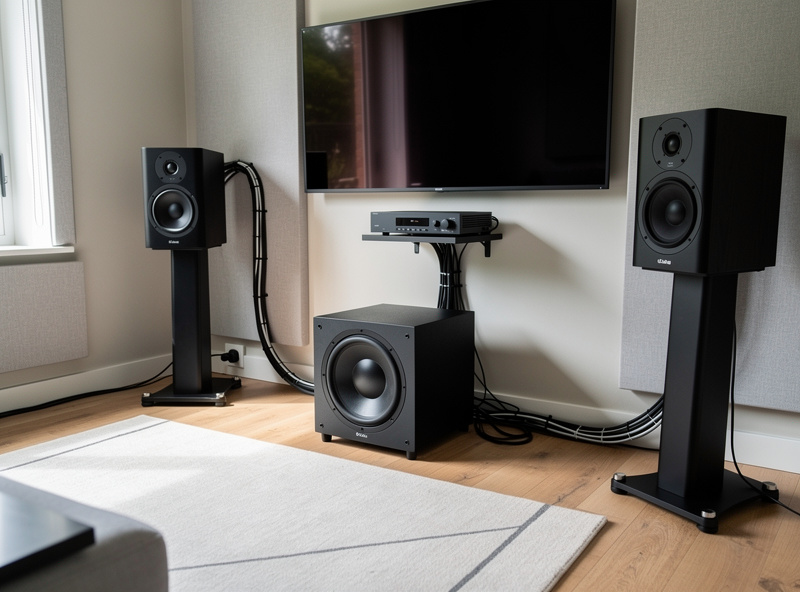
Subwoofer placement requires different techniques than main speaker placement because low frequencies propagate omnidirectionally. The crawl test identifies optimal subwoofer position: place the subwoofer at your listening position, play bass-heavy music, and crawl around the room perimeter listening for the smoothest, most even bass. Position the subwoofer at the location where bass sounds best — this is typically not where it looks best visually.
Corners maximize bass output but often create boomy, uneven response. Along a front wall between main speakers usually provides the best integration. Phase alignment between the subwoofer and main speakers prevents cancellation at the crossover frequency — flip the subwoofer phase switch and keep whichever position produces louder bass at the crossover point.
Room Treatment Basics
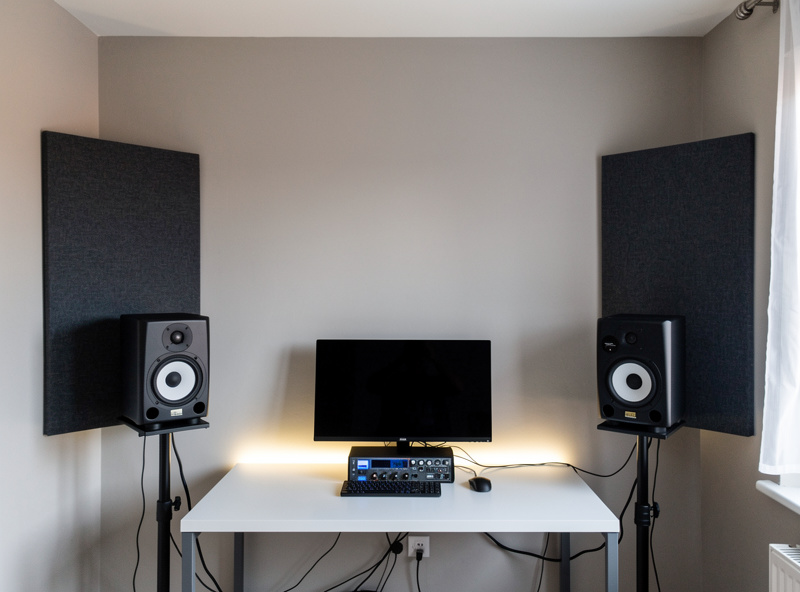
Hard, reflective surfaces — bare walls, glass windows, hardwood floors — create reflections that smear timing cues and color tonal balance. Soft furnishings absorb reflections, improving clarity. First reflection points — the surfaces nearest each speaker where sound bounces toward the listener — cause the most problematic reflections.
Find first reflection points using the mirror trick: sit in your listening position while a friend slides a mirror along the side wall. When you see the speaker’s reflection in the mirror, mark that position. Place absorptive panels, thick curtains, or bookshelves at these points. Even heavy drapes over nearby windows noticeably improve clarity.
A thick rug between speakers and the listener absorbs floor reflections. Bookshelves on rear walls scatter reflections rather than absorbing them, adding diffusion that prevents a dead-sounding room while reducing problematic reflections. Start with these low-cost treatments before investing in purpose-built acoustic panels.
Frequently Asked Questions
How far should speakers be from the wall?
Rear-ported speakers need at least 12 inches from the rear wall to prevent boomy bass. Front-ported and sealed speakers work at 6+ inches. Experiment with distance — closer to walls increases bass, further away tightens it. The optimal distance depends on your specific speakers and room acoustics.
What is the best speaker placement for a small room?
In small rooms, pull speakers 12-18 inches from the rear wall and create an equilateral triangle with the listening position. Place the listening position about one-third of the room length from the rear wall. Use toe-in to focus the soundstage. Avoid corner placement that creates excessive bass buildup.
Should I angle my speakers toward me?
Yes, moderate toe-in typically improves imaging and focus. Start with speakers pointed straight ahead, then gradually angle them inward until vocals center precisely between the speakers. Full toe-in (pointing directly at your ears) maximizes detail but may narrow the soundstage.
Do speaker stands make a difference?
Yes, significantly. Speaker stands position bookshelf speakers at proper ear height and decouple them from surfaces that cause vibrations. Metal stands with sand filling provide the most rigid, vibration-free platform. Budget $50-$100 for quality stands that match your speakers height requirements.
Where should I put a subwoofer in my room?
Use the crawl test: place the subwoofer at your listening position, play bass-heavy music, crawl around the room perimeter, and position the subwoofer where bass sounds smoothest. Along the front wall between speakers usually provides the best integration. Avoid corners unless you want maximum bass output at the cost of evenness.
Can I place speakers on a bookshelf?
You can, but expect compromised sound. Bookshelf placement couples speakers to the shelf surface, adding vibration and coloration. The enclosed space behind and beside speakers reinforces bass unnaturally. If shelf placement is unavoidable, use isolation pads ($15-$25) to decouple speakers from the shelf surface.
How do I reduce echo in my listening room?
Add absorptive materials at first reflection points: thick curtains on windows, rugs on hard floors, and acoustic panels or bookshelves on bare walls. Avoid covering every surface — some reflection adds liveliness. Start with first reflection treatment, then add bass traps in corners if bass remains problematic.
Related Articles
Related articles will be added as hub and sibling spokes are published.