Near-Field Listening Setup: How to Position Speakers in a Small Room
What Near-Field Listening Is and Why It Works
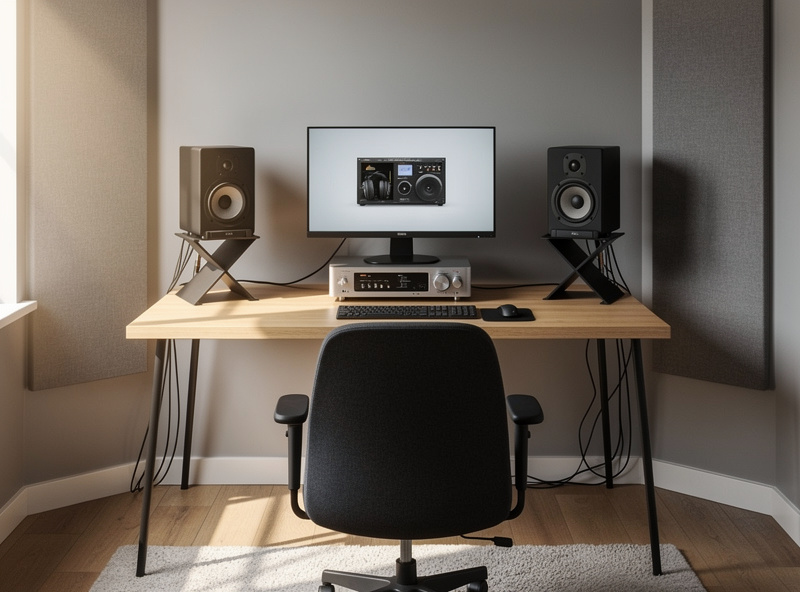
Near-field listening positions the speakers 0.8 to 1.5 meters from your ears — close enough that the direct sound from the drivers arrives significantly louder than the room’s reflected energy, typically by 10 to 15 dB. This ratio reduces the room’s influence on what you hear, making near-field the single most effective acoustic strategy for small rooms under 15 square meters. In my 14-square-meter listening space, pulling the speakers out to 1.1 meters from the listening position cuts the perceived room contribution by roughly half compared to a typical 3-meter far-field setup. This is the practical application of the principles I cover in the room acoustics guide — near-field listening gives you a head start on controlling the room’s contribution before you hang a single panel.
The physics behind this is the inverse square law combined with the precedence effect. Direct sound level drops 6 dB per doubling of distance. Reflected sound travels a longer path (speaker → wall → ear vs. speaker → ear) and arrives quieter plus delayed. When you sit close, the direct-to-reflected ratio is high — your brain locks onto the direct sound and suppresses the reflections. When you sit far away, the direct sound has attenuated more, the reflections are relatively louder, and the room dominates. In a small room where the first reflection delay is already short (under 10 milliseconds), far-field listening means your brain cannot separate direct from reflected sound at all. The result is a collapsed soundstage and smeared transients.
I discovered near-field listening by necessity. My listening room is small — 3.5 meters wide by 4.2 meters deep, with a concrete rear wall I already discussed in my room treatment article. When I first set up my system, I placed the speakers near the front wall and sat against the rear wall, a typical living-room arrangement. The sound was a mess — booming bass, no center image to speak of, and a sensation that the music was coming from two boxes rather than a coherent soundstage. Moving the listening position forward to create an equilateral triangle with the speakers at 1.2 meter sides transformed everything. Same speakers, same amplifier, same room — completely different presentation.
Why Small Rooms Benefit More From Near-Field Than Large Rooms
Small rooms produce earlier, stronger, and more damaging reflections than large rooms because the path length difference between direct and reflected sound is shorter — 3 to 8 milliseconds versus 15 to 30 milliseconds in a larger space. The human auditory system uses the first 5 to 10 milliseconds of arrival to localize sound sources; reflections arriving within this window (the Haas fusion zone) are perceptually fused with the direct sound, smearing imaging rather than creating a sense of spaciousness. Near-field listening increases the direct-to-reflected ratio enough to push reflected energy below the fusion threshold.
Room modes in small spaces also push the first few axial modes up into the bass and lower midrange where they are the most musically disruptive. In my room, the width mode at 49 Hz and the length mode at 40 Hz create interference patterns with nulls spaced roughly 1.75 meters apart. In a far-field setup, the listening position might land squarely in a null. In near-field, the shorter distance to the speakers makes the direct bass energy dominant over the modal contribution — you hear the speaker’s output first, not the room’s resonant buildup.
There is a practical consideration too: most people do not have dedicated listening rooms. They have offices, spare bedrooms, or corners of living rooms with 10 to 16 square meters of usable space. Near-field lets you get serious hi-fi sound without needing to knock down walls or dedicate an entire basement. My setup lives in a room that also contains a desk, bookshelves, and a chair that is not the listening chair. It works because close placement makes the room’s shortcomings less audible.
One thing I should emphasize: near-field does not mean headphones. You still get the natural crossfeed (left ear hears the right speaker and vice versa), the room still contributes some ambience, and the soundstage extends beyond the speakers in a way headphones cannot replicate. It is the best of both worlds — headphone-like clarity with speaker-like spatial presentation.
Equilateral Triangle Setup: The Foundation of Stereo Imaging
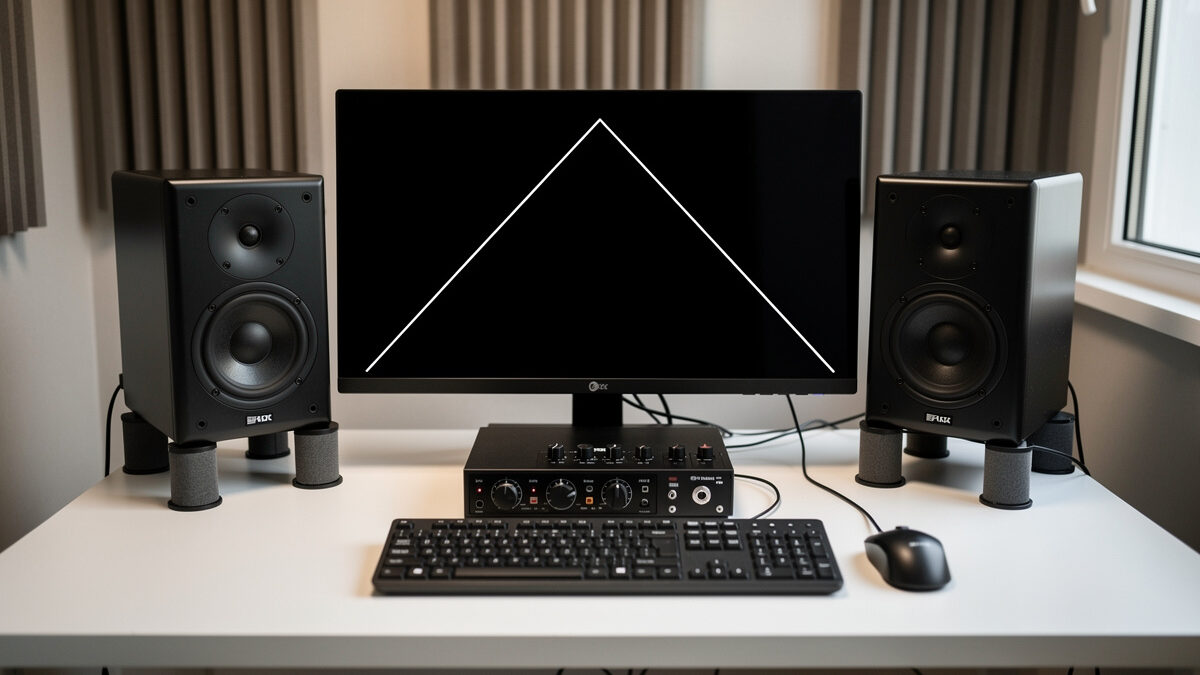
The equilateral triangle rule states that the distance between your two speakers should equal the distance from each speaker to your ears, forming a triangle with 60-degree angles at each vertex. This geometry produces the most stable phantom center image and the widest usable soundstage — deviations as small as 10 centimeters can shift the center image noticeably.
Why 60 degrees? Stereo recordings are mixed and mastered on monitor systems set up at 60 degrees (or sometimes 50 to 70). Playing those recordings back at the same angle reproduces the spatial relationships the mixing engineer heard. If you sit further away with the speakers at 30 degrees (a narrower triangle), the soundstage collapses toward mono. If you sit closer at 90 degrees (wider), you get a hole in the middle — phantom center vanishes and the sound flips out to the speakers. The 60-degree standard is not arbitrary; it is the playback geometry that matches the production geometry.
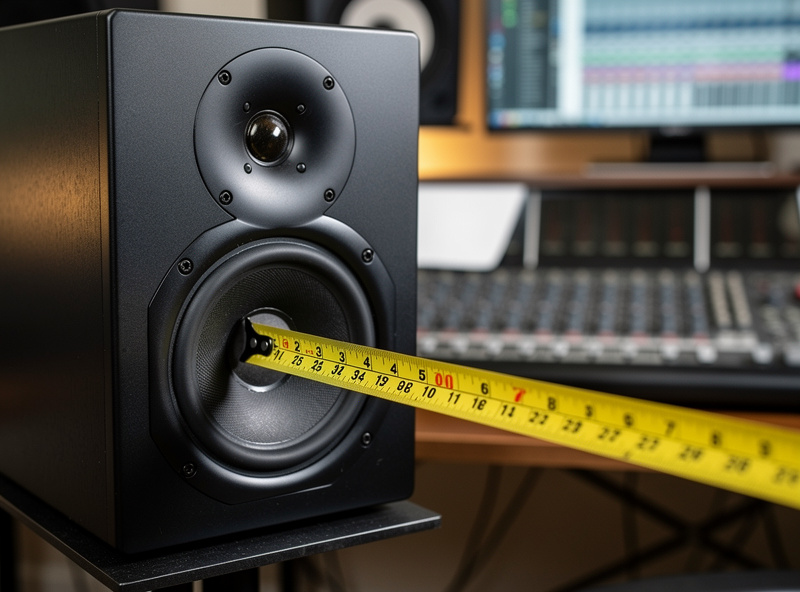
To set this up precisely, you need a tape measure. Mark the listening position. Measure the distance from your nose (or the point between your ears) to the left tweeter. Adjust the right speaker until the distance matches. Then adjust speaker spacing until the tweeter-to-tweeter distance matches the listening distance. Check the angle with a protractor or smartphone app if you want to be precise, but the tape measure is sufficient. Within 5 percent tolerance is close enough — your head moves when you listen anyway.
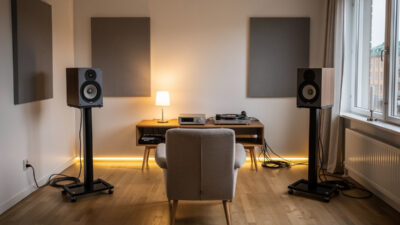
In my room, I use a piece of masking tape on the floor to mark the speaker positions and a second piece for the chair position. This sounds obsessive, but it means I can vacuum the floor and put everything back exactly where it was. The difference between “roughly where it was” and “exactly where it was” is audible — especially with small near-field setups where 5 centimeters shifts the center image. If you have hard floors, furniture sliders under the speaker stands let you adjust position easily and mark the final spots with tape.
Toe-In for Near-Field: How Much and Why
For near-field listening at 1 to 1.5 meters, I recommend 10 to 20 degrees of toe-in — enough that you can see a sliver of the inner side panel of each speaker from the listening position, but not so much that the tweeters point directly at your ears. Direct on-axis aiming at close range produces an overly bright, fatiguing presentation because tweeter output is 2 to 3 dB higher on-axis than at 15 degrees off-axis in most dome tweeter designs, and the high direct-to-reflected ratio of near-field means you get no acoustic softening from the room.
Toe-in affects three things simultaneously: tonal balance (more toe-in = more treble), soundstage width (less toe-in = wider but less precise), and center image solidity (more toe-in = denser phantom center). The trade-off is personal and depends on your speakers’ off-axis response. Speakers with well-behaved off-axis dispersion (smooth, even roll-off) can run with less toe-in and maintain tonal accuracy while giving a wider soundstage. Speakers with ragged off-axis response — peaks and dips at various angles — need more toe-in to avoid audible colorations from the side-wall reflection path.
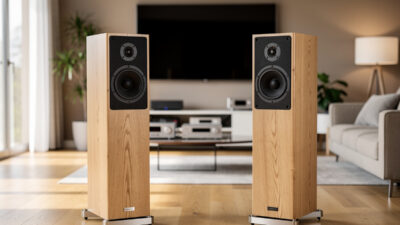
In my setup with dome-tweeter towers, I settled on approximately 15 degrees of toe-in. From the listening position, I can see about 25mm of the inner side panel of each cabinet. The center image is rock-solid — a solo vocalist sounds like they are standing exactly between and slightly behind the front plane of the speakers. If I rotate the speakers to face straight ahead (zero toe-in), the center image widens and loses focus, and the soundstage depth collapses. If I aim them directly at my ears (30 degrees toe-in), the treble becomes aggressive and the soundstage width shrinks — everything crowds toward the center.
Desk vs Stand Mounting: Which One for Near-Field
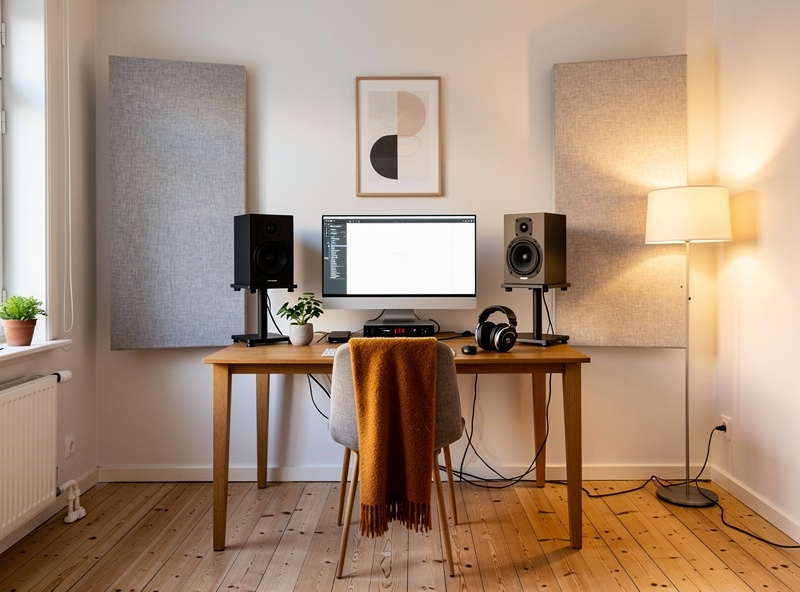
Speaker stands provide cleaner bass, better imaging, and more flexible positioning than desk mounting because they eliminate the desk surface reflection — a large, flat boundary that creates a strong, short-delay reflection arriving 3 to 5 milliseconds after the direct sound and producing a comb filter with deep cancellations in the 1 to 4 kHz range where the ear is most sensitive. In my room, moving the same pair of speakers from a 160cm-wide desk onto 70cm stands cleaned up the midrange so dramatically I initially thought I had turned off an EQ I did not know was on.
The desk reflection problem is measurable. With speakers sitting directly on a desk surface, the reflection path (driver → desk → ear) is typically 60 to 120 centimeters longer than the direct path, creating a comb filter with the first cancellation at roughly 1.4 kHz for a 120mm path difference. This corresponds to the presence region — vocals, guitar harmonics, and cymbal articulation all live here. The comb filter notches out narrow bands of frequencies, and moving your head slightly changes which frequencies cancel. It makes the sound phasey and unstable. This is fundamentally different from the room-level reflections that acoustic diffusion or absorption addresses — the desk reflection is a near-boundary interaction that requires closer, more targeted treatment.
If you must place speakers on a desk — and I recognize that many near-field setups are desk-based by necessity — there are mitigations that actually help: isolation pads that angle the speakers up toward your ears (reducing the desk bounce by aiming the sound above the desk surface), small desktop stands that raise the speakers 150 to 200mm above the desk, and placing a small broadband absorber on the desk between you and the speakers to catch the first desk reflection. The IsoAcoustics stands are effective at this — the angle and elevation reduce desk bounce significantly compared to speakers sitting flat. I have measured a 4 to 5 dB reduction in the comb filter depth just by elevating bookshelf speakers 180mm above the desk.
For permanent near-field setups, floor stands are the better solution. They decouple the speakers from room boundaries (the floor vibration path goes into the stand’s mass and spikes, not into the speaker cabinet), they allow precise height adjustment, and they get the speakers away from the desk entirely. In my room, even with a small near-field triangle, the speakers sit on 60cm stands pulled 80cm from the front wall. The imaging is better than any desk placement I have tried, and the bass is tighter because the stand’s mass-loaded column does not resonate the way a hollow desk cavity does.
Speaker Height and Tweeter Alignment: Getting the Vertical Axis Right
The tweeter should be at ear height — measured from the floor to your ear canal while seated in your listening position — because dome tweeters have a vertical listening window typically ±10 to 15 degrees before the frequency response changes audibly. Sitting above or below the tweeter axis produces a dip in the crossover region where the tweeter and midwoofer outputs overlap, typically 2 to 3 kHz, making vocals sound recessed and dull. In my listening chair, my ears are 95 centimeters from the floor; I set my stands so the tweeters are at exactly 95 centimeters.
The vertical dispersion pattern varies by speaker design. A two-way speaker with a vertically aligned tweeter and midwoofer has a null (cancellation lobe) above and below the tweeter axis at the crossover frequency. If the drivers are spaced 150mm apart and the crossover is at 2.5 kHz, the first vertical null appears roughly 20 degrees off-axis. Sit too high or too low, and you are listening in the null — the crossover region is partially canceled, and the speaker sounds like it has a hole in the midrange.
Coaxial drivers (tweeter mounted in the center of the midwoofer, like KEF’s Uni-Q) eliminate this vertical lobing because both drivers radiate from the same acoustic center. If you are setting up a near-field desk system with limited height adjustment options, coaxial speakers are more forgiving of vertical misalignment. That said, even coaxials should be aimed at or near ear height — the on-axis response is the reference response the designer intended.
For my setup, I use stands with adjustable spikes. I set the height once with a tape measure, marked the spike positions on the floor with tape, and have not touched them since. If I swap speakers — something I do occasionally when testing or reviewing — I measure the tweeter height of the new speakers and adjust accordingly. A 40mm height difference between speaker models is enough to shift the tonal balance audibly in near-field. Do not guess this — measure it.
Common Near-Field Mistakes I See Over and Over
The most common near-field mistake is placing the listening position against the rear wall — this creates a massive bass boost at the wall boundary (up to 6 dB below 100 Hz) and a strong, short-delay rear reflection that destroys front-to-back depth. You need at least 60 centimeters of space behind your head for the rear-wall reflection to arrive late enough and quiet enough that your brain can separate it from the direct sound. In my room, moving the chair from 50 centimeters to 90 centimeters from the rear wall cleared up soundstage depth entirely — recordings that sounded flat and two-dimensional acquired a third dimension.
Other mistakes I see frequently: placing the speakers too close to side walls (creates asymmetrical first reflections and unbalanced imaging), using speakers that are too large for the listening distance (big three-way towers in near-field do not integrate their drivers — you hear individual drivers rather than a cohesive sound), setting the speakers too wide or too narrow (breaks the equilateral geometry), and neglecting the ceiling reflection (a ceiling bounce 1.5 meters above the listening position is a strong, early reflection that smears vertical imaging).
Also: subwoofers in near-field. Most small-room near-field setups do not need a subwoofer for music if the speakers have usable output to 45 Hz or so — a good pair of bookshelf speakers under $300 with 130mm woofers in a sealed cabinet can produce satisfying near-field bass down to 55 Hz without any help. The close listening distance means the bass output from the main speakers arrives at your ears before the room modes fully develop, which subjectively makes the bass feel stronger. Adding a subwoofer to a near-field setup often creates more integration problems than it solves — phase alignment at the crossover point is harder at close distances where the wavelength at 80 Hz is over 4 meters. I run my near-field setup without a subwoofer and do not miss it for most music. When I do add one (for organ music or electronic), I place it near-field as well — directly between the speakers, phase-aligned by ear using a mono pink noise track. It works, but it took a full afternoon to dial in.
Near-Field vs Far-Field Comparison
| Characteristic | Near-Field | Far-Field |
|---|---|---|
| Listening distance | 0.8 – 1.5 meters | 2.5 – 4.0 meters |
| Direct-to-reflected ratio | High (10 – 15 dB above reflections) | Low (3 – 8 dB above reflections) |
| Room influence | Minimal — direct sound dominates | Significant — room contributes strongly |
| Soundstage width | Precise but intimate, extends slightly beyond speakers | Wider, more expansive, can extend well past speakers |
| Bass behavior | Direct sound dominates modes; less room boom | Room modes strongly influence response; needs treatment |
| Driver integration | Requires compact speakers; large multi-way designs do not cohere | Distance allows large multi-way designs to integrate properly |
| Best room size | 10 – 18 sq m (small bedrooms, offices) | 20+ sq m (living rooms, dedicated listening rooms) |
| Best speaker type | Small two-way bookshelf or compact floor stander | Full-range floor standers, large three-ways |
| Room treatment needed | Moderate — first reflections, some bass trapping | Extensive — full treatment recommended for controlled sound |
Frequently Asked Questions
What is the ideal listening distance for near-field speakers?
1.0 to 1.5 meters from tweeter to ear, forming an equilateral triangle where the tweeter-to-tweeter distance equals the listening distance. At this range, the direct sound arrives 10-15 dB louder than the first reflections in a typical small room, giving you precise imaging with minimal room coloration. Distances under 0.8 meters risk the sound not fully integrating before reaching your ears.
Do I need special speakers for near-field listening?
Not necessarily, but certain designs work better. Compact two-way speakers with drivers spaced close together integrate properly at short distances. Large three-way towers may not — the drivers are too far apart for their outputs to sum coherently at 1 meter. Speakers with smooth off-axis response handle the wider listening angle of near-field better than designs with erratic dispersion. Coaxial drivers like KEF’s Uni-Q are particularly well-suited.
Should I toe-in my speakers for near-field listening?
Yes, 10-20 degrees of toe-in — just enough that you can see a narrow slice of the inner side panel from the listening position. This stabilizes the center image and provides the intended on-axis response. Too much toe-in (30+ degrees, tweeters aimed directly at ears) makes the treble aggressive in near-field. Too little (zero toe-in) widens the soundstage but weakens the center image and reduces imaging precision.
Can I use floor standing speakers for near-field?
Small floor standers with compact driver arrays (tweeter and midwoofer within 200mm of each other) can work at 1.3-1.5 meters. Large three-way or four-way towers with drivers spaced 500mm or more apart will not integrate properly — you will hear each driver as a separate source rather than a unified sound. If your floor standers are physically large, pull the listening position back to at least 2 meters.
Why does my near-field setup sound bright and fatiguing?
Three likely causes: too much toe-in (tweeters aimed directly at your ears at close range), untreated first reflections from side walls or the desk surface, or a bare rear wall behind your head creating a strong comb-filtered reflection. Reduce toe-in to 10-15 degrees, add absorption at side-wall reflection points and on the desk between speakers and listener, and pull your chair at least 60 centimeters from the rear wall.