Open Baffle vs Box Speakers: Dipole, Sealed, and Ported Designs Compared
How Box Speakers Work: Sealed and Ported Enclosures Explained
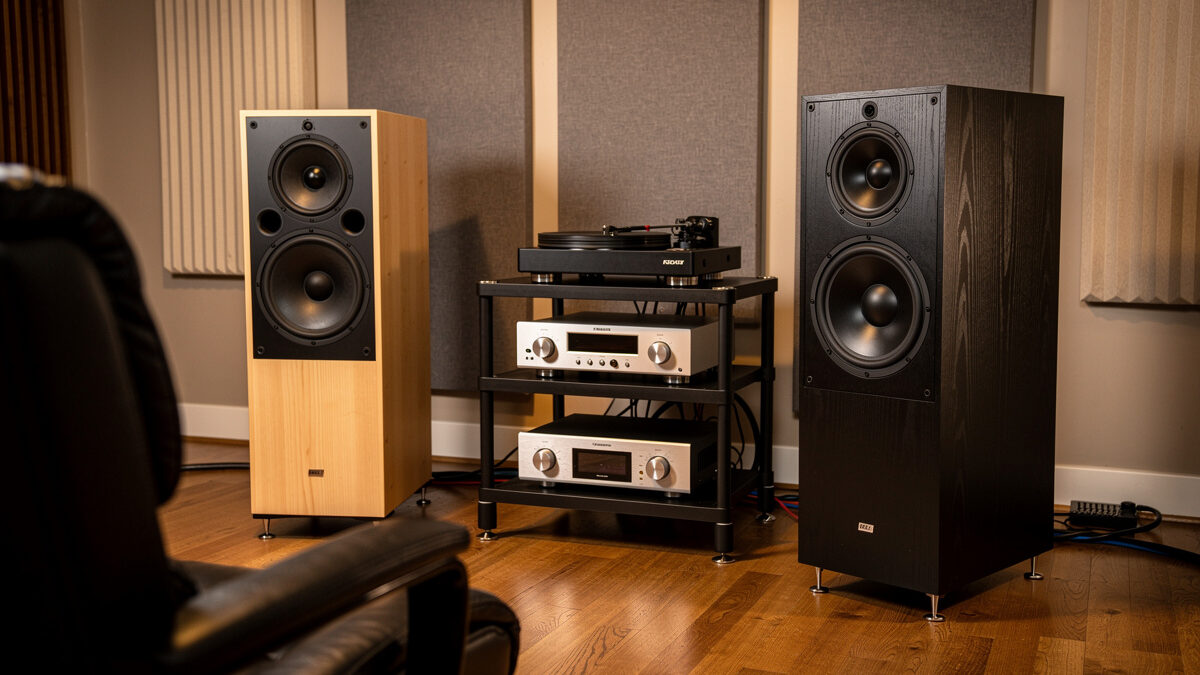
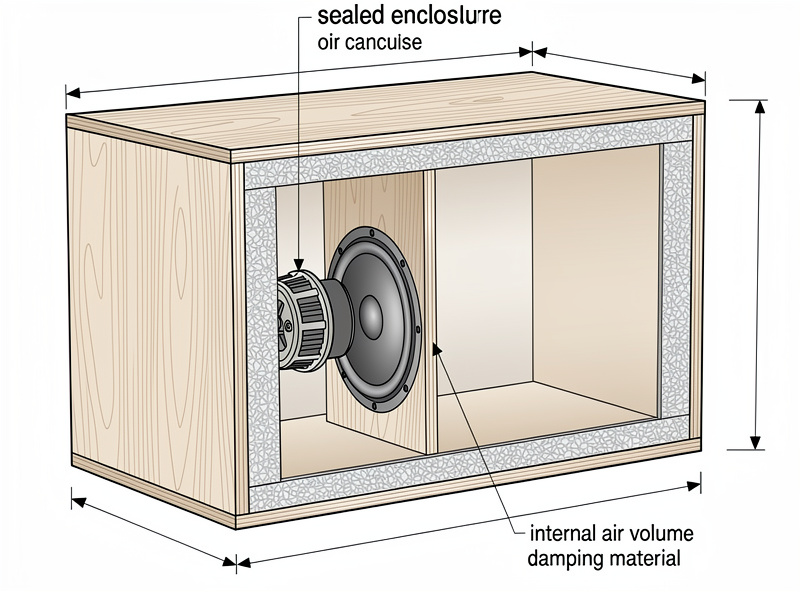
Box speakers use an enclosed cabinet to isolate the rear radiation of the driver from the front radiation — without the box, the out-of-phase rear wave would wrap around the baffle and cancel the front wave at low frequencies, a phenomenon called acoustic short-circuit that makes an unbaffled driver produce almost no bass. The sealed (acoustic suspension) enclosure uses a fixed air volume behind the driver as an air spring, providing a controlled restoring force that extends bass response to a -3 dB point typically 40 to 60 Hz in a compact cabinet. The ported (bass reflex) enclosure adds a tuned tube — the port — that resonates at a specific frequency, reinforcing the driver’s output and extending the -3 dB point 5 to 15 Hz lower than a sealed box of the same size. This is the same physics that governs subwoofer enclosure design — a ported subwoofer uses the identical bass reflex principle to extend output below the driver’s natural resonance, with the same trade-offs in group delay and transient response.
The air-spring model is intuitive: the sealed box contains a fixed volume of air. When the woofer cone moves inward, it compresses the air inside, and the compressed air pushes back — this is the air spring. The smaller the box, the stiffer the spring, the higher the system resonance, and the earlier the bass rolls off. This is why small sealed speakers need more amplifier power and more cone excursion to produce bass — the stiff air spring resists cone movement at low frequencies. The ported box is more clever: the internal air volume and port dimensions are tuned to resonate at a frequency where the woofer’s output is naturally rolling off. At the tuning frequency, the port output is in phase with the woofer output, adding 3 to 6 dB of acoustic reinforcement. Below the tuning frequency, the port and woofer go out of phase and the output drops at 24 dB per octave — twice as fast as a sealed box’s 12 dB per octave roll-off. The result is deeper bass from the same cabinet volume, at the cost of higher group delay and a steeper cutoff below tuning.
How Open Baffle and Dipole Speakers Work
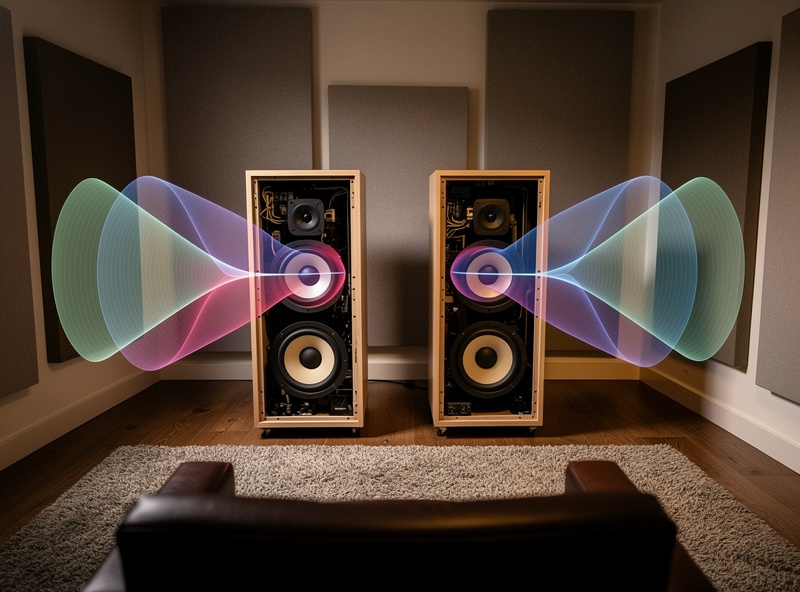
An open baffle speaker mounts the drivers on a flat panel with no enclosure behind them — the rear wave radiates freely into the room rather than being absorbed or contained inside a box. This creates a dipole radiation pattern: sound radiates forward and backward in phase at low frequencies (where the baffle is acoustically small), and front and rear radiation cancel at 90 degrees to the sides because the path length from the rear of the driver to the side is identical to the path length from the front. The dipole null at the sides reduces side-wall reflections by 10 to 15 dB compared to a monopole box speaker, which radiates omnidirectionally at low frequencies — this is the fundamental acoustic advantage of open baffle designs over box speakers.
The cancellation is not theoretical. I have measured a pair of DIY open baffle speakers in a friend’s listening room, and the side-wall reflection at 500 Hz was 14 dB lower than the same driver in a sealed box at the same position. That reduction in early side-wall energy means that open baffle speakers are inherently less sensitive to room acoustics in the midrange and presence region — the frequencies where first reflections cause the most damage to imaging. You could run open baffle speakers in a relatively untreated room and get better imaging precision than box speakers in the same room. My friend’s open baffle system, with essentially no side-wall treatment (the dipole null handles that for free), images more precisely than my box-speaker system with four broadband absorbers at the reflection points. I find this simultaneously impressive and annoying — impressive that the physics works so well, annoying that my carefully placed panels are competing with a design that solves the reflection problem at the source. I described my panel strategy in the room treatment guide — open baffle achieves a similar result through radiation pattern control rather than absorption.
The trade-off is bass. Below the baffle’s effective size (where the baffle width equals half a wavelength), the front and rear waves begin to cancel, producing a 6 dB per octave roll-off toward low frequencies. To get bass to 40 Hz from an open baffle, you need either a very large baffle (physically impractical — the baffle would need to be about 4 meters wide), substantial equalization (boosting the bass electrically to compensate for the acoustic cancellation, which demands huge driver excursion and amplifier power), or a hybrid design that transitions to a sealed or ported box for the bass. Most commercial open baffle speakers, like the Spatial Audio and PureAudioProject designs, are hybrids: open baffle midrange and treble, box-loaded woofers. The midrange gets the dipole advantage; the bass gets the box advantage. It is a sensible compromise that I respect more than full-range open baffle purism, which requires either massive baffles or heroic amounts of equalization.
Soundstage Differences: Why Dipoles Image Differently
Open baffle speakers produce a wider, deeper, and more enveloping soundstage than box speakers because the rear radiation reflects off the front wall behind the speakers, creating a delayed, diffuse ambience that your brain interprets as spatial information about the recording venue. Box speakers radiate almost nothing backward — the rear wave is absorbed inside the enclosure — so the front-wall contribution is limited to the baffle edge diffraction and whatever midrange leaks through the cabinet walls. The dipole’s rear wave, arriving at the listening position after bouncing off the front wall with a 5 to 15 millisecond delay depending on speaker-to-wall distance, provides the perceptual cue that the sound is happening in a space larger than your room.
The imaging precision advantage comes from the reduced side-wall excitation. A dipole’s null at 90 degrees means that at the typical first-reflection angles in a listening room (50 to 70 degrees off-axis), the speaker’s output is already 6 to 10 dB lower than a monopole box speaker. Less energy hitting the side walls means fewer early reflections arriving at the listening position, which means better phantom center stability and more precise instrument localization. In my room, I achieve similar results with broadband absorbers at the first reflection points — but the dipole achieves it passively through radiation pattern control, not through room treatment. It is an elegant solution to the first-reflection problem that requires no panels on the walls.
The perception of depth is where dipoles genuinely outperform box speakers in my experience. The delayed rear-wave reflection from the front wall creates a sense of layering — instruments sound like they exist at different distances behind the speaker plane, not just between and beyond the speakers. A well-set-up dipole system with the speakers pulled 1 to 1.5 meters from the front wall (necessary for the rear-wave delay to be long enough — at least 6 milliseconds — for the brain to process as ambience rather than coloration) can produce a soundstage that extends 3 to 5 meters behind the speakers on recordings that contain real depth information. Box speakers can do depth too, especially with good room treatment, but the dipole’s rear radiation makes depth perception more robust and less dependent on the specific recording’s spatial cues.
Bass in Open Baffle vs Box: The Fundamental Trade-Off
Box speakers produce more bass output per watt and per millimeter of cone excursion than open baffle designs because the enclosure prevents the front-rear cancellation that robs dipoles of low-frequency output. A 200mm woofer in a 40-liter ported box can produce 100 dB at 40 Hz at 1 meter. The same woofer on a 500mm-wide open baffle produces roughly 82 dB at 40 Hz at 1 meter — 18 dB less output at the same frequency. To match the box speaker’s 40 Hz output, the open baffle woofer would need eight times the excursion (if it could manage it without distortion) or substantial equalization with correspondingly higher amplifier power — roughly 60 times more power to make up an 18 dB deficit.
This is not an engineering oversight — it is physics. The open baffle’s 6 dB per octave bass roll-off below the baffle cutoff frequency is inherent to the dipole radiation principle. Manufacturers address this with three strategies. The most common is the hybrid approach: sealed or ported woofers below 150-250 Hz, open baffle above. This gives you clean, extended bass from the boxed section and the dipole midrange advantages. The second approach is massive equalization plus high-excursion woofers and high-power amplification — the Linkwitz LX521.4 uses four 250mm long-throw woofers per side with dedicated DSP and amplification to achieve flat response to 25 Hz in open baffle. This works but it is expensive, complex, and physically large. The third approach is simply accepting the bass limitation and listening to music that does not demand sub-40 Hz extension — string quartets, vocal jazz, folk. I know a listener who runs single-driver open baffle speakers with an F3 of about 65 Hz and claims he does not miss the bass. I do not believe him, but he seems happy, and that is what matters.
The subjective quality of open baffle bass — where it exists — is almost universally praised as tighter and more natural than box bass. This makes sense: the dipole does not pressurize the room the way a monopole does, so room modes are excited less strongly. The bass decays faster because less energy is stored in room resonances. In a small, untreated room, open baffle bass can sound cleaner than box bass simply because the room contributes less. But below the baffle cutoff, there is no bass to be clean — and the laws of physics do not negotiate. I have written about subwoofer integration elsewhere, and it is worth noting that adding a sealed subwoofer to an open baffle system is an effective hybrid approach that gives you dipole midrange and monopole bass.
Efficiency Comparison: How Much Power Each Design Needs
Sealed box speakers are the least efficient design — the air spring in the enclosure opposes cone movement, requiring more amplifier power for a given SPL. A typical sealed two-way bookshelf speaker has a sensitivity of 84 to 87 dB. Ported designs recover some efficiency — the port output reinforces the driver output at and above the tuning frequency, adding 2 to 4 dB of effective sensitivity in the bass range. A ported version of the same driver in the same cabinet volume typically measures 2 to 3 dB higher in sensitivity. Open baffle designs vary widely depending on baffle size and equalization, but a typical passive open baffle speaker measures 85 to 90 dB sensitivity in the midrange — comparable to ported boxes. The efficiency losses happen in the bass, where the dipole cancellation demands substantial equalization boost that can consume 10 to 15 dB of amplifier headroom in the low frequencies.
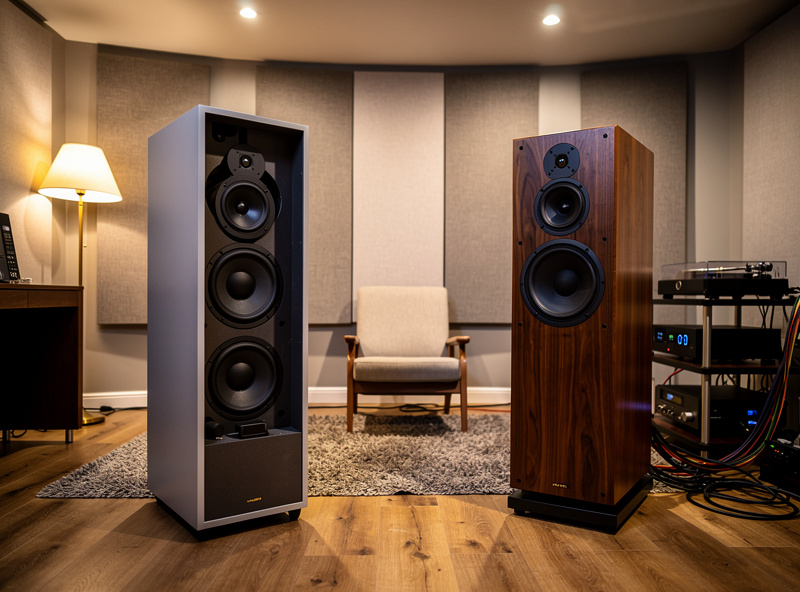
For amplifier matching, the takeaway is this: a sealed 85 dB speaker at 2.5 meters needs roughly 60 watts for 95 dB peaks. A ported 88 dB speaker needs about 30 watts. An open baffle speaker with 88 dB midrange sensitivity and 10 dB of bass boost (either active EQ or passive line-level compensation) effectively becomes a 78 dB speaker in the bass — meaning you need amplification capable of cleanly delivering roughly 10 times the power you calculate from the midband sensitivity if you want flat bass response at high output levels. In practice, most open baffle systems with passive crossovers use high-sensitivity pro-audio drivers (95-100 dB) to offset the baffle losses, and active systems use dedicated amplification per driver with DSP to manage the power distribution. Either way, open baffle demands more total amplifier power than an equivalent-bandwidth box speaker. This is not a defect — it is the trade-off for the radiation pattern advantages.
Placement Requirements: Where Each Design Works Best
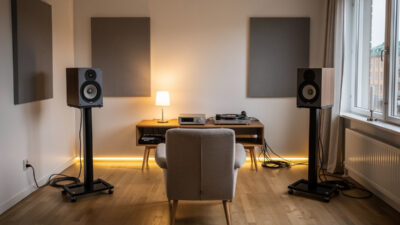
Box speakers are the most placement-tolerant design but still need breathing room — 60 to 100 centimeters from the front wall for floor standers to avoid excessive boundary gain, and at least 80 centimeters from side walls to keep first reflections balanced. Open baffle speakers have stricter requirements: they need 1 to 1.5 meters from the front wall to create sufficient delay in the rear-wave reflection (at least 6 milliseconds, equivalent to about 2 meters of round-trip path length). Pull an open baffle speaker to within 50 centimeters of the front wall and the rear reflection arrives too quickly — 3 milliseconds — and fuses with the direct sound, collapsing the soundstage depth the dipole is supposed to create and causing a comb filter in the upper midrange.
Side-wall distance is less critical for dipoles because of the 90-degree null, but they still benefit from at least 60 centimeters of clearance to avoid near-field boundary interactions that can alter the radiation pattern. In my room, with a width of 3.5 meters, I could accommodate open baffle speakers at roughly 1 meter from the front wall and 80 centimeters from side walls — adequate but not generous. The constraint in most rooms is the front-wall distance. Open baffle speakers pulled 1.5 meters into the room effectively consume a meter of living space behind them, which in a room that is 4.2 meters long means the speakers are sitting at the one-third point of the room — right where the first floor-to-ceiling mode has a pressure minimum, which helps reduce modal excitation. This is the same speaker placement physics that applies to box speakers — the one-third and one-fifth room dimensions are the starting points for minimizing modal excitation — but dipoles enforce stricter minimum distances to make the rear-wave delay work as intended.
Ported speakers have one additional placement sensitivity: the port output interacts with nearby boundaries differently than the woofer output because the port is typically on the rear or bottom of the cabinet. A rear-ported speaker needs more clearance from the front wall than a front-ported or sealed speaker because the port’s output at the tuning frequency (typically 30 to 50 Hz) reflects off the front wall and either constructively or destructively interferes depending on the distance. A rear port 30 centimeters from the wall will have a cancellation at roughly 285 Hz (quarter-wavelength at that distance) and reinforcement below about 140 Hz. The bass becomes unpredictable. I prefer front-ported or sealed speakers for this reason — the distance sensitivity is lower, and placement is more forgiving. Rear-ported speakers in small rooms where you cannot pull them far from the wall are a recipe for frustrating, inconsistent bass.
Which Design for Which Listener: Practical Recommendations
Sealed box speakers suit listeners who prioritize transient accuracy, compact size, and predictable placement — the bass rolls off gently and the group delay is minimal, making them the best choice for music where bass articulation matters more than bass extension. Small-room listeners, near-field listeners, and anyone pairing with a subwoofer should default to sealed mains. The subwoofer handles the bottom octave; the sealed mains handle everything above with clean transient behavior. I run ported floor standers because I wanted bass extension to 38 Hz without a subwoofer for most listening, but if I were starting over with a subwoofer in the system from day one, I would choose sealed mains crossed over at 70 Hz.
Ported box speakers suit listeners who want the deepest possible bass from a single pair of speakers without adding a subwoofer, and who have medium to large rooms where the speakers can be placed at least 80 centimeters from walls. The extra 10 to 15 Hz of bass extension compared to a sealed design of similar size is musically meaningful — it covers the fundamental of bass guitar E string (41 Hz) and kick drum fundamentals (40 to 60 Hz) with authority. Most floor standing speakers under $2,000 are ported for this reason — the floor standers under $1000 comparison shows how five leading ported designs achieve 36-42 Hz bass extension from modest cabinet sizes. The port’s group delay penalty is manageable in a well-designed modern speaker and is rarely the limiting factor in sound quality — room acoustics and placement errors dominate.
Open baffle speakers suit listeners who prioritize soundstage and imaging above all else, who have rooms large enough to accommodate the 1 to 1.5 meter front-wall requirement, and who are willing to either live with limited bass extension or invest in hybrid designs or separate subwoofers. The imaging precision advantage is real and repeatable — I have heard it, I have measured it in terms of reduced early side-wall reflections, and I respect the engineering. But open baffle is not the universal answer. In a small room where you cannot pull the speakers far from the front wall, the rear-wave reflection arrives too quickly and becomes a liability rather than an asset. In a room with a reflective front wall (bare drywall, no treatment), the rear-wave reflection is too strong and overwhelms the direct sound with excessive ambience. Open baffle works brilliantly in the right room and frustratingly in the wrong one. My room, at 14 square meters, is borderline — I could make it work with front-wall absorption to control the rear reflection level, but at that point I have traded away the simplicity that makes dipoles appealing.
For most listeners in typical residential rooms under 25 square meters, a well-designed ported floor stander or sealed bookshelf speaker with good speaker placement and basic room treatment will deliver more consistent results across more recordings than an open baffle design. The ported/box approach is the mature, thoroughly-engineered, and broadly-compatible solution. Open baffle is the specialist’s choice — extraordinary in the right context, compromised outside of it. I admire the dipole principle and the clarity it brings to the midrange, but for my room and my listening habits, I stick with boxes. If you want the dipole midrange advantage without the full bass trade-off, the subwoofer integration guide covers the hybrid approach: open baffle mains with a sealed subwoofer crossed over at 80-100 Hz, which gives you dipole clarity where it matters most and monopole bass extension where you need it.
Speaker Design Comparison
| Characteristic | Sealed Box | Ported Box | Open Baffle / Dipole |
|---|---|---|---|
| Bass extension (-3 dB, 165mm woofer) | 55-65 Hz | 38-48 Hz | 60-100 Hz (without EQ), 25-40 Hz (hybrid/active) |
| Bass roll-off rate | 12 dB/octave (gradual) | 24 dB/octave below tuning (steep) | 6 dB/octave below baffle cutoff (gradual but early) |
| Group delay (bass) | Low — 5-15 ms | Moderate — 20-40 ms at tuning | Very low — dipole does not store energy |
| Efficiency (typical sensitivity) | 84-87 dB | 86-91 dB | 85-90 dB midrange (bass requires EQ power) |
| Soundstage width | Good — defined, within-speaker to slightly beyond | Good — similar to sealed | Excellent — wider, deeper, more enveloping |
| Imaging precision | Very good with treatment | Very good with treatment | Excellent — dipole null reduces side reflections |
| Front wall distance needed | 60-100 cm | 80-120 cm (more for rear-ported) | 100-150 cm (critical for rear-wave delay) |
| Side wall sensitivity | High — needs treatment or distance | High — needs treatment or distance | Low — 90-degree null reduces reflections |
| Room size requirement | Works in small rooms (12+ sq m) | Medium rooms (16+ sq m) preferred | Medium to large (20+ sq m) for proper setup |
| Amplifier power demand | Higher — less efficient | Moderate — port adds bass efficiency | High — bass EQ demands significant power |
| Cost for equivalent bandwidth | Lowest — simple construction | Moderate — more complex tuning | Highest — large baffles, pro drivers, active EQ/DSP |
Frequently Asked Questions
What is the main advantage of open baffle speakers over box speakers?
Open baffle speakers create a dipole radiation pattern with a null at 90 degrees, which reduces side-wall reflections by 10-15 dB compared to box speakers and produces a wider, deeper soundstage. The rear radiation reflects off the front wall with a delay, creating natural ambience that enhances perceived depth. The trade-off is much weaker bass output — roughly 18 dB less at 40 Hz for the same driver compared to a ported box.
Are sealed or ported speakers better for small rooms?
Sealed speakers are generally better for small rooms under 16 square meters. Their gradual 12 dB/octave bass roll-off excites room modes less violently than ported designs, and they require less distance from walls — 60 cm versus 80+ cm for rear-ported speakers. Front-ported designs can work in small rooms if you can give them adequate front-wall distance, but sealed is the safer choice in tight spaces.
Why do open baffle speakers need so much amplifier power?
Below the baffle cutoff frequency, the front and rear waves cancel acoustically, creating a 6 dB per octave bass roll-off. To achieve flat bass response, the signal must be equalized with a corresponding boost — typically 10-18 dB at 40 Hz. This boost demands 10 to 60 times more amplifier power at low frequencies than the midrange, which is why active open baffle systems typically use dedicated high-power amplification for the bass section.
Can I build my own open baffle speakers?
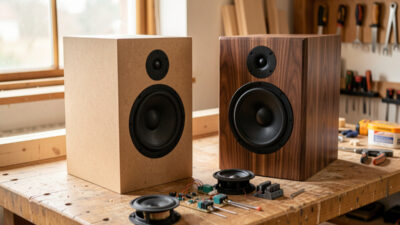
Yes, and it is one of the most accessible DIY speaker projects because there is no cabinet to build — you only need a flat baffle panel. However, getting flat bass response requires either a hybrid design (sealed/ported woofers for bass, open baffle mid/tweeter) or active DSP equalization with measurement capability. A simple passive open baffle will have almost no bass below 100 Hz unless the baffle is impractically large. Start with a proven design like the Linkwitz LXmini or the Manzanita.
Do I need room treatment with open baffle speakers?
Less than with box speakers, but not zero. The dipole null reduces side-wall first reflections without treatment, which is the biggest advantage. However, you still need bass trapping for room modes (open baffle bass below the baffle cutoff still pressurizes the room when EQ’d flat), and the front wall behind the speakers may need diffusion or absorption to control the level and spectral balance of the rear-wave reflection. A bare, reflective front wall can make the rear reflection too prominent and colored.
Related Articles
- Speaker Room Acoustics Guide: The Complete Overview
- Best Floor Standing Speakers Under $1000 for Music Listening
- Speaker Sensitivity and Amplifier Matching: Watts, Ohms, and Headroom
- How to Integrate a Subwoofer for Music: Crossover, Placement, and Phase
- Near-Field Listening Setup: How to Position Speakers in a Small Room