Phono Preamp Buying Guide: MM vs MC Gain Loading and RIAA Equalization
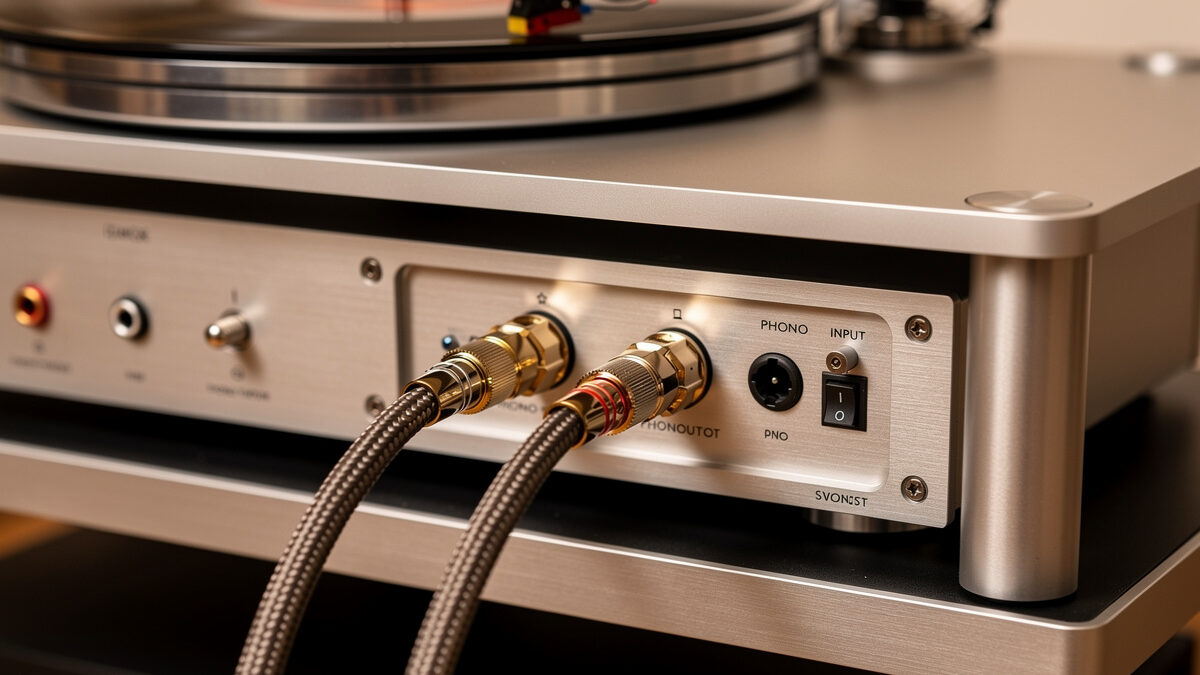
A phono preamp applies the RIAA curve — about 20 dB bass boost, 20 dB treble cut — reversing what the cutting lathe did to the record. Skip it and vinyl sounds thin. The choice: built-in stage (free), $50–150 external box, or $200–600 unit with selectable gain and loading.
I run a Schiit Mani 2 into a 6L6 push-pull integrated, fed by an Ortofon 2M Blue at 5.5 mV output — the Mani’s 42 dB MM gain matches that cartridge cleanly with no audible noise floor, which is the whole point of moving up from a built-in stage. The cartridge side of the chain (stylus profile, compliance, tracking force, alignment) is covered in detail on vinylgearhq.com’s phono cartridge guide. This article is the preamp side: what the box does to the signal, why MM and MC cartridges demand different gain and loading, and the one gain-matching mistake that ruined my first MC setup — and how to spot it before you wire up — which comes in the next section.
What a Phono Preamp Actually Does
A moving magnet (MM) cartridge outputs about 3–5 mV. A moving coil (MC) outputs 0.15–0.5 mV. A line-level input wants 150–300 mV. The preamp does two jobs at once: it provides voltage gain (about 40 dB for MM, 60 dB for MC) and applies the RIAA de-emphasis curve to restore flat frequency response. Neither job is optional. The RIAA curve itself is defined in IEC 60098 by three time constants — 3180 μs (low shelf below ~50 Hz), 318 μs (transition near 500 Hz), and 75 μs (high shelf above ~2.1 kHz) — and any preamp that claims “RIAA accurate” is measured against that curve. AES17 is the analog-audio measurement standard most manufacturers cite when publishing signal-to-noise and THD figures, so when a spec sheet quotes “>90 dB SNR (A-weighted)” the test method usually traces back to AES17.
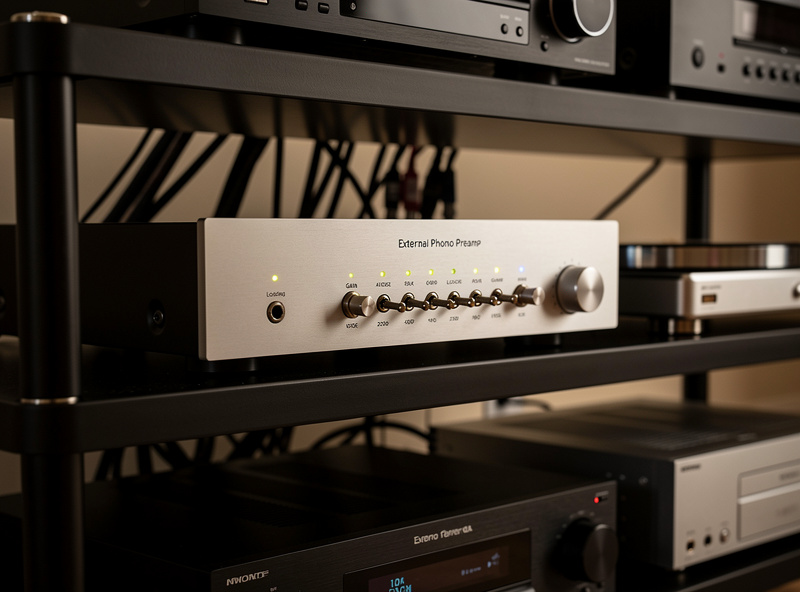
Built-in stages inside entry turntables (Audio-Technica LP60X, Sony PS-LX310BT) hand you fixed 40 dB MM gain, fixed 47 kΩ loading, one RIAA curve, and a $3 op-amp. They work — playback is recognizable — but they leave 30–40% of a decent cartridge on the table. Step up to a $100–200 external (Schiit Mani 2, iFi Zen Phono, Pro-Ject Phono Box S2) and you get gain stops and loading switches so the preamp actually matches the cartridge, not the other way around. I tried the iFi Zen Phono on the same Ortofon 2M Blue before settling on the Mani 2; the Zen sounded fine but its subsonic filter rolled off the very bottom on warped pressings, and I wanted that information present even when it costs me some woofer pumping.
MM vs MC: Why the Preamp Choice Changes
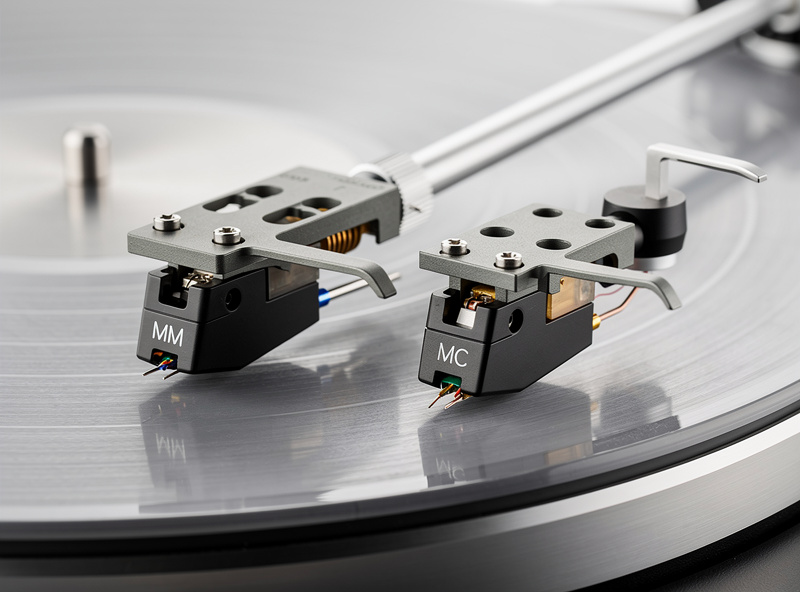
MM cartridges output 3–5 mV and expect 47 kΩ loading — the default on essentially every preamp. MC cartridges output 0.15–0.5 mV, need 60 dB of gain, and want a loading impedance that varies by model: 100 Ω for an Ortofon Quintet Blue, 400 Ω for a Denon DL-103, around 1 kΩ for a Hana SL. Connect an MC cartridge to a fixed MM-only stage and you get 30 mV at the output instead of 300 mV — a whisper with the volume cranked, and a loud hum because the noise floor is now sitting right on top of the music.
Here is the mistake I want anyone reading this to skip. The first time I added a Hana SL low-output MC to the rig, I plugged it into a friend’s MM-only preamp at the stock 47 kΩ loading because that’s what was wired in, and I figured I would “hear what it sounded like” before committing to a proper MC stage. The result was bright, glassy, fatiguing — and the low end was gone. I almost wrote the cartridge off as a bad match. A week later I moved the Hana to a preamp with selectable loading and dropped it to 100 Ω; the top end calmed down, the bass came back, and the cartridge sounded like a $750 cartridge instead of a defective one. Lesson: a wildly wrong load doesn’t just sound a little off, it makes a good cartridge sound broken. Always check the manufacturer’s recommended loading before you wire anything up.
The preamp upgrade path follows the cartridge upgrade path. If you are running an Ortofon 2M Red ($99) on a basic MM input, a $100 external is a meaningful jump. Move up to a 2M Blue or a high-output MC and you want $200–300 with selectable gain and loading. Drop to a low-output MC ($400+) and you need either a 60 dB preamp or a step-up transformer (SUT) in front of a MM stage. The SUT route can be cheaper and quieter — a $150 SUT into a $100 MM preamp will often match a $500 MC preamp because the SUT is a passive winding-ratio gain (no noise added) and the MM stage handles the RIAA correction.
What I’d Buy Today
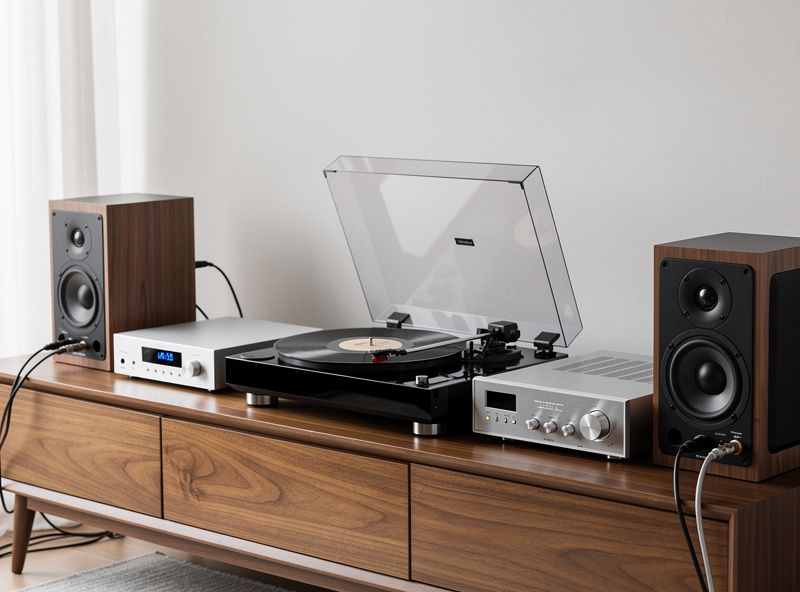
Starting MM with a $300–600 turntable and an Ortofon 2M Red or Blue, I would buy a Schiit Mani 2 ($149) and stop there — three gain stops, dead quiet, loading switches so you can grow into a high-output MC without replacing the box. Starting MC with a Denon DL-103 or Hana SL, I would run the same Mani 2 with a Bob’s Devices Cinemag-1254 SUT in front (about $450 combined, quieter than most $700 MC preamps). Cartridge selection — stylus profile, compliance, tracking force — lives on vinylgearhq.com; once the cartridge and preamp are sorted, the full chain — table, preamp, amplifier, and speakers — is covered in my turntable hi-fi system guide. Buy the loading switches even if you don’t think you need them. The day you upgrade the cartridge you will be glad they are there.
Frequently Asked Questions
Do I need a phono preamp if my turntable has a built-in one?
No, but a $100 external preamp substantially improves the sound from any cartridge above the entry-level tier. The built-in phono stage in a $150 turntable uses a $3 chip with fixed gain and loading. An external preamp with adjustable gain and selectable loading extracts 30–40 percent more detail from a mid-tier cartridge. If you are running the stock cartridge, the built-in preamp is adequate.
What happens if I connect a turntable to a regular AUX input without a phono preamp?
The sound will be extremely quiet, thin, and bass-less. The AUX input expects a line-level signal (150–300 mV) with flat EQ. The cartridge outputs 3–5 mV with RIAA EQ applied. Without a phono preamp, you are missing 40 dB of gain and the RIAA de-emphasis curve — the result is barely audible and tonally wrong.
Can I use the same phono preamp for MM and MC cartridges?
Only if the preamp has switchable MM/MC modes with adjustable gain. A fixed MM-only preamp cannot amplify an MC cartridge adequately because MC output is 10–30× lower than MM. Check the preamp specifications for MC gain (should be 55–65 dB) and selectable loading impedance before buying for MC use.
What is loading impedance and why does it matter?
Loading impedance is the resistance the preamp presents to the cartridge. MM cartridges are designed for 47 k ohms (standard). MC cartridges vary by model — 100 ohms to 1 k ohms. Incorrect loading changes the cartridge frequency response: too low loads the highs down, too high creates a resonant peak in the treble. Selectable loading lets you match the preamp to your specific cartridge.
Is a tube phono preamp better than solid-state?
Not inherently. Tube phono preamps add second-order harmonic distortion that some listeners perceive as warmth. Solid-state preamps measure flatter and quieter. A $200 solid-state preamp outperforms a $200 tube preamp on noise and accuracy. The tube-vs-solid-state preference is about the distortion character, not fidelity — either can sound excellent with the right system matching.
How much should I spend on a phono preamp relative to my turntable?
A rule of thumb: spend 25–50 percent of your turntable-plus-cartridge cost on the phono preamp. A $500 turntable with a $100 cartridge pairs well with a $150–300 preamp. Spending more than the turntable on the preamp produces diminishing returns because the turntable and cartridge become the limiting factors.