Turntable Integration With a Hi-Fi System: Complete Guide
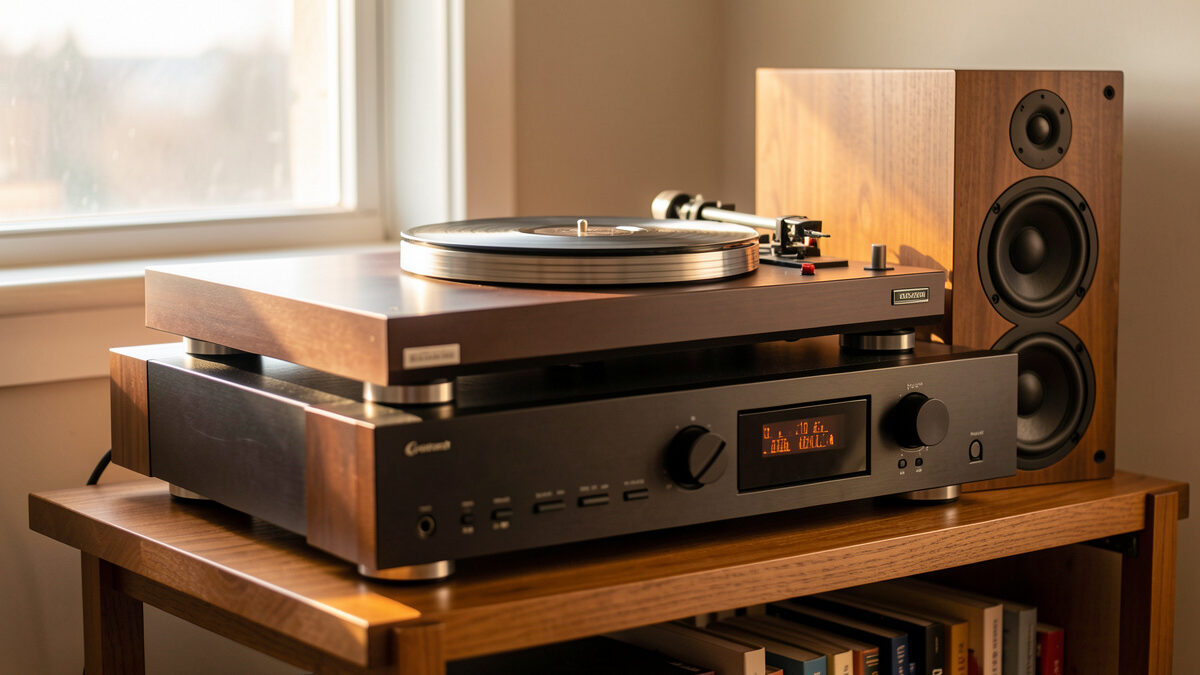
A turntable earns its place in a hi-fi system when the signal chain around it is right: a phono stage with correct gain and RIAA equalization, a clean ground path, and an amplifier-and-speaker pairing that the cartridge can actually drive. Get those three things wrong and even a good deck sounds thin, hummy, or harsh. I run a turntable as the secondary analog source in my measured listening room, swapped through the same integrated amp and speakers I A/B everything else against, and most “vinyl sounds bad” complaints I diagnose come down to integration, not the record.
This guide is about that integration layer specifically: how the turntable connects to the rest of the chain and how it behaves as a system, not the mechanical cartridge-and-platter side. For the alignment, tracking force, anti-skate, and isolation depth that belong to the deck itself, I send you to vinylgearhq.com, which owns that territory. Here we stay on the electrical chain from the tonearm leads to the speaker terminals.
The way I think about it, vinyl integration is a stack of decisions, each of which can quietly wreck the result if you skip it: where the phono stage lives, whether the gain and loading match the cartridge, how the deck grounds, how the amp and speakers pair, and how the room behaves. The seven spokes under this hub each take one of those decisions in full depth, and the sections below map the whole territory so you can jump to the one that is currently the weak link in your own setup. None of it requires a big budget — it requires the chain understood in the right order, which is what I lay out here.
Why System Integration Decides How Vinyl Sounds
A phono cartridge outputs a few millivolts, hundreds of times weaker than a line source, and that signal is recorded with the RIAA curve baked in. It needs roughly 40 dB of gain for moving-magnet and an inverse equalization applied before it ever reaches the amplifier’s volume control. Skip or mismatch that stage and the whole system collapses: too quiet, tonally wrong, or buzzing with hum.
That is why a turntable is the one source you cannot just plug into any input. Where a streamer or DAC hands the amp a finished line-level signal, the turntable hands it a raw, fragile one that depends entirely on the stage that follows. The room, the speakers, and the amp all matter as much as they do for digital, but vinyl adds this extra preamp dependency on top. I cover the room and speaker side in depth in my room acoustics and treatment guide and speaker placement guide — those apply identically whether the source is digital or analog.
The Vinyl Signal Chain, End to End
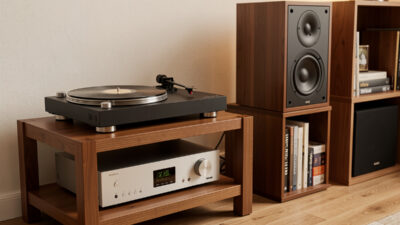
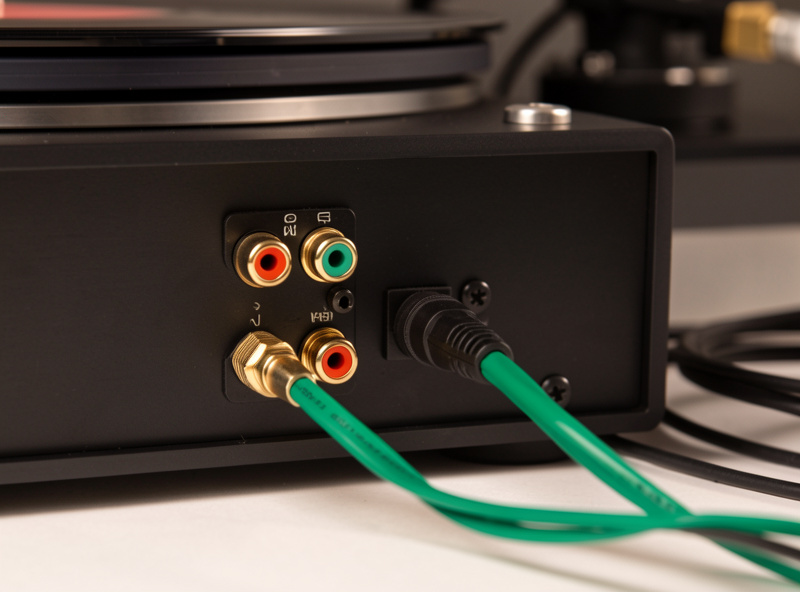
The chain runs cartridge → tonearm leads → phono preamp (gain + RIAA) → line input on amplifier → speakers. Every stage has to be matched to the one before it, and the ground wire runs alongside the whole thing to bleed away the hum the high-gain phono stage would otherwise amplify into a roar.
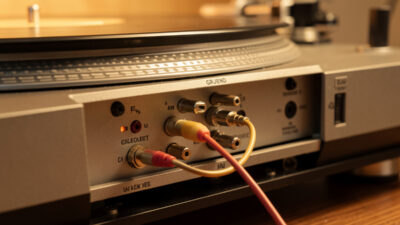
The single most common beginner mistake I see is running the turntable’s low-output leads straight into a regular line input — CD, aux, or tape — with no phono stage anywhere in the path. The result is barely-audible, bass-light sound with no body, because neither the gain nor the RIAA curve has been applied. The fix is always a phono stage somewhere: built into the amp, built into the turntable, or a separate box. The full step-by-step connection method has its own dedicated spoke in this cluster.
Where the Phono Stage Lives
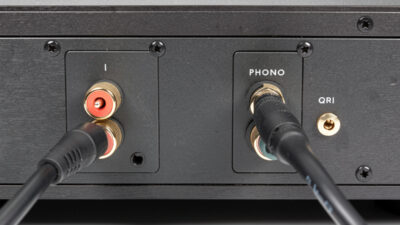
You have three places to put the phono stage, and the choice sets both your sound quality ceiling and your upgrade path. A built-in stage inside the amplifier or turntable is convenient and fine for getting started; a dedicated outboard phono preamp gives you better parts, lower noise, and the ability to dial in gain and loading for moving-coil cartridges later.
Most modern integrated amplifiers aimed at music either include a phono input or omit it entirely, and the difference matters when you shop. If your amp lacks one, you need either a turntable with a switchable built-in preamp or a standalone box. The convenience-versus-quality trade gets its own comparison spoke, and the deeper electrical side — MM versus MC gain, loading, RIAA accuracy — lives in my phono preamp buying guide.
Choosing a Turntable That Fits an Existing System
If you already own a competent amp and speakers, the turntable should be chosen to match that resolution, not to be the cheapest deck that spins. A system that resolves detail will expose a wobbly platter, a noisy motor, or a budget cartridge immediately — the better the rest of the chain, the more the source quality shows.
The sweet spot for most readers adding vinyl to a real hi-fi system is a belt-drive deck with a decent tonearm and an upgradeable cartridge, with or without a built-in preamp depending on what the amp already has. The amp side of that pairing is covered in my integrated amplifiers for vinyl and digital roundup, and a dedicated spoke in this cluster handles the deck-selection side.
Grounding, Hum, and Noise
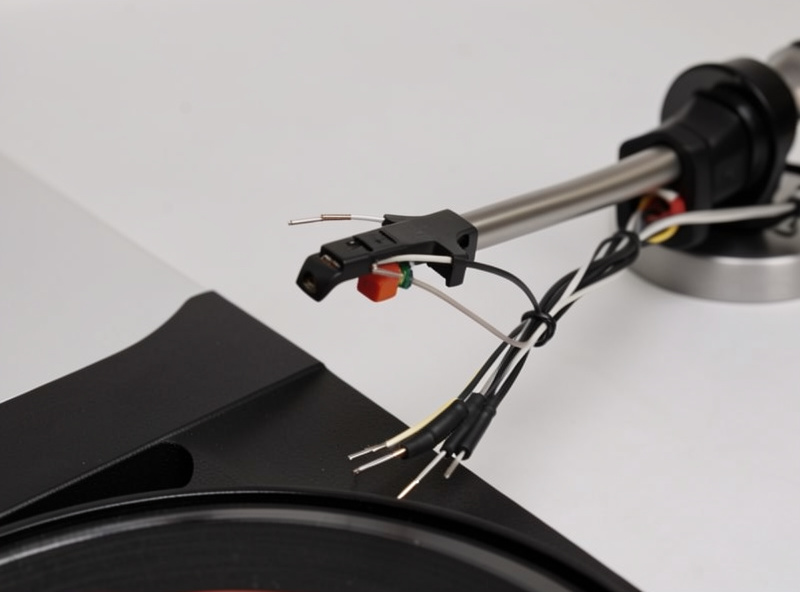
Hum is the defining failure mode of vinyl integration, and it is almost always a ground problem rather than a faulty record or cartridge. A turntable’s metal chassis and tonearm need a path to ground at the phono stage, and the high gain that vinyl requires turns any loose, missing, or doubled ground into an audible 50/60 Hz drone the moment you raise the volume.
The fix usually comes down to landing the ground wire on the phono preamp’s ground post, checking for a ground loop between components on different outlets, and keeping the low-level tonearm cable away from power leads and wall-warts. Because the phono stage amplifies so heavily, problems that would be inaudible on a line source become loud here. The diagnosis order I use is detailed in a dedicated hum-elimination spoke in this cluster.
Vinyl Versus Digital in the Same System
I run both a turntable and a Roon-fed streamer through the same amp and speakers, and the honest answer is that neither is universally “better” — they are different presentations, and the system around them decides which one shines. A well-mastered record on a properly integrated deck has a presentation many listeners love; a clean digital source measures more transparently and never wears out.
What actually separates them in a given room is the mastering, the phono stage quality, and the surface noise floor, not some mystical analog superiority. I keep both in my chain on purpose and pick by recording — some albums I own only sound right on the original pressing, others are flat-out cleaner from a good digital master, and pretending one format wins every time is the audiophile-cult thinking I avoid. The interesting part is that when both sources feed the same amp and speakers, the format difference shrinks and the room and the recording dominate, which is the opposite of what the forums tell you, and I make that full case in my turntable versus streaming sound-quality comparison. If your digital side needs work, start with my DAC buying guide and network streamer guide; if it is the streaming endpoint and library, the Roon library access guide covers that side.
Turntables With Active Speakers and Monitors
Active speakers and studio monitors have the amplifier built in, which removes the integrated amp from the chain — but it does not remove the need for a phono stage, and that is where most people get stuck. The turntable still needs gain and RIAA applied before its signal hits a line input on a powered monitor.
The practical path is a turntable with a built-in switchable preamp or a small outboard phono box feeding the monitors’ line inputs, with attention to whether the monitors expect balanced XLR or unbalanced RCA. I cover the powered-speaker route generally in powered versus passive speakers, and the specific turntable-into-monitors wiring has its own spoke in this cluster.
Upgrading From an All-in-One to Separates
All-in-one turntables with built-in speakers and a Bluetooth deck are a fine entry point, but they hit a hard ceiling fast — the platter, cartridge, and tiny speakers all limit each other. Moving to separates means splitting the job: a real deck, a proper phono stage, an amplifier, and standalone speakers, each chosen to be better than the all-in-one’s single compromised version.
The upgrade does not have to happen all at once. I usually advise starting with the speakers and amp, since they set the ultimate quality ceiling, then improving the deck and cartridge. The full migration order has its own spoke in this cluster, and the foundational chain is laid out in my hi-fi system for vinyl signal chain guide.
Matching the Amp and Speakers to the Cartridge
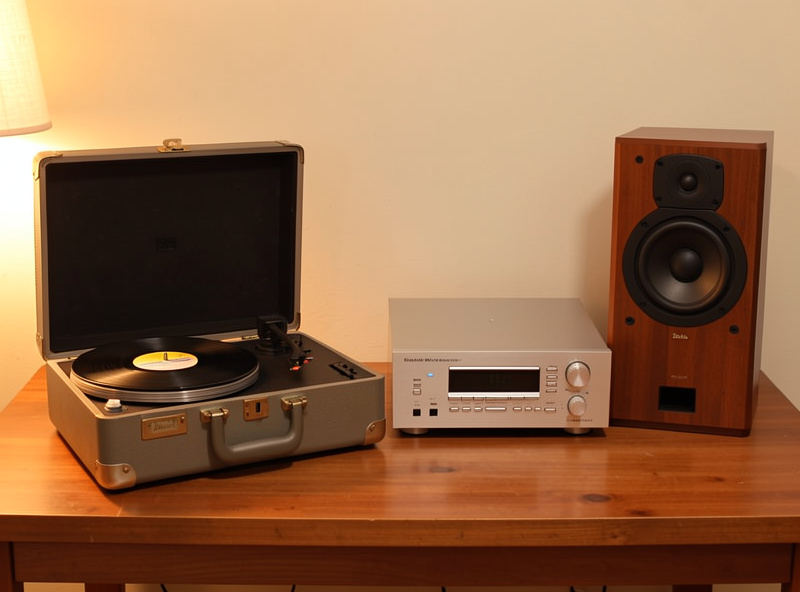
The downstream half of vinyl integration is the amplifier and speakers, and a turntable does not change the rules of that pairing — it just adds the phono stage in front of them. The cartridge’s output ultimately reaches the same volume control, power stage, and drivers as any other source, so an honestly matched amp and a speaker the amp can actually drive matter exactly as much for records as for streaming.
Where vinyl listeners trip up is assuming the source dictates the amp choice. It does not. Sensitivity, impedance, and real-world power headroom decide whether a speaker sings or strains, and I work through that math in speaker sensitivity and amplifier matching. The amp topology debate — whether a tube stage flatters records — is a separate question I cover in tube versus solid-state amplifiers, and if you are spending modestly, my best budget amplifiers under $500 roundup names the integrateds I trust.
Subwoofers, Room Modes, and Vinyl
Records are unforgiving about low-frequency setup because warps, rumble, and footfall feed straight into the phono stage as subsonic energy. A subwoofer adds bass extension, but if the crossover and room placement are wrong it amplifies that rumble and excites room modes, so vinyl rewards careful bass integration even more than digital does.
The fix is the same physics as any bass setup — sensible crossover, placement away from the worst modal nulls, and sometimes a subsonic filter — but the source’s susceptibility to rumble raises the stakes. My subwoofer integration for music guide covers the crossover and placement order, and the broader room treatment that tames modes lives in speaker and room acoustics. For small rooms specifically, the near-field listening setup reduces how much the room gets to interfere in the first place.
Clean Power and the Phono Stage
The phono stage’s enormous gain makes it the most power-supply-sensitive link in the chain, and noise that a line source would never reveal can show up here as hum, hash, or a raised noise floor. A clean mains feed, a tidy outlet arrangement that avoids ground loops, and physical distance between the phono cable and any switching power supply all pay off more for vinyl than for any digital source.
This is also where the amplifier’s own power supply matters, since a noisy front end compounds with a noisy phono stage. I dig into the front-end power question — including where linear and battery supplies genuinely help versus where they are audiophile theater — in why your amp cares about battery versus mains power. The practical takeaway: solve grounding and layout first, because those are free and fix the real hum, before spending on exotic power tweaks.
Desktop and Near-Field Vinyl Setups
A turntable on a desk with powered monitors is a genuinely good small-room hi-fi system, and it is increasingly how people add vinyl without a big rack. The near-field geometry sidesteps a lot of room trouble, but it concentrates two problems: isolation, because the deck sits close to the speakers and any vibration feeds back, and the phono stage, which still has to live outside the monitors.
Desk setups also reward thinking about whether your monitors are the right tool versus a traditional bookshelf-and-amp pairing. I compare the two approaches in studio monitors versus consumer speakers and in powered versus passive speakers, and the placement discipline that makes a near-field rig image properly is the same as in my speaker placement guide.
Connection Methods Compared
The four common ways to get a turntable into a system differ mainly in where the phono stage sits and what convenience you trade for sound quality. This is the table I point readers to when they ask which path fits their existing gear.
| Connection Path | Phono Stage | Best For | Sound Ceiling | Upgrade Path |
|---|---|---|---|---|
| Turntable into amp’s phono input | Inside the amplifier | Amps with a dedicated phono input | Good — tied to amp quality | Add outboard phono later, bypass internal |
| Turntable with built-in preamp into line input | Inside the turntable | Amps with no phono input | Modest — fixed budget stage | Switch off built-in, add separate box |
| Turntable into outboard phono preamp into line input | Separate box | Quality-focused and MC cartridges | High — best parts and matching | Upgrade the phono box independently |
| Turntable into active monitors | Built-in or outboard, never in the monitor | Desktop and small rooms | High — monitors are revealing | Upgrade phono stage or monitors separately |
The Integration Mistakes I See Most
After diagnosing a lot of “my vinyl sounds wrong” setups, the failures cluster into a short, predictable list, and almost none of them are the deck’s fault. Knowing them up front saves the frustrating loop of blaming the cartridge or the pressing when the real problem is two stages downstream.
The first is the missing phono stage already covered — a deck plugged into a line input with no gain or RIAA. The second is a doubled phono stage: a turntable with its built-in preamp left switched on, fed into the amp’s phono input, applying RIAA twice and producing a thin, screechy, distorted sound. The third is the ground wire left dangling or never connected, guaranteeing hum. The fourth is impedance and gain mismatch on a moving-coil cartridge run into a moving-magnet stage, which leaves it quiet and lifeless. The fifth, and the one people resist most, is putting the deck on a flimsy shelf next to the speakers so footfall and bass feed straight back into the stylus.
None of these need expensive fixes. They need the chain understood and set up in the right order — source, phono stage, gain matching, ground, then isolation — which is exactly the order the spokes in this cluster follow. If you are building the whole thing from scratch rather than retrofitting, my complete beginner’s guide to hi-fi systems sets the foundation the turntable then plugs into.
Frequently Asked Questions
Can I plug a turntable directly into any amplifier input?
Only if that input is a phono input or the turntable has a built-in preamp. A phono cartridge needs about 40 dB of gain plus RIAA equalization before a line input, so a bare deck into a CD or aux jack sounds faint and bass-light.
Do I need a separate phono preamp?
Not always. You need a phono stage somewhere in the chain. It can live in the amplifier, in the turntable, or in a separate box. A standalone phono preamp gives the best sound and lets you match moving-coil cartridges, but a built-in stage works to start.
Why does my turntable hum when nothing else does?
The phono stage adds heavy gain, so it amplifies any ground problem into an audible 50 or 60 Hz hum. Usually the ground wire is missing, loose, or creating a loop. Land it on the phono preamp ground post and separate the tonearm cable from power leads.
Is vinyl actually better than streaming in a hi-fi system?
Neither is universally better. The mastering, the phono stage, and the record condition decide more than the format. A clean digital source measures more transparently; a well-pressed record on a well-integrated deck has a presentation many listeners prefer. Running both lets you pick per recording.
Can I connect a turntable to active studio monitors?
Yes, but the monitors have no phono stage, so you still need gain and RIAA applied first. Use a turntable with a built-in preamp or a small outboard phono box feeding the monitors line inputs, matching balanced XLR or unbalanced RCA as the monitors require.
Should I upgrade my all-in-one turntable or buy separates?
All-in-ones hit a ceiling fast because the deck, cartridge, and speakers all limit each other. Moving to separates lets each part be better. Start with the amp and speakers, which set the quality ceiling, then improve the deck and cartridge over time.