Speaker Sensitivity and Amplifier Matching: Watts, Ohms, and Headroom
What Speaker Sensitivity Means: Decibels at 1 Watt, 1 Meter
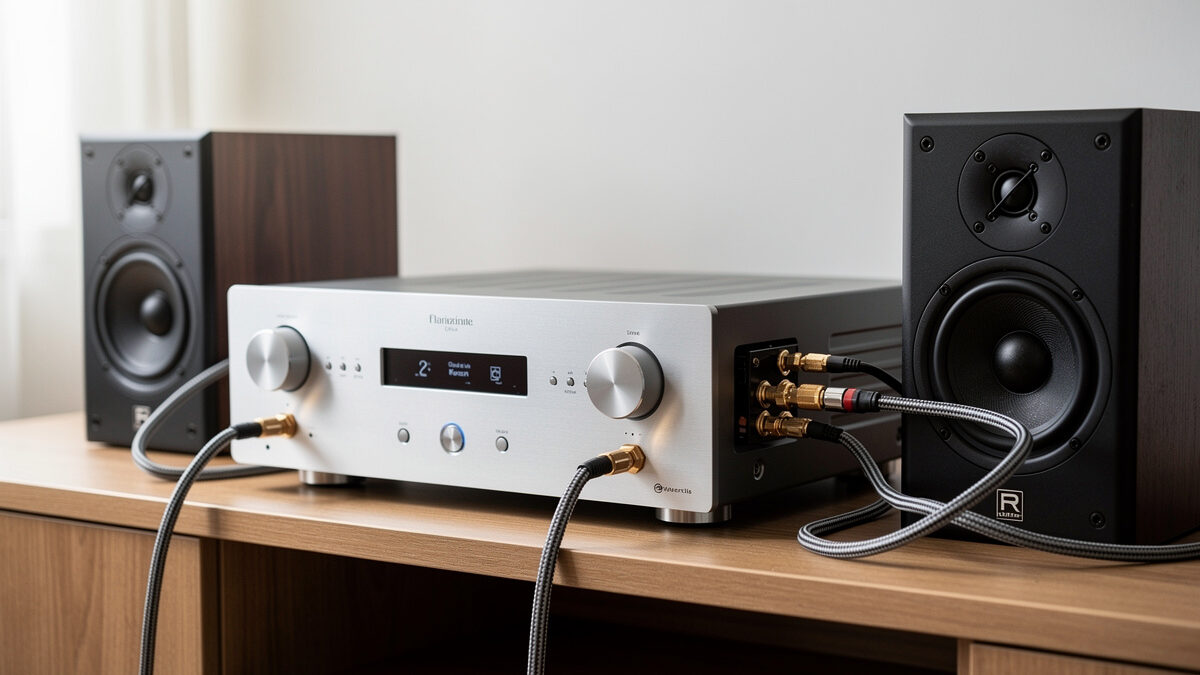
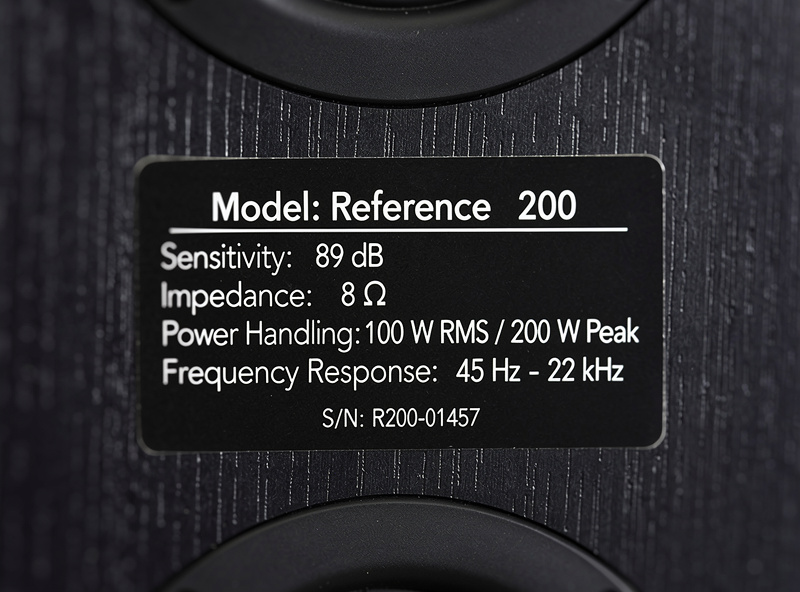
Speaker sensitivity is the sound pressure level a speaker produces at a distance of 1 meter when fed 2.83 volts — which equals 1 watt into an 8-ohm load. A speaker rated at 91 dB sensitivity plays 91 dB at 1 meter with 1 watt, while an 85 dB speaker requires 4 watts to reach the same level. This 6 dB difference represents a fourfold power requirement — the 85 dB speaker needs an amplifier with four times the power output to play at the same volume as the 91 dB speaker, which makes sensitivity the single most important number on a speaker’s specification sheet for determining what amplifier you need.
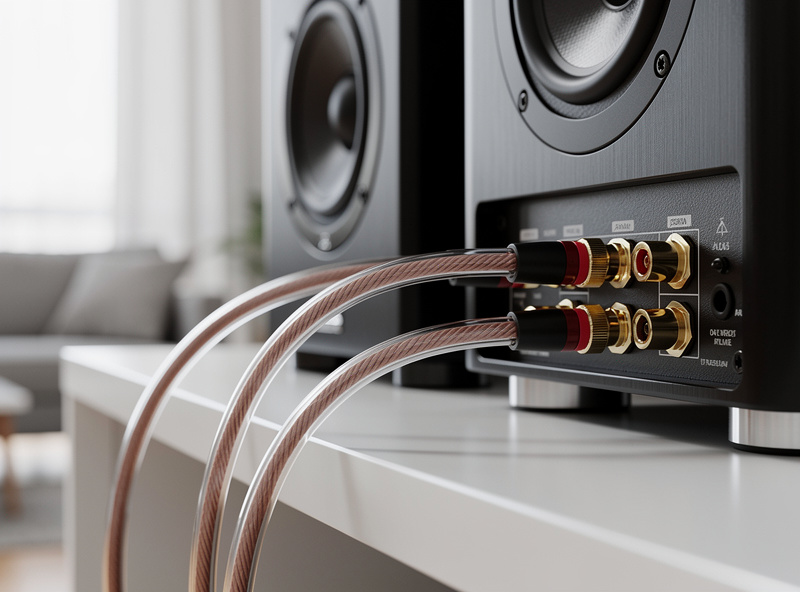
The relationship is logarithmic: every 3 dB increase in sensitivity halves the amplifier power required for a given SPL. Moving from 85 dB to 88 dB sensitivity cuts your power needs in half. Moving from 88 dB to 91 dB cuts them in half again. This means a 94 dB speaker needs one-eighth the amplifier power of an 85 dB speaker to reach the same volume. In my system, the speakers I run are rated at 89 dB sensitivity. My 60-watt integrated amplifier drives them to 95 dB peaks at my 2.7-meter listening distance with headroom to spare. If I swapped to 85 dB speakers, that same amplifier would clip on the same peaks — I would need roughly 150 watts to maintain the same headroom. The relationship between sensitivity and power is why I recommend checking the floor standing speaker comparison for sensitivity ratings before buying an amplifier — choosing the speakers first and matching the amplifier to them avoids the most common matching mistake.
One caveat that most sensitivity ratings conveniently omit: 2.83 volts into a 4-ohm speaker is 2 watts, not 1 watt (power = voltage squared divided by resistance). A 4-ohm speaker rated at 91 dB with 2.83V is actually 88 dB at 1 watt — the rating is inflated by 3 dB because it is drawing twice the power. Always check whether the sensitivity spec references “2.83V” or “1W.” If it says 2.83V into a 4-ohm nominal speaker, subtract 3 dB for the true 1W/1m figure. Most manufacturers use 2.83V regardless of impedance, which is why 4-ohm speakers sometimes appear to have suspiciously high sensitivity ratings. They do not — they are just drawing more current from the test signal.
Impedance Curves and Their Real Meaning in the Real World
A speaker’s nominal impedance — the 4, 6, or 8 ohms printed on the back — is a single number that represents almost nothing about how the speaker actually loads an amplifier across the frequency range. The actual impedance curve varies by a factor of 3 to 10 across the audio band: an “8-ohm” speaker might dip to 3.2 ohms at 150 Hz and rise to 30 ohms at the port tuning frequency of 35 Hz. The amplifier sees an ever-changing load, not a fixed resistor, and its ability to deliver current into the impedance minimum — the lowest point on the curve — determines whether it can drive the speaker cleanly at high output levels.
The impedance minimum matters because amplifier power is inversely proportional to impedance for a given voltage output. If your amplifier produces 60 watts into 8 ohms, it might produce 100 watts into 4 ohms — but only if its power supply can deliver the required current. At the 3.2-ohm minimum, the amplifier would be asked to deliver roughly 120 watts into a load that some amplifiers’ protection circuits will interpret as a near-short. The result is current limiting, increased distortion, or thermal shutdown. This is also why I recommend against using budget passive speakers with cheap amplifiers — the combination of low-sensitivity speakers and a current-limited amplifier makes both components perform below their individual capabilities.
The phase angle of the impedance compounds the problem. An impedance minimum combined with a highly reactive phase angle (capacitive or inductive, ±45 degrees or more) increases the current demand beyond what the simple magnitude suggests. This is why Electrostatic speakers and some complex dynamic designs (Wilson, older Thiel models) are notorious for being “amplifier killers” — they present low impedance at phase angles that stress amplifier output stages in ways that resistive test loads on the test bench do not. For most conventional dynamic speakers from mainstream manufacturers, the impedance minimum is the primary concern and the phase angle is secondary. But if you see a speaker with a 2.8-ohm minimum and a -60-degree phase angle at the same frequency, know that you need a seriously robust amplifier — something with a large toroidal transformer and substantial filter capacitance, not a Class D chip amp in a slim chassis.
Why Low Impedance Dips Stress Amplifiers — And Which Ones Survive
An amplifier’s ability to drive low-impedance loads depends on its power supply and output stage design. A traditional Class AB amplifier with a large toroidal transformer and 20,000-40,000 microfarads of filter capacitance can typically deliver double its 8-ohm rated power into 4 ohms and remain stable into 2-ohm dips. A compact Class D amplifier with a switch-mode power supply might be rated at 100 watts into 8 ohms but only 120 watts into 4 ohms — indicating that the power supply is current-limited and will struggle with reactive loads that dip below 4 ohms.
The rule of thumb: look at the amplifier’s 4-ohm power rating relative to its 8-ohm rating. If 4-ohm power is nearly double the 8-ohm power (e.g., 60W/8Ω → 110W/4Ω), the amplifier has a robust power supply and will handle impedance dips gracefully. If 4-ohm power is only slightly higher than 8-ohm power (e.g., 100W/8Ω → 120W/4Ω), the amplifier is current-limited and will audibly strain on speakers with low impedance minima. Most multi-channel AV receivers fall into the second category — the power supply is shared across five to nine channels, and there is simply not enough transformer iron and capacitor storage to deliver sustained current into low impedances. This is why AV receivers sound anemic driving 4-ohm speakers at high output, even if the spec sheet says “4-ohm compatible.” Compatible means it will not catch fire; it does not mean it will sound good.
In my system, the integrated amplifier I use is rated at 60 watts into 8 ohms and 95 watts into 4 ohms — a ratio of 1.58, which indicates a reasonably capable power supply but not a doubling monster. My speakers have a minimum impedance of 4.2 ohms, so the amplifier never sees a load that challenges its current delivery. This is an intentional pairing — I chose speakers and amplifier together, matching the impedance profile to the amplifier’s capability. If I were running speakers with a 2.8-ohm minimum, I would need a different amplifier, probably something like a Hegel or a beefy Rotel with a proper overspec power supply. The same principle applies when choosing an integrated amplifier — the 4-ohm power rating tells you more about real-world capability than the 8-ohm headline number.
Calculating Power Needs: How Many Watts Do You Actually Use?
Most music listening at moderate levels uses 1 to 10 watts of amplifier power — not 100, not 500. With 89 dB speakers at a 2.5-meter listening distance, 1 watt produces roughly 79 dB at the listening position (accounting for in-room gain and two-speaker summation). 10 watts produces 89 dB. 100 watts produces 99 dB — louder than most people ever listen. The amplifier power you need depends entirely on: your speakers’ sensitivity, your listening distance, your target peak SPL, and the crest factor of your music. Highly dynamic music (orchestral, well-recorded jazz) has peaks 15 to 20 dB above the average level, meaning your amplifier must deliver 30 to 100 times its average power output on peaks without clipping.
Here is the calculation I use for my own system, which you can adapt:
- Target average listening level: 80 dB SPL at the listening position.
- Speaker sensitivity: 89 dB at 1W/1m.
- Listening distance: 2.7 meters. SPL drops roughly 3-4 dB per doubling of distance in a typical room (somewhere between anechoic 6 dB and purely reverberant 0 dB). At 2.7 meters, I lose about 6 dB relative to 1 meter.
- Stereo pair gain: Two speakers playing in phase add roughly 3 dB.
- Room gain: Below roughly 200 Hz, boundaries reinforce bass by 3 to 6 dB — I do not factor this into headroom calculations because it is frequency-dependent and I want headroom across the full bandwidth.
Net SPL at listening position for 1 watt: 89 – 6 + 3 = 86 dB. To reach 80 dB average: need 0.25 watts. To handle a 15 dB peak from 80 dB average (95 dB peak): need 8 watts. To handle a 20 dB peak (100 dB peak): need 25 watts. My 60-watt amplifier has plenty of headroom for 100 dB peaks, which I do not hit often. If I had 85 dB speakers, the same calculation gives: 85 – 6 + 3 = 82 dB at 1 watt. 95 dB peak requires 20 watts, 100 dB peak requires 63 watts — right at the limit of my amplifier. That is the difference that sensitivity makes.
Headroom Explained: Why More Watts Than You Think You Need Matters
Amplifier headroom is the difference between the amplifier’s maximum clean output power and the power demanded by the loudest musical peaks in your listening. Having 6 to 10 dB of headroom — meaning your amplifier can produce 4 to 10 times the power you normally use before clipping — ensures that transient peaks pass cleanly without the amplifier’s output stage hitting the voltage rails, which produces harsh odd-order harmonic distortion that is audible as hardness, grain, or loss of soundstage depth even on brief peaks. Clipping on cymbal crashes, snare hits, and piano fortissimo chords is particularly objectionable because the high-frequency harmonics of the clipped waveform fall in the 5 to 10 kHz range where the ear is most sensitive to distortion.
The reason headroom matters even at moderate volumes is the crest factor of uncompressed music. A well-recorded orchestral crescendo might average 80 dB at the listening position with peaks hitting 100 dB — a 20 dB crest factor, meaning the amplifier must deliver 100 times its average power on peaks (10 dB = 10× power, 20 dB = 100× power). If your amplifier is cruising at 0.5 watts during soft passages and 5 watts during loud passages, those 100 dB peaks demand 100 watts. If your amplifier is rated at 50 watts, it clips. The clipping might last only a few milliseconds — you will not hear it as a gross distortion, but you will hear the soundstage collapse slightly, the strings turn grainy, and the brass lose brilliance. Clean headroom is the single biggest determinant of whether a system sounds effortless or strained at realistic volumes.
I target at least 10 dB of headroom above my loudest expected peaks. For my system, that means an amplifier capable of 150 watts into 8 ohms would provide textbook headroom for 100 dB peaks at my listening position. My 60-watt amplifier provides about 8 dB of headroom above 95 dB peaks — slightly under my target, but I rarely listen above 85 dB average, and the music I play most (small-group jazz, acoustic folk, chamber music) has crest factors closer to 12-15 dB. The headroom is adequate. If I regularly played Mahler symphonies at realistic levels, I would want more power, or more sensitive speakers, or both. I cover this in more detail in my discussion of room acoustics — the room’s contribution to perceived loudness and clarity means you may need less power in a well-treated near-field setup than you would in a large, live room.
Matching Amp Power to Speaker Sensitivity: Practical Pairings
The table below shows how much amplifier power you need for different speaker sensitivities to achieve 95 dB SPL peaks at a listening distance of 2.7 meters (about 9 feet) in a typical room. I chose 95 dB because it represents a realistic peak level for engaged music listening — loud enough to convey dynamics but not hearing-damage territory. If you listen at 85 dB average with 10 dB dynamic peaks, subtract about 6 dB from the required power (roughly one-quarter). If you listen at 90 dB average with 15 dB peaks (105 dB at the listening position), multiply the power numbers by 10. This is not exact — real rooms vary — but it is close enough for amplifier shopping.
| Speaker Sensitivity (1W/1m) | Power for 95 dB peak at 2.7m | Recommended Amplifier Power | Example Pairing |
|---|---|---|---|
| 85 dB | 63 watts | 100-150 W/ch into 8 ohms | Parasound NewClassic 275, Rotel RB-1552 MkII |
| 88 dB | 32 watts | 60-100 W/ch into 8 ohms | Cambridge Audio CXA81, Rega Elex Mk4 |
| 91 dB | 16 watts | 40-60 W/ch into 8 ohms | Marantz PM6007, Rega Brio, Audiolab 6000A |
| 94 dB | 8 watts | 20-40 W/ch — even single-ended tube amps viable | Decware SE84UFO, Schiit Aegir, low-power SET |
The “Recommended Amplifier Power” column includes headroom — roughly 6 dB above the calculated minimum. This ensures that even on recordings with high crest factors, the amplifier stays clean. Buying exactly the power you calculate leaves no margin for error (or for enthusiastic volume knob use) and is a recipe for a system that sounds fine at moderate levels but falls apart when you turn it up.
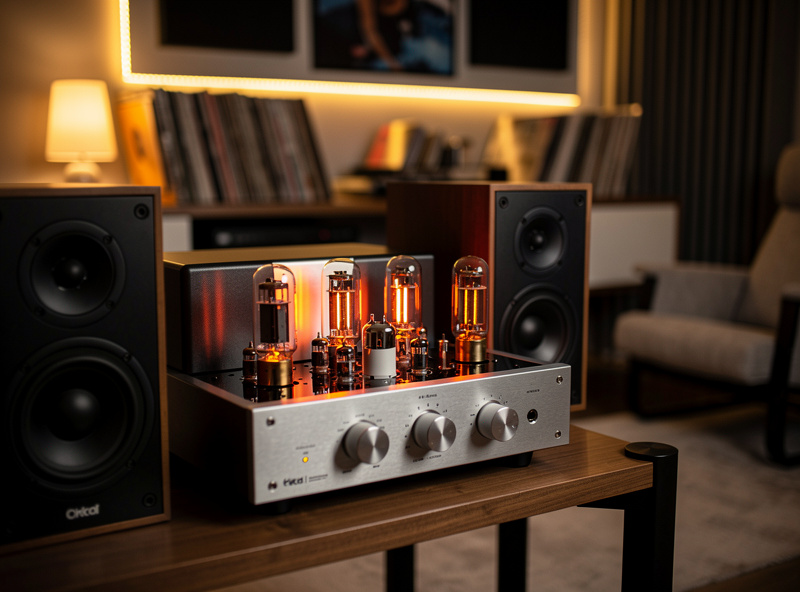
For the tube amp enthusiasts: the power requirement stays the same, but the way tube amps clip is subjectively more benign than solid-state clipping (soft clipping with even-order harmonics vs. hard clipping with odd-order harmonics). A 15-watt single-ended triode amplifier driving 91 dB speakers might audibly clip on 95 dB peaks, but the clipping may sound like a pleasant compression rather than a harsh crack. Do not confuse tolerance for clipping with adequate headroom — the clipping is still happening, it is just less objectionable. If you want real dynamic headroom from tubes, you need push-pull designs in the 40-80 watt range, or very sensitive speakers (96 dB and up), or both. More on this in my article on tube versus solid-state amplifiers.
Tube Amp Matching: Special Considerations for Low-Power Amplifiers
Tube amplifiers impose additional constraints on speaker matching beyond sensitivity and impedance. Single-ended triode (SET) amplifiers, typically 3 to 10 watts per channel, need speakers with sensitivity above 94 dB to produce usable dynamic range — and equally importantly, they need a relatively flat impedance curve without wild swings because the amplifier’s high output impedance (typically 0.5 to 3 ohms, versus 0.01 to 0.1 ohms for solid-state) interacts with the speaker’s impedance curve to create frequency response variations of ±2 to 5 dB. The amplifier’s output impedance forms a voltage divider with the speaker’s impedance, and as the speaker’s impedance rises and falls with frequency, the voltage delivered to the speaker rises and falls proportionally. This is not subtle — a 2-ohm output impedance interacting with an impedance curve that swings from 4 ohms to 30 ohms can produce frequency response deviations of ±3 dB, which is equivalent to a significant tonal coloration.
Push-pull tube amplifiers, typically 20 to 80 watts, are more forgiving. Their output impedance is lower (0.2 to 1 ohm) and their power output allows a broader range of speaker sensitivities. For a 40-watt push-pull tube amp, speakers with 88 dB sensitivity and a benign impedance curve (minimum above 4 ohms, no huge inductive peaks) will work well. The key specification for tube-friendly speakers is not just high sensitivity but a smooth impedance curve with no sharp swings at crossover frequencies where the impedance phase angle is also reactive. Klipsch Heritage series, Zu Audio, and Devore Fidelity speakers are all designed with tube amplifiers in mind and present relatively flat, moderate impedance loads. Most modern budget floor standers with complex crossovers and low impedance minima are designed for solid-state amplifiers and will not pair well with tube amplification regardless of their sensitivity rating.
In my own system, I run solid-state amplification — a 60-watt integrated — and have not felt the need to switch. A well-designed solid-state amp with adequate headroom driving reasonably sensitive speakers at moderate volumes does not sound “solid-state” or “tubey” — it sounds like the recording. I have heard excellent tube systems and excellent solid-state systems, and the common denominator was always clean power matched to appropriate speakers, not the amplifier topology itself.
Frequently Asked Questions
How do I calculate the amplifier power I need for my speakers?
Start with your speakers’ sensitivity rating in dB at 1W/1m. For each 3 dB above your target peak SPL at the listening position, halve the power requirement. At a typical 2.7m distance: 85 dB speakers need roughly 63 watts for 95 dB peaks, 88 dB needs 32 watts, 91 dB needs 16 watts, 94 dB needs 8 watts. Add 6-10 dB of headroom (multiply power by 4-10) for clean dynamic peaks without clipping.
What happens if I use an underpowered amplifier with my speakers?
The amplifier clips when asked to deliver more voltage than its power supply can provide. Clipping produces high-frequency harmonic distortion that is particularly damaging to tweeters — the clipped waveform contains high-energy high-frequency harmonics that can overheat tweeter voice coils, which handle far less power than woofers. More tweeters are destroyed by underpowered amplifiers clipping than by overpowered amplifiers playing cleanly. Underpowering is more dangerous than overpowering.
Does a 4-ohm speaker need a special amplifier?
It needs an amplifier rated for 4-ohm loads with a power supply capable of delivering adequate current. Check the amplifier’s 4-ohm power rating: if it is close to double the 8-ohm rating, the amplifier handles 4-ohm loads well. If the 4-ohm rating is only 20-30% higher than the 8-ohm rating, the amplifier is current-limited and will struggle. AV receivers rarely deliver good performance into 4-ohm speakers regardless of the rated spec.
Why do some speakers have a nominal impedance of 6 ohms?
A 6-ohm nominal rating usually means the speaker’s impedance dips below 4 ohms somewhere in the frequency range but averages around 6 ohms. It is a compromise rating that says ‘this speaker may be difficult for some amplifiers’ without triggering the 4-ohm warning that some amplifier manufacturers use to void warranties. Treat 6-ohm speakers as 4-ohm for amplifier matching purposes unless the manufacturer publishes a full impedance curve showing a minimum above 5 ohms.
Can I use a tube amplifier with any speaker?
No. Tube amplifiers, especially low-power single-ended triode designs, need high-sensitivity speakers (94 dB and above) with relatively flat impedance curves that stay above 4 ohms and avoid sharp phase angles. A tube amp’s high output impedance interacts with the speaker’s impedance curve to create frequency response deviations, and speakers with complex crossovers and low impedance minima will sound colored and potentially unstable. Look for speakers specifically designed or known to be tube-friendly.
Related Articles
- Speaker Room Acoustics Guide: The Complete Overview
- Best Floor Standing Speakers Under $1000 for Music Listening
- Tube vs Solid-State Amplifiers: Which Technology Is Right for You
- Best Integrated Amplifiers for Vinyl and Digital
- Open Baffle vs Box Speakers: Dipole, Sealed, and Ported Designs Compared