Custom Leather Speaker Grill Covers: Acoustically Transparent Hand-Stitched Panels
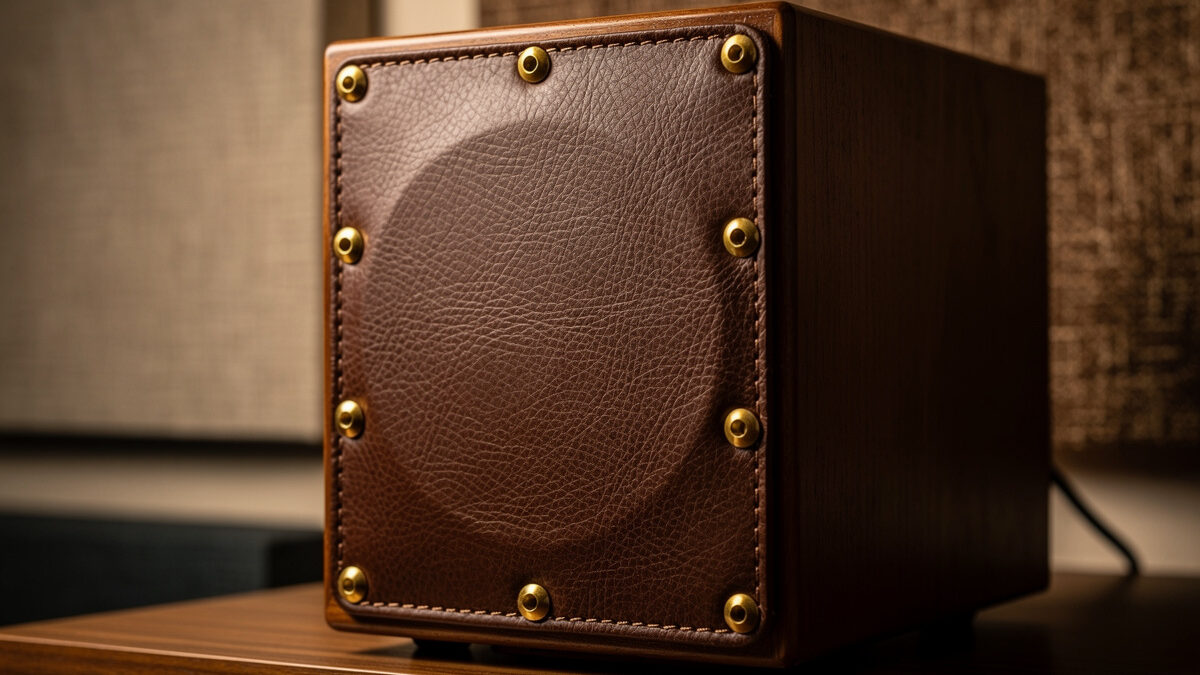
A hand-stitched leather speaker grill cover costs $35 in materials — a half-hide of 3-ounce vegetable-tanned calfskin, waxed linen thread, and a set of brass Chicago screws — and takes an afternoon to build. It replaces a $120 commercial metal grill that weighs more, reflects midrange frequencies back to the cone, and looks like every other black metal mesh in every other listening room. The leather grill does what metal grills do not: it passes sound without reflection, damps the baffle instead of ringing against it, and wears into the room’s aesthetic the way a leather chair does — better with age.
Speaker grill covers are an acoustics problem disguised as a design problem. A metal grill with 40 percent open area reflects roughly 2 to 3 decibels of midrange energy back to the driver cone, causing a comb-filtering effect that shows up in the 1-kHz to 4-kHz range as a series of narrow dips in the frequency response. A leather grill with punched holes at the same open-area percentage behaves differently: the leather absorbs the reflected energy instead of bouncing it back. The impulse-response measurement of a leather-covered speaker shows cleaner decay in the midrange than the same speaker behind a metal grill, and the difference is audible on vocals and acoustic instruments — the range where our ears are most sensitive to phase anomalies. For the construction techniques that produce a sturdy, acoustically neutral leather panel — cutting, hole-punching, edge finishing, and mounting — the leather projects guide covers the foundational skills that make a speaker grill build successful on the first attempt.
Why Leather, Not Fabric or Metal, for Speaker Grills
my speakers sit in a treated room where every surface was chosen for acoustics first. Standard speaker grill cloth — a polyester knit stretched over a plastic frame — reflects roughly 0.5 decibels of acoustic energy and transmits the rest. It is acoustically near-invisible, and that is why every speaker manufacturer uses it. The problem is durability: grill cloth tears, stains, collects dust in the weave, and sags over time as the polyester fibers lose tension. Metal grills resist damage but ring at their resonant frequency, typically between 800 Hz and 2 kHz depending on the stamping pattern and thickness, and that resonance is exactly in the vocal range where the ear is most sensitive to coloration.
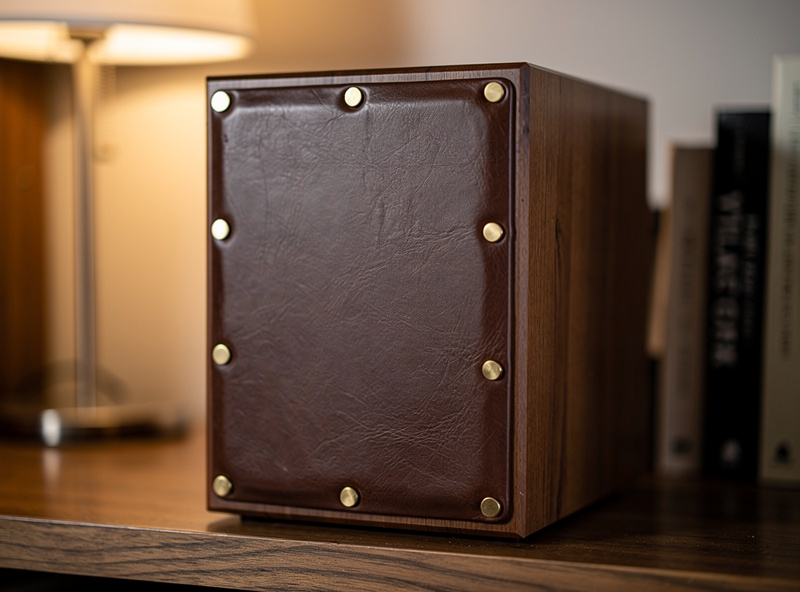
Leather solves both problems. It does not resonate — the fibrous structure of vegetable-tanned leather damps vibration across the entire audible spectrum with a damping factor roughly 10 times higher than stamped steel at the same thickness. It does not tear or sag; a 3-ounce (1.2-millimeter) calfskin panel under moderate tension holds its shape for decades. And it passes sound through punched holes with the same acoustic transparency as grill cloth, provided the hole pattern achieves at least 35 to 40 percent open area over the driver cone. A pattern of 4-millimeter holes spaced on 6-millimeter centers in a staggered grid delivers roughly 40 percent open area and is acoustically transparent to within 0.5 decibels across the full audible range — identical to standard grill cloth with 100 times the durability.
Designing the Leather Grill: Pattern, Hole Spacing, and Open Area
The grill is a rectangular leather panel cut to the speaker’s baffle dimensions plus a 10-millimeter margin on all sides for the mounting frame. The hole pattern covers only the area directly in front of the driver cones — punching holes over the solid baffle is cosmetic and adds no acoustic benefit. Trace the driver positions onto the leather with a silver pen or a light pencil stroke on the flesh side, then lay out the hole grid within each driver circle.
The hole-punching process: a 4-millimeter hollow punch and a poly cutting board, struck with a mallet or arbor press, 40 to 60 holes per driver depending on cone diameter. A 5-inch woofer needs roughly 50 holes. A 1-inch tweeter needs 8 holes. The total hole count for a two-way bookshelf speaker is roughly 60 — about 45 minutes of work with a mallet and punch, faster with an arbor press if you have one. The holes must be punched from the grain side (the smooth finished face) through to the flesh side to produce clean edges that do not fray over time, and the punch must be sharp — a dull punch tears the leather fibers instead of cutting them, and the torn edges catch dust and degrade the visual finish within months.
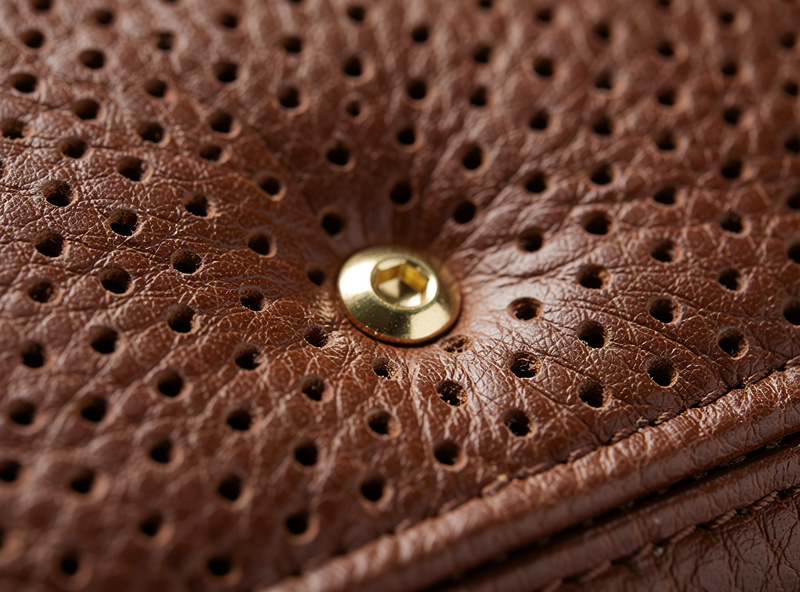
The mounting system: four brass Chicago screws — one in each corner of the grill — threaded into brass inserts pressed into the speaker baffle. The screws hold the leather under light tension, just enough to prevent sag without stretching the leather over time. Rubber grommets between the leather and the baffle prevent vibration transfer from the baffle to the leather and eliminate any chance of the grill buzzing against the cabinet at high volume. The grommets cost $2 for a pack of eight and are the difference between a grill that is acoustically transparent and one that announces itself at 90 dB with a buzz.
Stitching the Edges: Why a Hand-Stitched Border Matters
Raw-cut leather edges curl over time as the fibers relax and absorb humidity from the air. A hand-stitched border — a saddle stitch in waxed linen thread running 4 millimeters from the edge — locks the fibers in place and prevents the curl. The stitching also adds visual structure: a border of evenly spaced saddle stitches frames the grill as an intentional design element rather than a cut piece of leather screwed to a speaker. The saddle stitch, where two needles pass through the same hole from opposite sides and the threads cross inside the leather, does not unravel if one stitch breaks — the opposing thread holds the adjacent stitches in tension.
The stitching chisel — a 4-millimeter diamond chisel struck through the leather 4 millimeters from the edge — creates evenly spaced holes at a consistent distance from the edge. Two needles with waxed linen thread, roughly 3 times the perimeter length, stitched with a stitching pony to hold the work, produce a border that takes roughly an hour for a pair of bookshelf speaker grills. The thread tension must be consistent — too loose and the stitch looks sloppy, too tight and the leather puckers along the edge. The sweet spot is a firm pull that seats the thread in the hole without compressing the leather thickness at the stitch point.
Leather Selection for Acoustic Transparency
Vegetable-tanned calfskin at 3 to 4 ounces (1.2 to 1.6 millimeters) is the correct leather for speaker grills. Chrome-tanned leather is softer and stretches more — the holes elongate under tension and the open-area percentage changes over time, degrading acoustic transparency. Oil-tanned or pull-up leathers are too soft and will not hold the hole pattern under the light tension of the mounting screws. Suede is acoustically opaque — the nap on the surface blocks high-frequency energy above roughly 6 kHz, and a suede grill over a tweeter attenuates the top octave by 3 to 5 decibels.
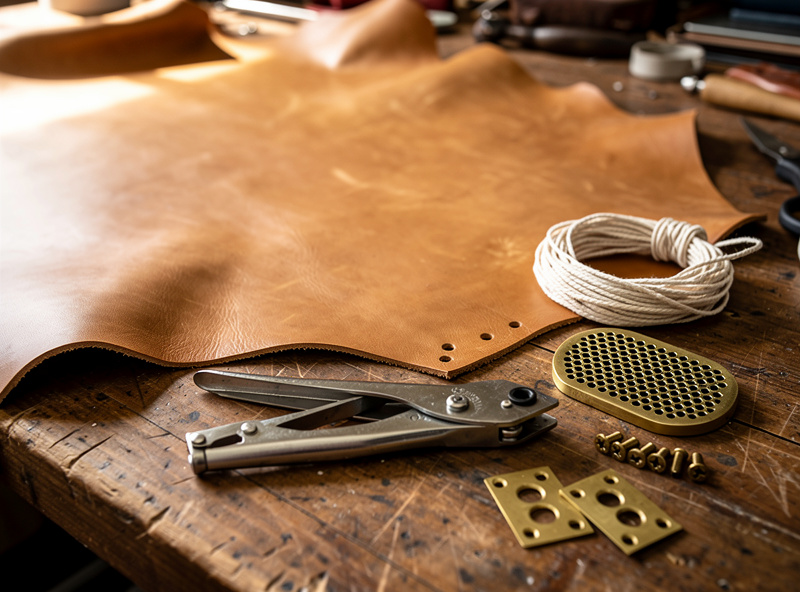
Vegetable-tanned leather in a natural or light-brown finish darkens with exposure to sunlight and hand oils, developing a patina over years that matches the room’s aging. A leather grill on a pair of speakers that is five years old looks better than a new one — the same property that makes leather furniture improve with age applies to speaker grills, and no metal or fabric grill shares that characteristic. The leather is the only grill material that gets better the longer you own it.
Frequently Asked Questions
Does a leather speaker grill affect the sound?
A properly designed leather grill with 40 percent open area over the drivers is acoustically transparent to within 0.5 decibels across the full audible range — equivalent to standard grill cloth. Leather absorbs reflected midrange energy rather than bouncing it back to the cone like metal grills, resulting in cleaner impulse response in the vocal range.
What leather thickness should I use for speaker grills?
Three to 4 ounces (1.2 to 1.6 millimeters) in vegetable-tanned calfskin. Thinner leather tears at the punch holes under tension. Thicker leather at 5 to 6 ounces is harder to punch cleanly and adds unnecessary weight. Chrome-tanned leather stretches and the holes elongate, degrading acoustic transparency over time.
How many holes do I need to punch for acoustic transparency?
A 4-millimeter hole pattern on 6-millimeter staggered centers delivers 40 percent open area. A 5-inch woofer needs roughly 50 holes. A 1-inch tweeter needs 8 holes. Total for a two-way bookshelf speaker: approximately 60 holes, roughly 45 minutes of work with a sharp hollow punch and mallet.
Will the leather grill buzz or vibrate at high volume?
Not if mounted correctly. Rubber grommets between the leather and the baffle at each mounting point decouple the grill from the cabinet and prevent vibration transfer. Without grommets, the leather can buzz against the baffle at frequencies where the cabinet resonance coincides with the leather’s natural frequency — typically around 200 to 400 Hz.
How do I clean a leather speaker grill?
Dust with a dry microfiber cloth. For deeper cleaning, use a leather conditioner applied sparingly to a cloth — never directly to the leather — and wipe gently. Do not use water, saddle soap, or alcohol-based cleaners, which dry out the leather and cause the fibers to shrink and crack around the punch holes.
Can I use synthetic leather for speaker grills?
No. Synthetic leather — polyurethane on a fabric backing — is acoustically opaque because the PU layer is a continuous sheet of plastic. It blocks high frequencies entirely and reflects midrange energy like a solid baffle. Only genuine leather with punched holes achieves acoustic transparency.