How to Select Drivers for DIY Speakers
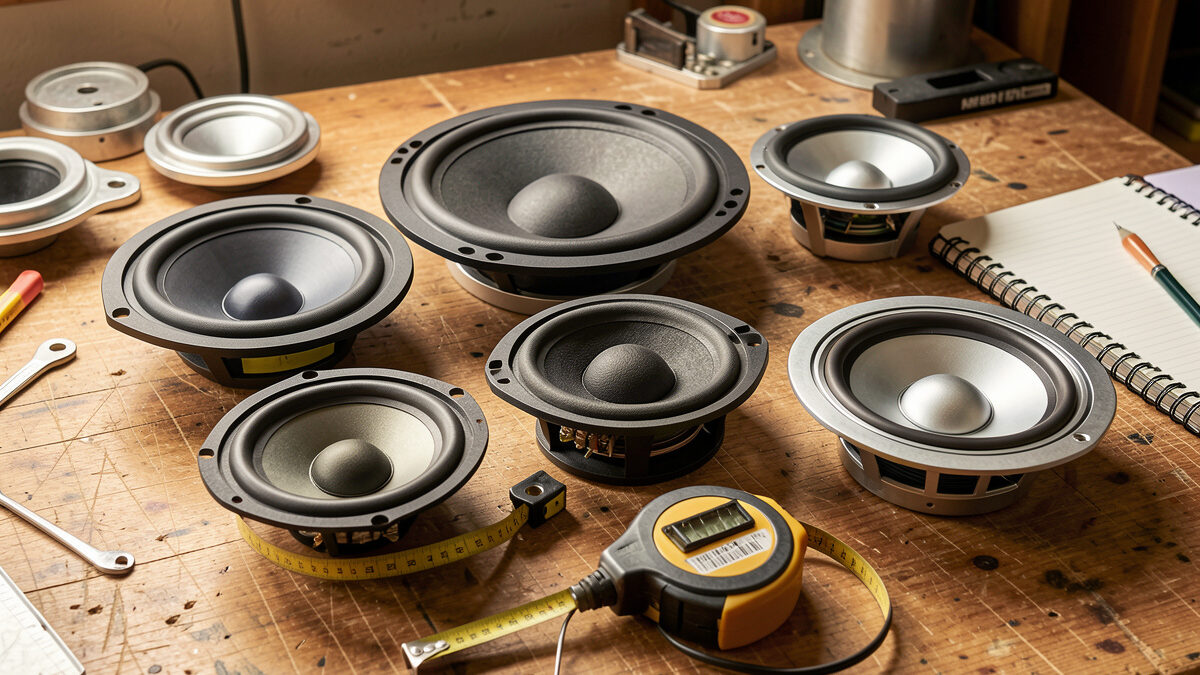
Selecting drivers for a DIY speaker comes down to two measurements, not marketing copy: the woofer’s Thiele–Small parameters, which decide what enclosure it wants, and the on-axis frequency response of both drivers, which decides whether they can be crossed together cleanly. Get those right and a $120 driver pair can outperform a $500 commercial speaker. Get them wrong and no crossover will save the build.
I choose drivers the way I evaluate any component that passes through my listening room — I measure first and let the marketing wash over me. A driver is a transducer with a published, falsifiable spec sheet, and the good ones measure as advertised. This guide is the process I use to pick a woofer and tweeter that will actually work together, written for a first or second two-way build. For the full project context, start with the DIY speaker building guide; this piece zooms in on the single most important decision in it.
The Two Specs That Decide Everything
A woofer’s behavior in a box is governed by three Thiele–Small parameters above all others: Fs (the driver’s free-air resonant frequency, in Hz), Qts (its total Q, a unitless damping figure), and Vas (the equivalent air compliance volume, in liters). Together they tell you what enclosure volume and alignment the driver was designed for. A low-Qts woofer (roughly 0.3 or below) generally wants a ported box to reach its potential; a higher-Qts driver (around 0.5–0.7) often does its best work sealed. Trying to force a low-Qts woofer into a tiny sealed box gives you a bass-shy speaker no EQ can fully rescue.
The second decisive spec is the published frequency-response and impedance curve. You want a woofer with a smooth response through its passband and a controlled break-up region well above your intended crossover, and a tweeter whose resonant frequency (Fs) sits comfortably below the crossover point so it isn’t stressed near its limit. If a tweeter’s Fs is 700 Hz, crossing at 2.5–3 kHz is safe; crossing at 1.5 kHz invites distortion and failure. These are the numbers that matter — not the cone material’s romance.
Matching the Woofer and Tweeter
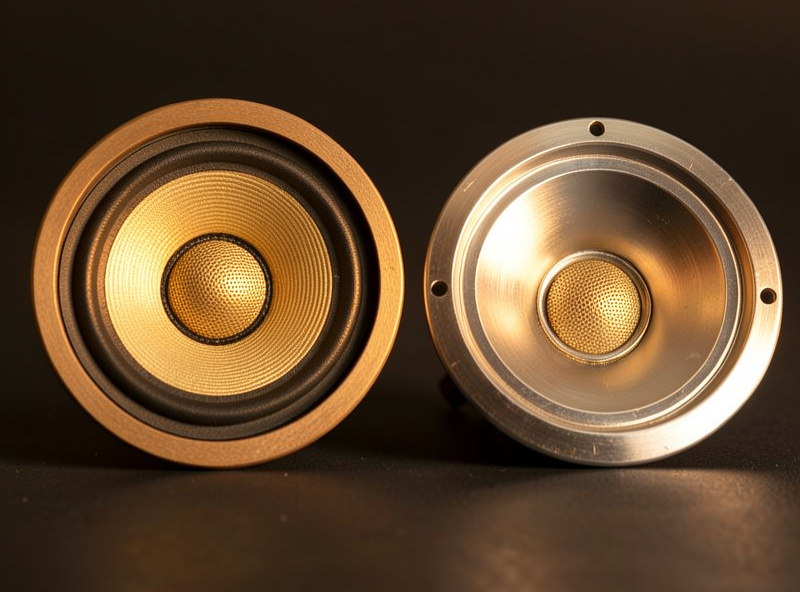
The two drivers have to be partners, and three things determine whether they can be. First, sensitivity: the two drivers should be reasonably close in efficiency, because the crossover will pad the more sensitive driver down to match the other. A tweeter that’s 4 dB more sensitive than the woofer is normal and easily handled with a resistor network; a 10 dB mismatch wastes a lot of the woofer’s output and forces a heavy attenuation network. Second, the crossover region itself: the woofer must still be behaving well (no breakup peak) at the frequency where the tweeter is comfortable taking over. Their usable ranges have to overlap with margin.
Third is power and excursion matching for the volume you’ll actually play. In a normal room at sane levels this is rarely the limiting factor for a bookshelf, but it’s worth a sanity check. Sensitivity also dictates the amplifier you’ll need, which is why I treat driver choice and amp choice as one decision — the full reasoning is in speaker sensitivity and amplifier matching. An 84 dB sealed two-way and a 90 dB ported design ask very different things of a budget integrated.
Cone Materials: What Actually Changes the Sound
This is where audiophile mythology runs thickest, so here’s the measurement-informed version. Cone material changes the break-up behavior of a driver — the frequency and severity of the resonance where the cone stops moving as a rigid piston — far more than it changes some intrinsic “tonal character” within the passband. A well-designed driver sounds like its frequency response, whatever the cone is made of.
| Cone material | Break-up character | Practical notes |
|---|---|---|
| Paper / treated paper | Gentle, well-damped break-up | Forgiving, easy to cross, classic for a reason |
| Polypropylene / filled poly | Smooth, low-Q break-up | Very forgiving; common in budget drivers |
| Aluminum / metal | Sharp, high-Q break-up peak well above passband | Clean in-band but needs a steeper crossover or notch filter to suppress the peak |
| Silk dome (tweeter) | Smooth, low-fatigue top end | Forgiving and easy to integrate; the safe first-build tweeter |
For a first build, paper or poly woofers and a silk-dome tweeter are the forgiving combination — their benign break-up means the crossover doesn’t have to do heroic work to keep things clean. Metal cones are excellent but punish a sloppy crossover, because that high-Q resonance will ring audibly if you don’t notch it out. There’s no “best” material; there’s the material that matches your willingness to design a careful filter.
Why I Measure Drivers Instead of Trusting the Sheet
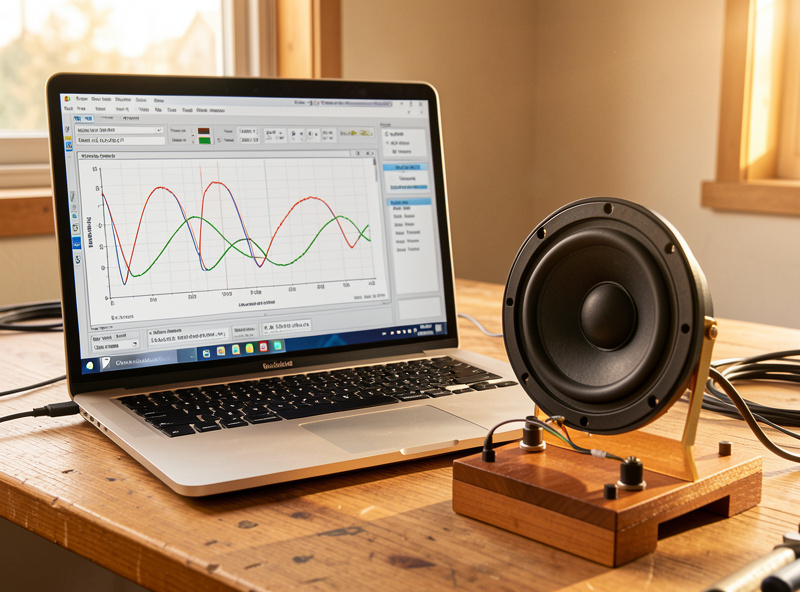
Spec sheets are honest about the design target, but manufacturing tolerances are real. Two woofers from the same production run can differ by a few percent on Fs and Qts, and for a stereo pair that asymmetry can smear the center image — the thing you most want a good speaker to do well. I measure T/S parameters with a Dayton Audio DATS-style impedance rig before I commit, and for a matched pair I’ll buy a couple of extra drivers and pick the two closest. It costs a little more and removes a variable you can’t fix later.
I also take a quick gated response measurement of each driver mounted in a test baffle, because the response in the actual cabinet — with baffle diffraction and baffle step — is what the crossover has to be designed against, not the anechoic curve on the data sheet. If you’re new to taking these measurements, my REW room measurement guide covers the setup with a calibrated mic. Designing a crossover to a manufacturer’s anechoic curve and ignoring your own baffle is one of the most common reasons a first build sounds thin.
How Many Drivers: Two-Way vs Three-Way
For almost every first build, a two-way is the right answer: one woofer covering bass and midrange, one tweeter covering the highs, one crossover point to get right. A three-way adds a dedicated midrange driver and a second crossover region, roughly doubling the design difficulty for a benefit you won’t reliably realize as a beginner. The two-way’s single crossover is where you should spend your learning effort.
The exception is if you specifically want high output or very wide bandwidth from a large floorstander — there a three-way earns its complexity. But you can build superb stand-mounted speakers as two-ways; I compared the broader format trade-offs in open baffle vs box speakers, and a sealed or ported two-way remains the most rewarding place to learn. If a finished commercial bookshelf is your real benchmark, my shortlist in best bookshelf speakers under $300 is a useful sound-quality yardstick to build against.
Where to Buy and What to Spend
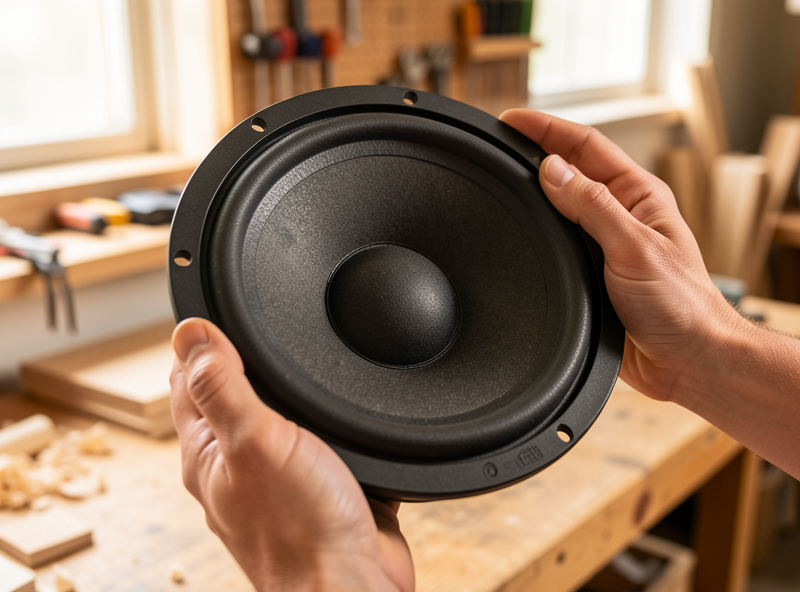
For a first two-way, a driver budget of roughly $120–$220 per pair (woofers and tweeters together) buys genuinely good components from established makers whose drivers have published, measurable specs and a track record in proven designs. The strongest move for a beginner is to buy the exact drivers a published, tested design calls for — you inherit a known-good measured result instead of gambling. If you’d rather browse what’s available, a search across common hi-fi drivers and tweeters shows the entry-level field, and dedicated speaker-parts retailers carry the wider catalog and the T/S data you’ll want.
Whatever you buy, the discipline is the same as everything else on my bench: read the measurements, match the pair, and design around the response you actually have rather than the one you hoped for. Drivers set the ceiling; the rest of the build just decides how close you get to it.
As an Amazon Associate I earn from qualifying purchases.
Frequently Asked Questions
What is the most important spec when choosing a speaker driver?
For the woofer, the Thiele-Small parameters – especially Fs, Qts and Vas – because they decide what enclosure volume and alignment the driver needs. For the tweeter, a resonant frequency well below your crossover point. The on-axis frequency response of both drivers matters more than the cone material.
Does speaker cone material change the sound?
Mostly it changes the break-up behavior – the frequency and sharpness of the resonance above the passband – rather than an intrinsic tone within the usable range. Paper and poly have gentle break-up that is easy to cross; metal cones are clean in-band but need a careful crossover to suppress their sharp break-up peak.
How do I match a woofer and tweeter for a DIY speaker?
Keep their sensitivities reasonably close so the crossover can pad the louder driver down, make sure the woofer is still well-behaved at the frequency where the tweeter is comfortable taking over, and choose a tweeter whose resonant frequency sits well below the crossover point. Their usable ranges must overlap with margin.
Should I measure drivers or trust the manufacturer specs?
Trust the spec sheet for the design target, but measure for a matched pair. Manufacturing tolerances mean two drivers from one batch can differ a few percent on Fs and Qts, which smears the stereo center image. Measuring with an impedance rig lets you pick the two closest drivers and design the crossover to your real baffle.
Is a two-way or three-way better for a first build?
A two-way. One woofer, one tweeter and a single crossover point keep the engineering tractable while still producing excellent sound. A three-way adds a midrange driver and a second crossover region, roughly doubling the difficulty for a benefit beginners rarely realize reliably.
How much should I spend on drivers for a first DIY speaker?
About $120 to $220 per pair buys genuinely good woofers and tweeters from established makers with published specs. The best value move is to buy the exact drivers a proven, tested design specifies, so you inherit a known-good measured result rather than gambling on an untested combination.