Best Floor Standing Speakers Under $1000 for Music Listening
Why Floor Standers Over Bookshelf Speakers for Music
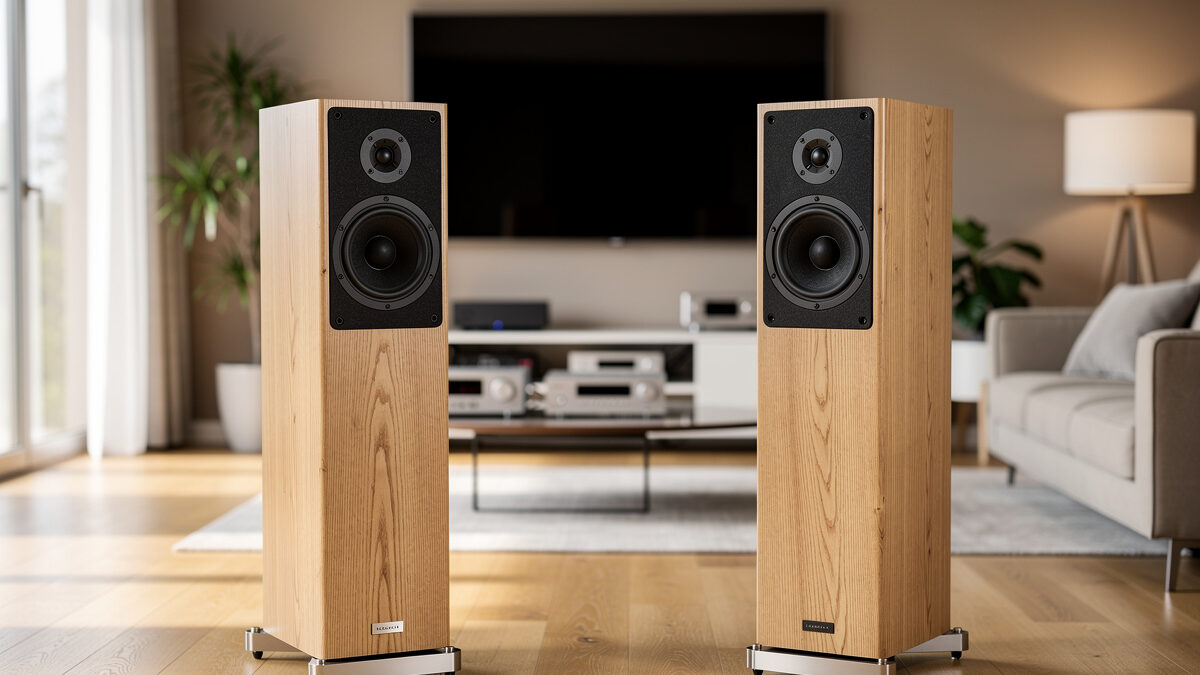
Floor standing speakers deliver 15 to 25 Hz deeper bass extension, 2 to 4 dB higher sensitivity, and substantially greater dynamic headroom than equivalently-priced bookshelf speakers because the larger cabinet volume allows for larger woofers and more efficient bass alignment. A typical $800 floor stander reaches 35-40 Hz with authority where a $800 bookshelf speaker on stands rolls off below 50 Hz — that extra octave of bass adds physical weight to kick drums, bass guitar, and piano left hand that bookshelf speakers simply cannot reproduce at realistic listening levels. I have covered the bookshelf end of this comparison in the best bookshelf speakers under $300 article, and while you can certainly build a satisfying system around compact speakers and a subwoofer, a well-chosen floor stander eliminates the stand cost, the subwoofer cost, and the integration complexity in one step.
The physics is straightforward: low-frequency output requires moving air, and moving air requires either large cone area, long cone excursion, or both. A typical 165mm midwoofer in a two-way bookshelf speaker has roughly 130 cm² of cone area. A pair of 165mm woofers in a floor standing three-way design has 260 cm² — double the radiating area, which means 6 dB more output capability at the same excursion, or the same output at one-quarter the excursion, which dramatically reduces distortion. In my room, the difference between the bookshelf speakers I used to run and the compact floor standers I run now is not subtle: orchestral tutti passages that compressed and hardened through the bookshelf speakers open up and breathe through the floor standers. It is not about loudness — it is about effortlessness.
There is a cost consideration that often gets overlooked. A $600 pair of bookshelf speakers needs stands — decent steel stands with mass-loading capability run $150 to $300. Add that to the speaker price and the bookshelf-plus-stands total is $750 to $900, which is directly competitive with entry-level floor standers. The floor stander gives you more cabinet volume (better bass) and often more drivers (better power handling) for the same total investment. The bookshelf speaker gives you flexibility — easier to place, easier to move, works on a desk or shelf in a pinch. This is the same trade-off I discuss in powered vs passive speakers, where the integrated solution (powered) simplifies the chain while the separates approach (passive) gives you more upgrade paths. Floor standers are the passive-speaker equivalent in the form-factor debate: fewer boxes, fewer variables, less clutter.
What $1000 Actually Buys in Tower Speakers Today
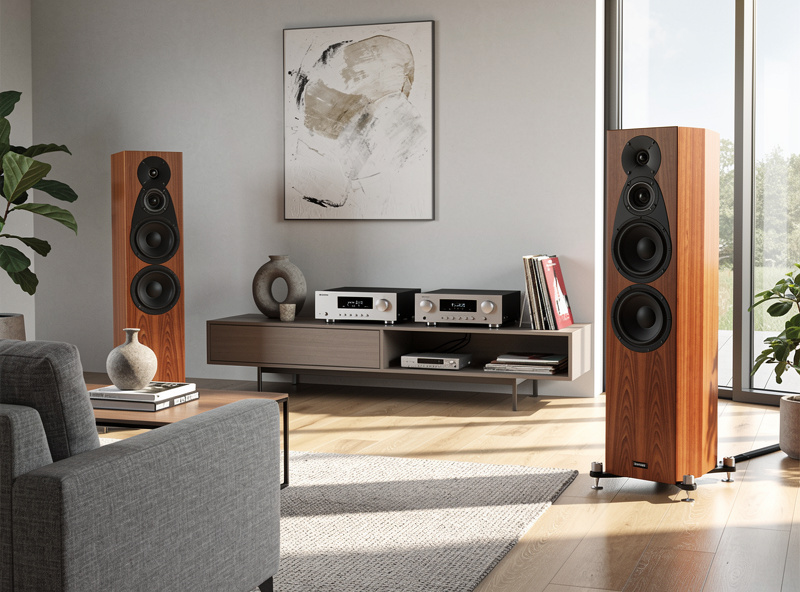
At the $1,000 price point for a pair of floor standing speakers, you get a two-and-a-half-way or entry-level three-way design with dual 130-165mm woofers and a 25mm dome tweeter, real wood-veneer or high-quality vinyl finish, and bass extension to 35-45 Hz from a cabinet built with 15-19mm MDF with internal bracing. This is the sweet spot where engineering compromises become manageable — above $1,000 per pair, you gain refinement and slightly deeper bass, but the law of diminishing returns kicks in hard around $1,500.
The crossover is where manufacturers cut costs on budget floor standers. A properly engineered three-way crossover with air-core inductors, polypropylene capacitors, and decent resistors costs $40 to $80 in parts alone. At $500 per pair, the crossover budget might be $15 — so you get iron-core inductors that saturate and distort, electrolytic capacitors that drift in value over time, and sand-cast resistors. The result is a speaker that measures adequately on a swept sine wave but falls apart on complex musical signals where the crossover components are stressed. At $1,000 per pair, the crossover budget can support decent components, and the audible result is cleaner separation between drivers and lower distortion on dynamic peaks.
In my experience comparing budget and mid-priced floor standers, the jump from $500 to $1,000 is the largest single step in performance per dollar in all of hi-fi. A $500 pair of towers will play loud and produce bass, but they will sound like speakers — you will always be aware you are listening to boxes. A $1,000 pair from a manufacturer that knows what they are doing (Dali, Elac, Q Acoustics, Wharfedale, Polk Reserve series) can disappear into the soundstage. The cabinets are better damped, the driver integration is cleaner, and the bass is tighter and more tuneful rather than just louder. Pair one of these with a competent integrated amplifier for vinyl and digital in the $500-800 range and you have a complete amplification-and-speaker chain for about $1,500 that will embarrass systems costing three times as much that were chosen without attention to component matching.
Key Specs That Actually Matter: Sensitivity, Impedance, and Frequency Response
Sensitivity tells you how loud the speaker plays for a given amplifier power — a speaker rated at 91 dB produces 91 dB at 1 meter with 2.83 volts (1 watt into 8 ohms). In a small to medium room at 2.5 to 3 meters listening distance, a 91 dB speaker needs roughly 10 watts to hit 90 dB peaks, while an 85 dB speaker needs 40 watts for the same level — a fourfold difference that determines whether a modest 50-watt amplifier drives the speaker comfortably or runs out of steam on dynamic material. I run speakers in the 89-91 dB range specifically because my integrated amplifier makes 60 watts into 8 ohms, and I want enough headroom that the amp never approaches clipping.
Impedance is the other spec that actually matters, and the nominal number printed on the back of the speaker (usually 4, 6, or 8 ohms) tells you almost nothing useful. What matters is the impedance minimum — the lowest value the speaker drops to at any frequency, and where that minimum occurs. A speaker rated “8 ohms nominal” that dips to 3.2 ohms at 150 Hz will demand three times the current from your amplifier at that frequency compared to an 8-ohm resistive load. Many budget amplifiers, especially receivers and class-D chip amps, cannot deliver that current without current-limiting or distorting. I have seen an otherwise competent $400 integrated amplifier shut down driving a “6 ohm nominal” speaker that dipped below 3 ohms in the upper bass. The spec sheet is not lying, but it is not telling the whole truth either. I cover this in detail in my article on speaker sensitivity and amplifier matching, where I explain how to calculate exactly how much power you need for your specific speakers and room.
Frequency response specifications are the least trustworthy numbers in hi-fi. A speaker rated “45 Hz – 25 kHz” without a tolerance window (typically ±3 dB or ±6 dB) is meaningless — it might be 10 dB down at 45 Hz, which is effectively inaudible as bass. Look for a ±3 dB specification and then check independent measurements (SoundStage Network, Audioholics, Erin’s Audio Corner on YouTube all publish anechoic and quasi-anechoic data). The -3 dB point is the frequency where output has dropped by half (-3 dB = 50% power), and for music listening, you want this to be at or below 40 Hz for satisfying full-range sound without a subwoofer. A speaker with a -3 dB point of 55 Hz will sound thin on kick drum and lack the fundamental of bass guitar E string (41 Hz).
2.5-Way vs 3-Way Designs: What the Extra Half-Way Actually Does
A 2.5-way design uses two identical woofers where one runs full-range in the bass and midrange while the second rolls off earlier (typically below 300-500 Hz) to reinforce only the bass. This provides the bass output advantage of dual woofers without the complex three-way crossover and without the vertical lobing problems that occur when two different-sized drivers (midrange and woofer) are spaced apart on the baffle.
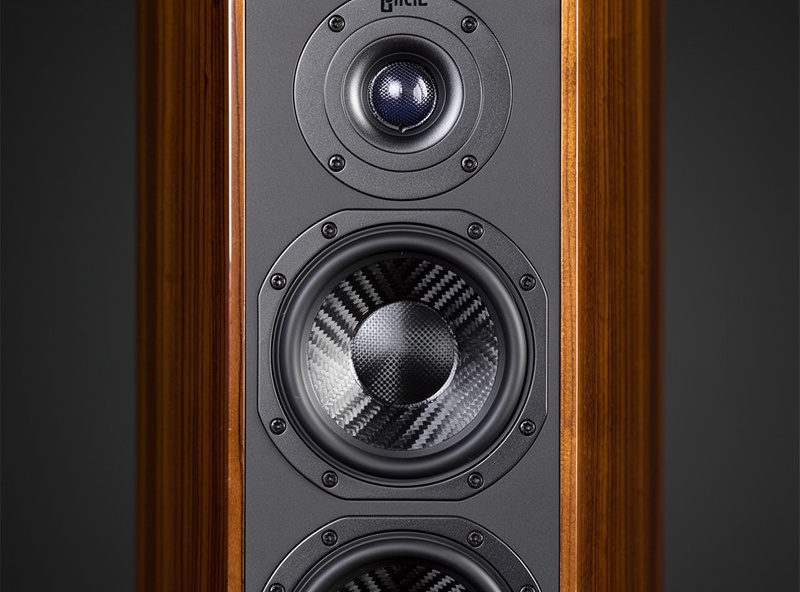
A full three-way design uses a dedicated midrange driver with its own bandpass crossover section, which reduces intermodulation distortion because the midrange cone is not simultaneously trying to reproduce 40 Hz bass fundamentals and 1 kHz vocal harmonics.
The trade-off is cost and complexity. A 2.5-way design keeps the crossover simpler — essentially a two-way crossover plus a low-pass filter for the second woofer — and is easier to get right at a given price point. A full three-way requires more crossover components, more careful driver integration, and a more expensive cabinet with separate internal air volumes for the midrange driver to prevent bass pressure from modulating the midrange cone. At $1,000 per pair, a well-executed 2.5-way design will almost always outperform a cheaply-executed three-way design.
In my listening experience, the audible difference shows up at higher volumes. A 2.5-way speaker with 165mm woofers playing a complex passage — say, a piano concerto with full orchestra — at 90 dB peaks will hold together, but you can hear the midrange hardening slightly as the woofer cone excursion increases at low frequencies while the cone is also reproducing midrange. A good three-way with a dedicated midrange driver (typically 100-130mm) playing the same passage stays cleaner because the midrange cone barely moves — it is not handling anything below 300 Hz. The difference is not night and day, but it is real and repeatable. For most listeners in small to medium rooms at moderate volumes (75-85 dB average), a well-designed 2.5-way is entirely sufficient. If you listen loud and listen to complex, dynamic material, the three-way advantage becomes audible.
Placement Requirements for Floor Standing Speakers
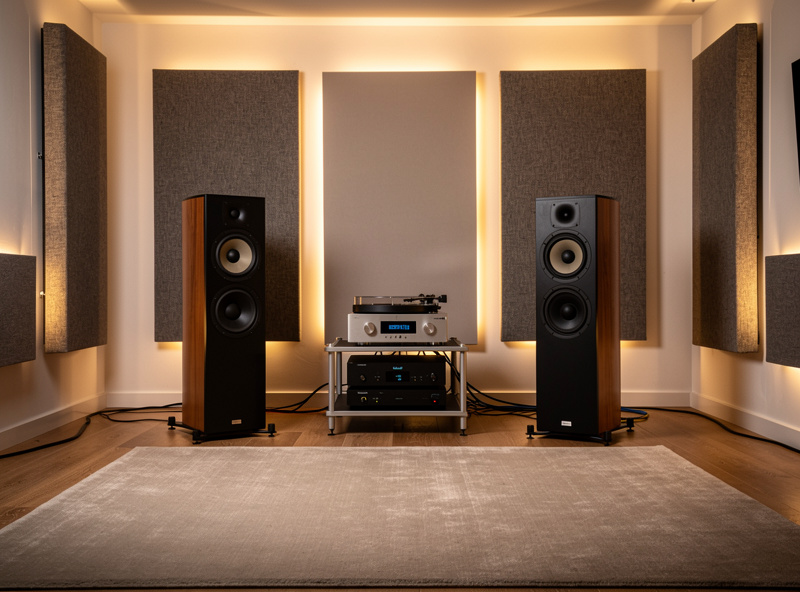
Floor standing speakers need breathing room — I recommend at least 60 centimeters from the front wall and 80 centimeters from side walls to avoid boundary gain (bass boost from nearby surfaces) that makes the sound boomy and obscures midrange detail. The bass alignment of most tower speakers assumes free-space or quarter-space loading; pushing them against a wall increases bass output by 3 to 6 dB below 200 Hz, which sounds impressive for 30 seconds and then becomes oppressive as you realize you cannot hear the bass player’s articulation — just a low-frequency wash.
In my room, pulling the floor standers from 40 centimeters to 80 centimeters from the front wall transformed the bass from a one-note thump to something approaching pitch definition. The measurement confirmed what I heard: the boundary gain at 40 centimeters created a 6 dB shelf below 150 Hz. At 80 centimeters, the shelf reduced to about 2 dB — still present (you cannot eliminate boundary effects in a small room) but no longer dominating the tonal balance. This is the same boundary effect I address in the speaker room acoustics guide, where pulling speakers further into the room is one of the five most impactful setup changes you can make without spending any money.
Floor standers also couple to the floor differently than bookshelf speakers on stands. The larger cabinet footprint and lower driver placement mean the floor bounce (the reflection off the floor between the speaker and the listening position) arrives with a different delay and at a different frequency depending on woofer height. A floor stander with woofers positioned 300-400mm above the floor will have a floor-bounce cancellation in the 300-500 Hz range, right in the lower midrange where body and warmth live. Carpeted floors reduce this; hard floors make it worse. A thick rug between the speakers and the listening position is the simplest fix — it absorbs the floor reflection above roughly 500 Hz and reduces the cancellation depth.
Recommended Floor Standing Speakers Under $1000
These five models represent what I consider the best engineering-per-dollar ratios currently available below $1,000 per pair. I have heard all of them either in my own room or in controlled comparison sessions at a local dealer. None are perfect — perfection does not exist at this price — but each does something genuinely well that makes it worth considering for a particular listener and room.
Dali Oberon 5: A compact 2.5-way with dual 130mm wood-fiber woofers and Dali’s 29mm soft dome tweeter. Sensitivity is 88 dB with a 6-ohm nominal impedance (minimum 4 ohms). The bass extends to a measured 39 Hz (-3 dB) from a slim 830mm tall cabinet — surprisingly deep for its size. The characteristic Dali sound is slightly forward in the presence region, which gives vocals excellent projection but can become fatiguing in bright rooms. In my treated room, they were detailed without being etched. Best for small to medium rooms where cabinet size matters.
Q Acoustics 3050i: A 2.5-way with twin 165mm woofers in a cabinet that is wider and deeper than most at this price point (200mm wide), which pays off in bass extension to a measured 38 Hz (-3 dB). Sensitivity is 91 dB into 6 ohms — easy to drive with modest amplifiers. I spent an afternoon with a pair at a friend’s place and came away impressed by the tonal evenness: nothing stood out, no frequency range called attention to itself. The downside is the cabinet size — they need space, and the MDF is 18mm with minimal bracing, so cabinet coloration is slightly higher than the Dali. Best for medium rooms and listeners who prioritize tonal neutrality.
Elac Debut 2.0 F6.2: A three-way design at a 2.5-way price — dual 165mm woofers, a dedicated 130mm midrange, and a cloth dome tweeter in a 1.02-meter cabinet. Sensitivity is 87 dB at 6 ohms, which means they need a real amplifier — 50 watts minimum, 80-100 watts preferable. The measured -3 dB point is 36 Hz, the deepest in this group. The three-way design shows its advantage on complex material: orchestral climaxes, dense rock mixes, and electronic music with layered bass all stay cleaner than through the 2.5-way competitors. The downside: they are physically large and visually unremarkable. I would describe the finish as “competently adequate.” Best for larger rooms and listeners who prioritize bass extension and driver integration.
Wharfedale Diamond 12.3: A 2.5-way design with Wharfedale’s 25mm textile dome and dual 130mm Klarity cones. Sensitivity is 89 dB, 8 ohms nominal — easy amplifier load. The -3 dB point is around 42 Hz from a relatively compact cabinet. The Diamond 12.3 presents a slightly warmer, more relaxed tonal balance than the Dali or Elac, which makes it forgiving of bright recordings and reflective rooms. The trade-off is a slight softness in the uppermost treble that some listeners will perceive as a lack of air. In my room, with acoustic treatment already in place, I preferred the slightly more incisive Dalis, but in an untreated room the Wharfedale would be the easier speaker to live with. Best for untreated or lively rooms and listeners sensitive to treble forwardness.
Polk Monitor XT70: A 2.5-way with dual 165mm bi-laminate woofers and a 25mm Terylene dome tweeter. Sensitivity is 90 dB, 8 ohms — amplifier-friendly. Measured -3 dB at 38 Hz. The XT70 uses Polk’s power-port bass alignment (a tapered port with a flared exit) which reduces port turbulence noise at high output levels — a real engineering advantage over standard tube ports that chuff audibly when driven hard. The tonal balance is slightly v-shaped — elevated bass and treble with a slightly recessed midrange — which provides an exciting, dynamic presentation at the expense of vocal naturalness. Best for home theater dual-use and listeners who like a lively, punchy presentation.
Floor Standing Speaker Model Comparison Under $1000
| Model | Driver Configuration | Sensitivity | Bass Extension (-3 dB) | Nominal Impedance | Best For |
|---|---|---|---|---|---|
| Dali Oberon 5 | 2.5-way, dual 130mm woofers, 29mm tweeter | 88 dB | 39 Hz | 6 ohms | Small rooms, vocal clarity, compact cabinets |
| Q Acoustics 3050i | 2.5-way, dual 165mm woofers, 22mm tweeter | 91 dB | 38 Hz | 6 ohms | Medium rooms, tonal neutrality, easy amplifier load |
| Elac Debut 2.0 F6.2 | 3-way, dual 165mm woofers, 130mm midrange, tweeter | 87 dB | 36 Hz | 6 ohms | Larger rooms, complex music, deep bass without sub |
| Wharfedale Diamond 12.3 | 2.5-way, dual 130mm woofers, 25mm tweeter | 89 dB | 42 Hz | 8 ohms | Untreated rooms, relaxed listening, forgiving of bright sources |
| Polk Monitor XT70 | 2.5-way, dual 165mm woofers, 25mm tweeter | 90 dB | 38 Hz | 8 ohms | Home theater dual-use, dynamic presentation, high output |
Frequently Asked Questions
Are floor standing speakers worth the extra money over bookshelf speakers?
For dedicated two-channel music listening, yes — if you factor in the cost of quality stands ($150-300), the total investment for bookshelf speakers often approaches floor standing prices. Floor standers provide 15-25 Hz deeper bass extension without the stand cost, plus typically higher sensitivity and greater dynamic headroom from larger cabinet volumes and additional drivers. The bass difference alone is worth the price for most music listeners.
How much amplifier power do floor standing speakers need?
It depends on the speakers’ sensitivity, not their size. A 91 dB floor stander needs less power than an 85 dB bookshelf speaker. For a pair of 88-91 dB floor standers in a medium room, 50-80 watts per channel into 8 ohms is sufficient for clean playback at 85-90 dB average levels with headroom for peaks. Less sensitive models (85-87 dB) benefit from 80-150 watts to avoid amplifier clipping on dynamic material.
Can I use floor standing speakers in a small room?
Yes, but choose compact models with slim cabinets (under 200mm wide) and bass tuning that does not rely on boundary reinforcement. Large floor standers with dual 200mm woofers in a room under 15 square meters will overwhelm the space with bass and never integrate properly. The Dali Oberon 5 or Wharfedale Diamond 12.3 are examples of compact towers that work well in smaller spaces at 80+ centimeters from the front wall.
What is the difference between 2-way, 2.5-way, and 3-way floor standing speakers?
A 2-way has one woofer and one tweeter. A 2.5-way adds a second identical woofer that only reinforces bass below 300-500 Hz, doubling bass output without the complexity of a full three-way crossover. A 3-way uses a dedicated midrange driver (typically 100-130mm) handling 300 Hz to 3 kHz, reducing intermodulation distortion because the midrange cone does not also reproduce deep bass. At $1,000 per pair, a well-executed 2.5-way usually outperforms a cheaply-executed 3-way.
Do I need a subwoofer with floor standing speakers?
Not necessarily. Floor standers with a -3 dB point at or below 40 Hz cover the fundamental of every instrument except pipe organ and synthesizers below 35 Hz. For most acoustic music, jazz, and rock, floor standers with good bass extension to 38 Hz provide satisfying full-range sound without a subwoofer. Electronic music with sub-bass content below 35 Hz, home theater LFE channels, or very large rooms may still benefit from a sub, but for music in small to medium rooms, good towers can stand alone.
Related Articles
- Speaker Room Acoustics Guide: The Complete Overview
- Speaker Sensitivity and Amplifier Matching: Watts, Ohms, and Headroom
- Open Baffle vs Box Speakers: Dipole, Sealed, and Ported Designs Compared
- Best Integrated Amplifiers for Vinyl and Digital
- How to Integrate a Subwoofer for Music: Crossover, Placement, and Phase