How to Integrate a Subwoofer for Music: Crossover, Placement, and Phase
Why a Subwoofer for Music, Not Just Home Theater
A properly integrated subwoofer for music does not add bass — it extends the bass you already have downward by 20 to 40 Hz, filling in the fundamental frequencies of instruments that bookshelf and many floor standing speakers simply cannot reproduce at realistic levels: the 32 Hz low C on a five-string bass guitar, the 27 Hz low A at the bottom of a piano keyboard, and the 41 Hz low E of a standard bass guitar that most bookshelf speakers reproduce at -6 to -10 dB rather than flat. The goal is not more bass but complete bass — hearing every note the musician played rather than guessing at the bottom octave from harmonics. This principle applies whether you are running floor standing speakers under $1000 or compact bookshelf monitors — the physics of driver excursion and cabinet volume do not change with the price point.
The physics makes this necessary. A 165mm woofer in a bookshelf speaker moving ±5mm of linear excursion in a 10-liter sealed cabinet produces roughly 90 dB at 50 Hz at 1 meter — adequate in a small room. At 40 Hz, output drops to 84 dB. At 30 Hz, it is around 75 dB — barely audible above the noise floor of a quiet room. A dedicated subwoofer with a 250-300mm driver in a properly sized cabinet, powered by its own amplifier with 200-500 watts on tap, produces flat output to 25 Hz or below. The subwoofer is not adding character to the bass — it is adding the bass that your main speakers are physically incapable of reproducing.
In my room, adding a sealed 12-inch subwoofer crossed over at 70 Hz to my floor standers transformed recordings I thought I knew. A Telarc recording of the Saint-Saens Organ Symphony (Symphony No. 3) went from “that is a nice string section with some low rumbling somewhere” to “the organist is playing actual notes with pitch in the pedal register.” The 32 Hz pipe fundamental became a distinct musical pitch rather than a vague pressure sensation. This is what a subwoofer is for — not shaking the room during explosions, but revealing the bottom octave of real instruments that your main speakers filter out. After the room treatment I described in the acoustic treatment guide, adding a properly integrated subwoofer was the second biggest upgrade in my system — bigger than any DAC change, bigger than any amplifier swap.
Crossover Frequency and Slope: The Foundation of Subwoofer Integration
The crossover frequency determines the handoff point between your main speakers and the subwoofer — the frequency above which the mains play and below which the sub takes over. For music systems with floor standing speakers that reach 35-45 Hz, I set the crossover between 60 and 80 Hz. With bookshelf speakers that roll off at 50-60 Hz, I start at 80 Hz and sometimes go as high as 100 Hz for small sealed monitors that struggle below 80 Hz. The key principle is crossing over at least half an octave above the main speakers’ -3 dB point so the speakers are still producing clean output as the subwoofer gradually takes over, creating a smooth transition rather than an abrupt handoff with a gap in the middle.
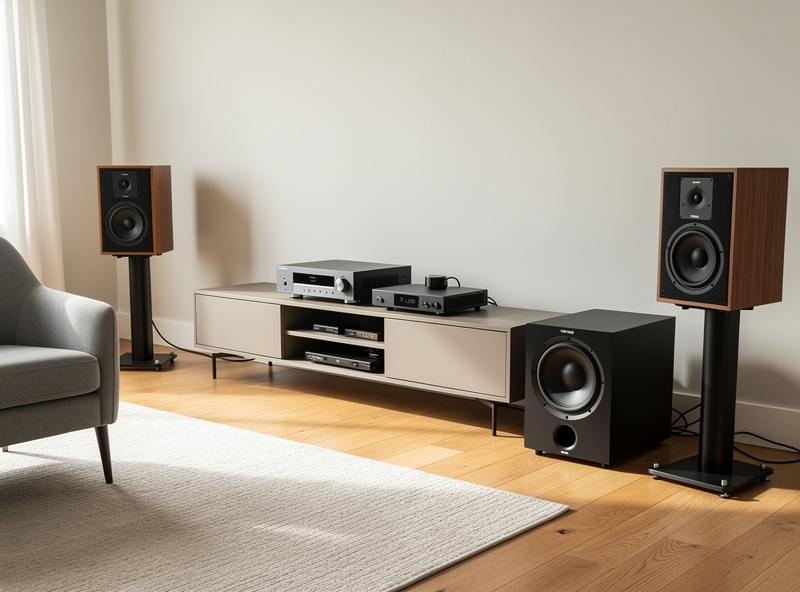
Slope — the rate at which the crossover attenuates signal beyond the crossover frequency, measured in dB per octave — matters as much as the frequency. A 24 dB/octave (fourth-order) Linkwitz-Riley slope is the standard for subwoofer integration because it creates a -6 dB sum at the crossover point when the subwoofer and mains are in phase, producing flat combined output. A 12 dB/octave slope is more forgiving of phase errors but allows more midbass leakage into the sub (which can localize the subwoofer — your ears can hear where the bass is coming from, which ruins the illusion) and more sub-bass leakage into the mains (which increases distortion in the main speakers). Most active subwoofers offer a low-pass filter with 12 or 24 dB/octave slope; use 24 if available, 12 if that is what you have.
In practice, I run my system with the subwoofer’s built-in low-pass filter set to 70 Hz at 24 dB/octave, and I run the main speakers full-range (no high-pass filter). This is not textbook — a textbook implementation would high-pass the mains at the same 70 Hz to relieve them of bass duty — but my integrated amplifier does not have a line-level high-pass output, and the floor standers handle 70 Hz with essentially zero strain. If I were integrating a subwoofer with bookshelf speakers that compress audibly below 80 Hz, I would use a subwoofer with speaker-level high-pass outputs (or an external active crossover like the MiniDSP 2×4 HD) to filter the bass from the mains. Removing sub-bass from the main speakers reduces their distortion dramatically — intermodulation distortion products drop by 6 to 12 dB when you relieve a small woofer from reproducing 40 Hz fundamentals simultaneously with 1 kHz midrange.
Subwoofer Placement: The Sub Crawl Technique That Works
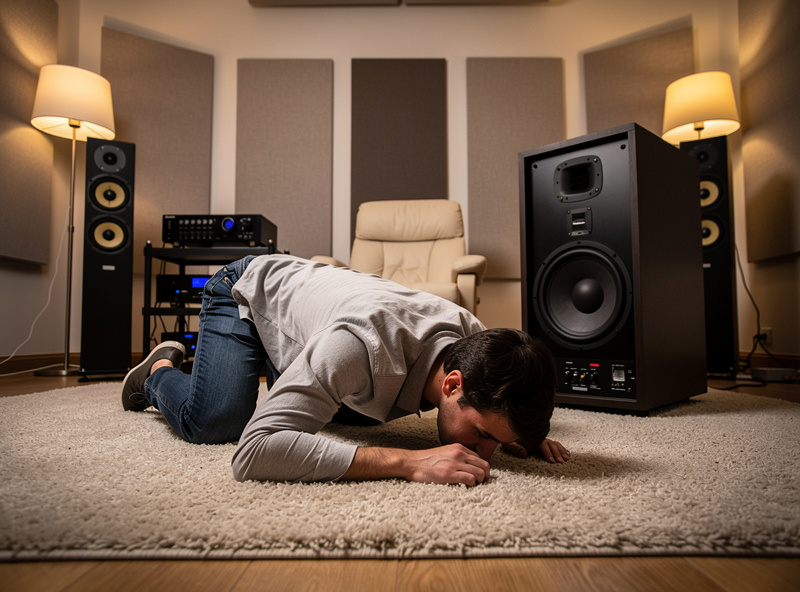
The sub crawl is the most reliable method for finding the best subwoofer position in your room without measurement equipment. Place the subwoofer at your listening position (yes, on your chair), play a bass-heavy track with consistent low-frequency content — a track with a repetitive bass line, not a frequency sweep — and crawl around the room listening for the position where the bass sounds most even and articulate, not just loudest. Wherever your head is when the bass sounds best: that is where the subwoofer goes. The physics works because low-frequency room modes are reciprocal — the transfer function from point A to point B is identical to the transfer function from B to A.
In my room, the sub crawl revealed that the front right corner — the intuitive choice based on “put it in a corner for more bass” — produced a massive 50 Hz peak that made every bass note sound like the same note. The position that worked was 1.2 meters from the front wall along the right side wall, roughly one-third of the room width from the corner. At that position, the first three axial room modes were excited roughly equally, producing a relatively flat in-room response from 30 to 80 Hz. A MiniDSP UMIK-1 and Room EQ Wizard measurement later confirmed what my ears told me during the crawl: ±4 dB from 30 to 80 Hz without any EQ applied. In a small, untreated room, that is about as good as it gets. If you have not yet set up REW, the REW room measurement software guide covers mic calibration, sweep setup, and waterfall interpretation from the ground up.
A few practical notes about the sub crawl: use a track you know intimately, not a test signal. I use the opening bass line from Daft Punk’s “Something About Us” — simple, repetitive, covers a three-octave range, and I know what it should sound like on headphones and near-field monitors. Avoid tracks with heavily compressed or synthesized bass where the fundamental is buried in harmonics — you are listening for evenness of low-frequency fundamentals, not overall bass quantity.
Phase Adjustment: Getting the Subwoofer to Play in Time
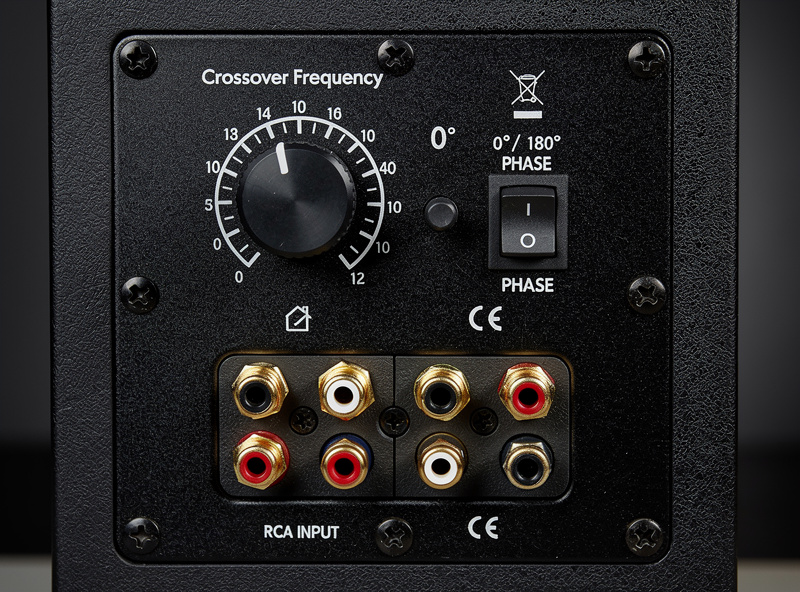
Phase adjustment ensures that at the crossover frequency, the subwoofer and main speakers’ outputs arrive at the listening position in phase — their waveforms add constructively rather than partially cancelling, which would create a dip in the frequency response right at the crossover point where both are contributing significant output. A continuous phase knob (0 to 180 degrees) lets you dial this in by ear; a two-position switch (0 or 180) forces a compromise that is often close enough but rarely optimal. The most reliable method without measurement equipment is playing a mono sine wave at the crossover frequency — 70 Hz if your crossover is set at 70 Hz — and adjusting phase for the loudest output at the listening position. When the subwoofer and mains are perfectly in phase, they sum to the highest SPL at the crossover frequency.
Phase is an acoustic parameter, not just an electronic one. The subwoofer’s electronic low-pass filter introduces phase shift — 90 degrees per order of the filter at the crossover frequency. Physical distance between the subwoofer and the main speakers introduces additional phase shift proportional to the path length difference divided by the wavelength at the crossover frequency. At 80 Hz, the wavelength is about 4.3 meters. If your subwoofer is 1 meter closer to you than the main speakers, it arrives about 2.9 milliseconds earlier, which is roughly 84 degrees of phase lead at 80 Hz. The phase knob compensates for this combined electronic-plus-acoustic phase difference.
In my system, with the subwoofer positioned about 40 centimeters closer to the listening position than the main speakers, the optimal phase setting ended up around 45 degrees — not 0, not 180, but somewhere in between. A two-position switch would have forced me to choose between a 4 dB dip at 70 Hz (0 degrees) and a 3 dB peak (180 degrees), neither of which is ideal. A continuous phase knob or a DSP-based delay adjustment (which most modern subwoofers from SVS, RSL, and HSU include) lets you hit the exact value where the sum is maximally flat.
Sealed vs Ported Subwoofers for Music: The Real Differences
Sealed subwoofers produce cleaner, faster-sounding bass with lower group delay and gentler roll-off below the system resonance, making them the preferred choice for music where transient accuracy and pitch definition matter more than maximum output at 20 Hz.
Group delay is the technical term for what audiophiles describe subjectively as “fast bass” or “slow bass.” It measures the time delay between the electrical input signal and the acoustic output, as a function of frequency. A ported subwoofer’s port output lags behind the driver output by a full cycle (360 degrees) at the tuning frequency, which means a 30 Hz fundamental arrives roughly 33 milliseconds later than the harmonics at 120 Hz and above. Your brain processes this as a slight disconnect between the leading edge (the stick hitting the kick drum head, which is mostly harmonics above 100 Hz) and the body of the note (the 30-50 Hz fundamental). Sealed subwoofers, with no port output lag, maintain much tighter time alignment between harmonics and fundamental. The difference is subtle — measurable more than casually audible — but in a system I listen to critically, I notice it on acoustic bass and kick drum where the transient attack and body need to feel like one event, not two.
That said, ported subwoofers have improved dramatically in the last decade. The RSL Speedwoofer 10S MkII ($449) and SVS SB-1000 Pro and PB-1000 Pro ($499-$799) use DSP to flatten group delay and control driver excursion below tuning. A modern ported subwoofer with competent DSP is not the boomy one-note device that gave ported subs their bad reputation in the 1990s. For a music-first system, I still lean sealed — the physical simplicity of the alignment means fewer variables to control, and the transient behavior is inherently cleaner. For a dual-use music-and-movies system, a ported sub makes more sense because the 20-25 Hz extension matters for LFE effects.
Dual Subwoofers: Why Two Can Be Better Than One
Dual subwoofers, when properly positioned and phase-aligned, reduce seat-to-seat bass variation by 30 to 50 percent because the two sources excite room modes differently and their combined output smooths the in-room response. One subwoofer in a rectangular room will always create a pattern of peaks and nulls where standing waves constructively and destructively interfere — move your listening chair 50 centimeters and the bass changes completely. Two subwoofers placed asymmetrically (for example, one front center and one rear center, or midpoint of opposing side walls) excite a different set of room modes for each sub, and the superposition at the listening position is flatter than either subwoofer alone.
The practical benefit is not just more even bass across multiple seats — in a music system with a single listening position, it is still useful because it reduces the reliance on finding the one perfect position during the sub crawl. With one subwoofer, my best position was a specific spot 1.2 meters from the front wall along the right side wall — accurate to within 10 centimeters. With two smaller subwoofers placed at the midpoints of opposite side walls, the response was ±3 dB from 28 to 80 Hz across a listening area roughly a meter wide, meaning I could lean left or right in my chair without the bass balance shifting. The improvement was convenience and robustness more than a dramatic change in sound quality at the sweet spot.
I will be the first to admit: dual subwoofers are a luxury, not a necessity. A single well-placed subwoofer with careful crossover and phase adjustment provides 90 percent of the benefit for one-tenth the complexity and half the cost. Only go dual if you have already exhausted single-sub optimization (sub crawl, phase adjustment, and ideally some parametric EQ to trim peaks) and you still have objectionable seat-to-seat variation or a null at the listening position that you cannot position your way out of. In my room, a single subwoofer works well enough that I have not bought a second one. The marginal improvement is real but small, and I would rather spend the money on more acoustic treatment or a better phono cartridge.
Gain Matching: Balancing the Subwoofer With Your Main Speakers
Gain matching means setting the subwoofer’s volume so the perceived bass level is continuous from the main speakers through the crossover region and down into the sub-bass — the transition should be inaudible. This is harder than it sounds because human hearing sensitivity drops sharply below 100 Hz: a 40 Hz tone needs to be roughly 10 dB louder than a 1 kHz tone to sound equally loud at moderate listening levels (per the equal-loudness contours defined in ISO 226:2003). Your ear is the calibration instrument, and it is unreliable in the bass. Objective measurement — a UMIK-1 and REW — is far more accurate than guessing.
Without measurement equipment, here is the best ear-based method: play pink noise through your system with the subwoofer off. Listen to the tonal balance. Turn the subwoofer on with the gain at minimum and slowly increase it until you just start to hear the subwoofer’s contribution — then back it down 2-3 dB. At that point, the subwoofer should be essentially invisible on most music, filling in the bottom octave without calling attention to itself. Then play a track with strong, consistent bass content — the Daft Punk track I mentioned earlier works — and listen for evenness across different bass notes. If you hear a single note that booms louder than the others, your gain is likely too high and you are exciting a room mode. If the bass is uniformly weak, your gain is too low.
I use a calibrated microphone and REW to set my subwoofer gain. My target is a flat in-room response from 30 to 200 Hz (allowing for room modes below 100 Hz, which I can only partially control) with a gentle 3-5 dB rise below 50 Hz — a house curve, in other words. The slight bass rise sounds more natural to my ears at the moderate listening levels I use (75-80 dB average) because of the ear’s reduced sensitivity to low frequencies at low SPL. At higher playback levels (above 85 dB average), the ear’s bass sensitivity increases and the house curve becomes unnecessary — flat measured response starts to sound flat subjectively. I set the gain once, measured it, and have not touched the knob in two years. If you are wondering whether your amplifier can handle the subwoofer’s demands alongside your main speakers, the speaker sensitivity and amplifier matching article covers power calculations for full-range systems including subs.
Sealed vs Ported Subwoofer Comparison
| Characteristic | Sealed Subwoofer | Ported Subwoofer |
|---|---|---|
| Bass extension (-3 dB) | 28-35 Hz (12-inch driver) | 18-25 Hz (12-inch driver) |
| Group delay at tuning | 10-15 ms | 30-50 ms |
| Roll-off below tuning | 12 dB/octave (gradual) | 24 dB/octave (steep) |
| Transient accuracy | Excellent — clean attack and decay | Good to very good (modern DSP-assisted) |
| Cabinet size (12-inch) | 35-60 liters | 60-100 liters |
| Max output at 20 Hz | Lower — excursion-limited below F3 | Higher — port reinforces driver output |
| Best for music | Critical music listening — transient accuracy over extension | Dual-use music/HT — wants deeper extension |
| Amplifier power needed | Higher — no port reinforcement | Lower — port provides acoustic gain at tuning |
Frequently Asked Questions
What crossover frequency should I use for music?
Set the crossover at 60-80 Hz for floor standing speakers that reach 35-45 Hz, and 80-100 Hz for bookshelf speakers that roll off at 50-60 Hz. Cross over at least half an octave above your main speakers’ -3 dB point so both the subwoofer and mains are contributing during the transition, ensuring a smooth handoff rather than a gap or abrupt jump. Use a 24 dB/octave slope if available for cleanest integration.
Is one subwoofer enough for music, or do I need two?
One well-placed subwoofer with careful crossover and phase alignment provides 90% of the benefit of dual subwoofers for a single listening position. Dual subwoofers reduce seat-to-seat variation (useful for multiple listeners) and can fill in a null that cannot be resolved by moving a single sub, but for one dedicated chair, the improvement is marginal. Optimize with one before buying a second.
Can I use a home theater subwoofer for music?
Yes, but sealed subwoofers generally outperform ported designs for critical music listening due to 10-15 ms lower group delay, resulting in tighter, more articulate bass transients on kick drum and plucked double bass. Modern ported subwoofers with DSP (like the SVS PB-1000 Pro or RSL Speedwoofer 10S MkII) can be tuned for excellent music performance, so the gap has narrowed significantly in the last decade.
How do I prevent my subwoofer from sounding boomy?
Boominess comes from three sources: incorrect placement, excessive gain, or an untreated room mode. Move the subwoofer using the sub crawl method to find the most even-sounding position. Reduce gain until the subwoofer is just audible and then back it down 2 dB. Apply parametric EQ to reduce the dominant room mode peak (the frequency that rings longest). Corner placement maximizes boom — try pulling the sub out 60-100 cm from the corner.
Does adding a subwoofer improve soundstage and imaging?
Indirectly, yes. A subwoofer relieves your main speakers from reproducing deep bass, which reduces intermodulation distortion in the midrange — the woofer cone is no longer trying to reproduce 40 Hz fundamentals and 1 kHz harmonics simultaneously. The cleaner midrange that results improves imaging precision and soundstage depth, especially on complex material with both deep bass and delicate upper-frequency content like orchestral music or well-recorded jazz.
Related Articles
- Speaker Room Acoustics Guide: The Complete Overview
- Best Floor Standing Speakers Under $1000 for Music Listening
- Speaker Sensitivity and Amplifier Matching: Watts, Ohms, and Headroom
- Room Acoustics Treatment: Absorbers, Diffusers, and Bass Traps That Work
- Powered vs Passive Speakers: Which Setup Is Right for You