Over Ear vs On Ear vs In Ear Headphones: Which Type for You?
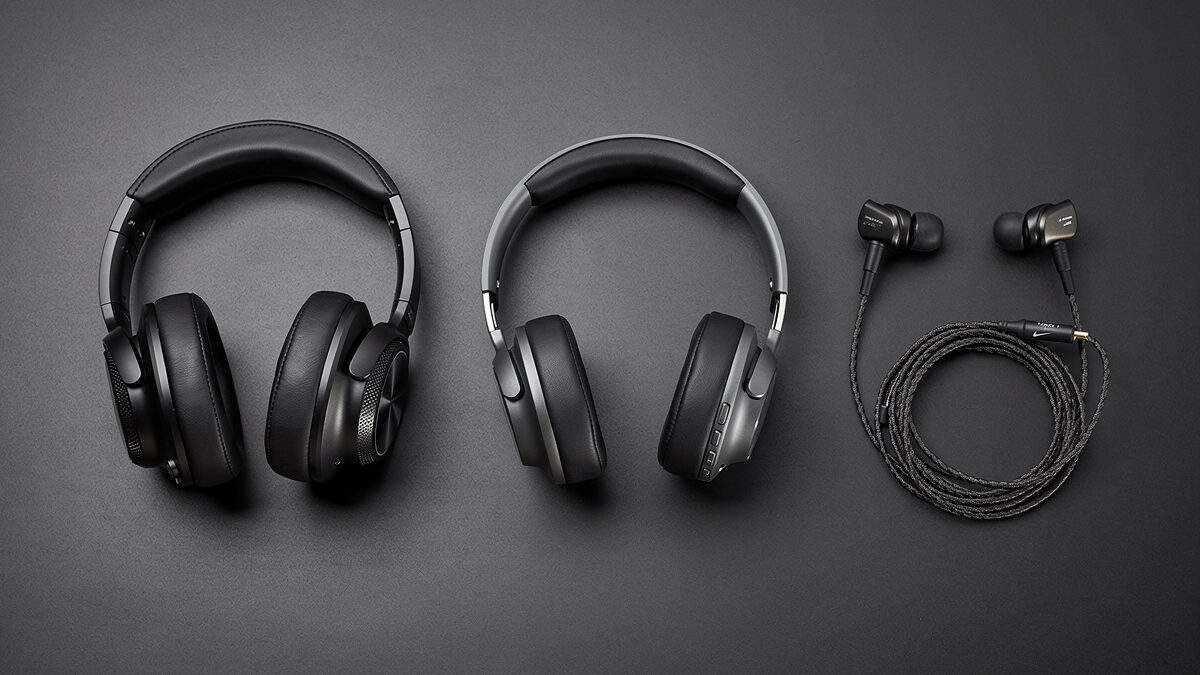
The choice between over-ear, on-ear, and in-ear headphones depends on your primary use case, comfort requirements, and isolation needs. Over-ear headphones deliver the widest soundstage and best bass extension. On-ear models balance portability with sound quality. In-ear monitors provide maximum isolation and the most compact form factor for daily carry.
Each wearing style creates a fundamentally different acoustic relationship between the driver and your ear. Over-ear cups create a sealed or vented chamber around the entire pinna, on-ear pads press directly against the outer ear, and IEMs bypass the outer ear entirely by coupling directly to the ear canal. These differences affect frequency response, soundstage perception, comfort over time, and practical use cases in ways that go far beyond simple convenience.
Over-Ear Headphones: Soundstage and Comfort Leaders
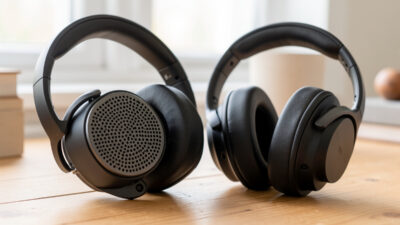
Over-ear headphones surround the entire ear with a circumaural pad, creating the widest soundstage of any headphone type. Open-back over-ears produce soundstage width comparable to nearfield speakers. Closed-back over-ears trade staging for 15-25 dB passive isolation. Both types distribute weight across a wider contact area, enabling 4-6 hour listening sessions without pressure points.
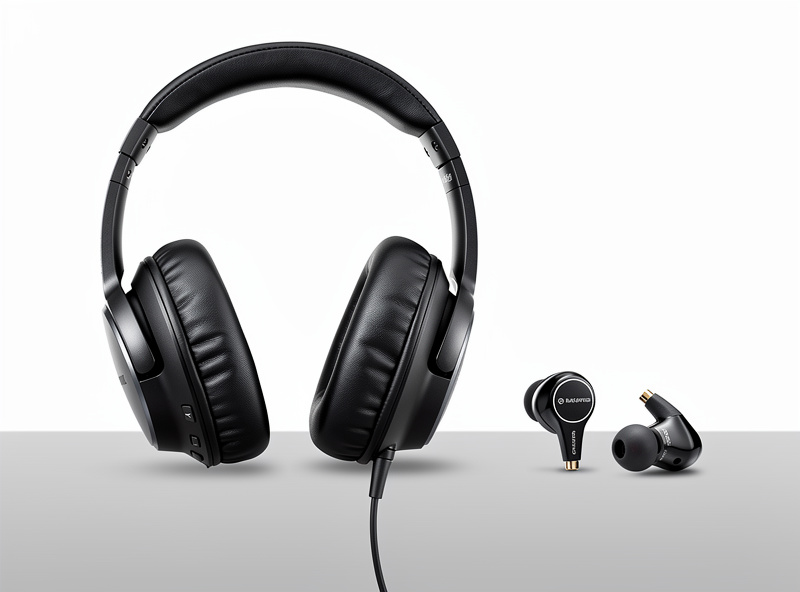
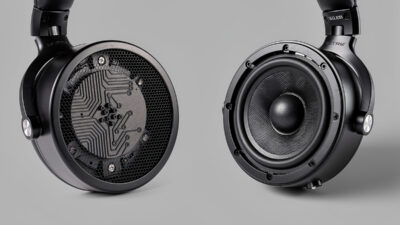
The circumaural design allows the driver to interact with your ear’s natural shape, including the concha and pinna folds that contribute to spatial perception. Open-back models like the Sennheiser HD 600 and HIFIMAN Sundara vent sound through perforated grilles, allowing the driver to behave more like a miniature speaker in free space. This produces soundstage depth and width that on-ear and in-ear designs cannot replicate, with instrument separation across a perceived stage extending beyond the head.
Over-ear pads come in three primary materials: protein leather (pleather), velour, and hybrid. Protein leather seals best, adding 3-5 dB of isolation versus velour but trapping more heat. Velour pads breathe better and feel softer against skin, reducing heat buildup by approximately 30%. Hybrid pads use leather on the sealing surface and velour on the outer ring, combining isolation with breathability. The closed-back headphone guide covers pad materials in more detail.
Weight ranges from 230 grams (AKG K371) to 700 grams (Audeze LCD-4). Headphones exceeding 400 grams benefit from suspended headband designs that distribute weight across the crown rather than creating a single pressure line. The HIFIMAN Ananda at 395 grams uses a self-adjusting headband that eliminates the need for manual sizing, reducing setup time and improving weight distribution.
On-Ear Headphones: Compact and Portable
On-ear headphones rest pads directly against the outer ear without enclosing it. This reduces size and weight by 30-50% compared to over-ear models but limits isolation to 5-15 dB and compresses soundstage. On-ear designs work best for listeners who prioritize portability and quick on/off convenience over maximum sound quality.

The smaller cup size of on-ear headphones means smaller drivers — typically 30-40mm versus 40-53mm in over-ear models. Smaller drivers generally produce less sub-bass extension, rolling off below 60 Hz in most on-ear designs. Exception: the Grado SR80x and SR325x use 44mm drivers in open-back on-ear cups that achieve surprisingly deep bass due to the vented design allowing unrestricted air movement.
Clamp force is higher in on-ear designs because the pads must seal against the curved surface of the ear rather than the flat area around it. Average clamp force for on-ear models is 4.5-5.5 Newtons, compared to 3.5-4.5N for over-ears. This higher pressure improves isolation and bass response but limits comfortable wearing time to 2-3 hours for most listeners.
On-ear headphones excel as grab-and-go options for commuting, walking, and casual listening. The Koss Porta Pro at 60 grams and the Koss KPH30i at 70 grams are legendary for their sound-to-weight ratio. The Grado SR60x at 170 grams delivers audiophile-grade open-back sound in a form factor small enough for jacket pockets. For closed on-ear isolation, the Beats Solo 4 at 240 grams provides effective ANC in a compact package.
In-Ear Monitors: Maximum Isolation in Minimum Size
IEMs insert directly into the ear canal, achieving 25-35 dB passive isolation with foam tips and 20-28 dB with silicone tips. Modern IEMs use single dynamic drivers, multiple balanced armatures, planar magnetic micro-drivers, or hybrid configurations with frequency response extending from 8 Hz to 40 kHz. They weigh 15-30 grams and fit in a pocket case.
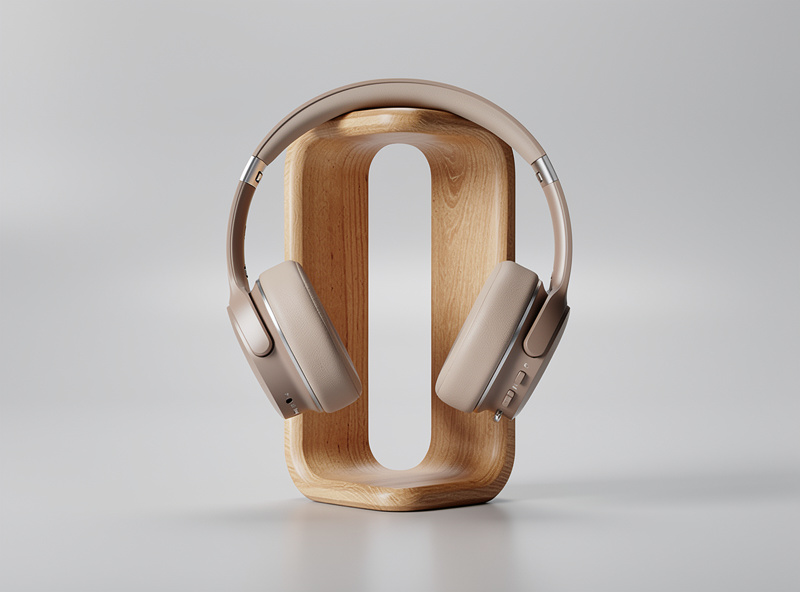
The IEM market in 2026 offers the widest range of any headphone category. Budget options like the Moondrop Chu II ($20) and 7Hz Salnotes Zero ($15) deliver sound quality that embarrasses $100 over-ear headphones from five years ago. Mid-range models like the Moondrop Blessing 3 ($270) and Truthear Hexa ($80) use multi-driver crossovers to divide frequency bands across specialized drivers.
High-end IEMs use 4-18 balanced armature drivers per side, with dedicated drivers for sub-bass, mid-bass, lower midrange, upper midrange, lower treble, and upper treble. The 64 Audio U18t ($2,400) uses 18 balanced armature drivers with a patented tia tube for the tweeter, achieving 20 Hz-20 kHz response with under 0.3% THD. The Empire Ears Odin ($3,500) combines balanced armatures, dynamic drivers, and electrostatic tweeters in a tribrid configuration.
IEM soundstage is inherently narrower than over-ear headphones because the sound originates inside the ear canal rather than from a distance. However, multi-driver IEMs with proper phase alignment create imaging precision that rivals over-ear models. The key is shell fit — custom-molded IEMs or well-fitting universals that maintain consistent canal seal produce the most accurate staging and bass response. The headphone buying guide covers IEM fitting in detail.
Sound Quality Comparison at Each Price Point
At every price tier, over-ear headphones deliver the widest soundstage, deepest bass extension, and most natural tonality. IEMs offer the best isolation and detail retrieval per dollar. On-ear models compete primarily on portability and convenience rather than pure sound quality. Understanding these tradeoffs prevents disappointment when switching between wearing styles.
At the $50-100 level, over-ear headphones like the AKG K361 ($75) and Samson SR850 ($50) outperform IEMs in staging and bass body. However, the Moondrop Chu II ($20) and 7Hz Salnotes Zero ($15) rival the K361 in midrange clarity and treble detail while providing 25 dB of isolation. On-ear options like the Koss Porta Pro ($35) offer a uniquely engaging warm signature but cannot match either in technical precision.
At $200-300, the playing field levels. The HIFIMAN Sundara ($230) planar magnetic over-ear offers bass speed and extension that no IEM at the price matches. The Moondrop Blessing 3 ($270) multi-driver IEM provides treble extension and micro-detail that the Sundara cannot touch. The Grado SR325x ($295) on-ear delivers the most aggressive, exciting presentation of the three. Genre preference determines the winner: jazz and classical favor the Sundara, electronic and pop favor the Blessing 3, rock and punk favor the Grado.
Above $500, over-ear headphones pull ahead in absolute sound quality due to larger driver surface area and acoustic design space. The Focal Clear MG ($1,300) over-ear delivers a level of dynamic impact, staging depth, and timbral accuracy that no IEM or on-ear model matches regardless of price. However, high-end IEMs like the 64 Audio U18t ($2,400) outperform in noise isolation and portable convenience, making them the better choice for travel and commuting.
Use Case Matching: Which Type for Which Situation
Home critical listening favors open-back over-ear headphones for maximum soundstage and natural presentation. Office and commuting require closed-back over-ear or IEM isolation. Gym and active use demands IEMs with secure fit and sweat resistance. Casual walking and social settings suit on-ear headphones for quick on/off convenience and awareness of surroundings.
Studio monitoring requires closed-back over-ear headphones with flat frequency response and high isolation to prevent bleed into microphones. The Audio-Technica ATH-M50x and Beyerdynamic DT 700 Pro X are industry standards for tracking and mixing. For mastering, open-back over-ears like the Sennheiser HD 600 provide more natural tonality and wider staging for evaluating the final mix.
Gaming headsets fall primarily into the closed-back over-ear category with boom microphones. However, audiophile gamers increasingly use dedicated IEMs like the Moondrop Blessing 3 with a separate USB microphone for superior sound quality. The IEM’s passive isolation blocks keyboard and environmental noise better than most gaming headset ANC implementations.
For podcast and audiobook listening, any comfortable headphone works, but over-ear models with warm signatures like the Meze 99 Classics reduce vocal sibilance and fatigue during extended narration sessions. The best headphone amps under $300 pair well with mid-tier over-ear and on-ear models to maximize vocal clarity.
Comparison Table: Over-Ear vs On-Ear vs In-Ear
| Attribute | Over-Ear | On-Ear | In-Ear (IEM) |
|---|---|---|---|
| Driver Size | 40-100mm | 30-44mm | 5-15mm (DD), 2-8mm (BA) |
| Weight Range | 230-700g | 60-350g | 15-30g |
| Passive Isolation | 15-25 dB (closed) / 0 dB (open) | 5-15 dB | 20-35 dB |
| Soundstage | Wide (open), moderate (closed) | Narrow to moderate | Narrow, in-head |
| Bass Extension | Flat to 20 Hz (planar) | Rolls off below 60-80 Hz | Flat to 8-20 Hz (multi-driver) |
| Comfort Duration | 4-6 hours | 2-3 hours | 3-5 hours |
| Portability | Low to moderate | High | Maximum |
| Entry Price | $30 | $15 | $8 |
| Best Use | Home, studio | Commute, casual | Gym, travel, stage |
| Amplification Need | Often required (150+ ohms) | Rarely needed | Rarely needed |
Which headphone type sounds the best?
Over-ear headphones generally deliver the widest soundstage, deepest bass extension, and most natural tonality due to larger driver surface area and acoustic design space. However, multi-driver IEMs can match or exceed over-ear treble detail and isolation at comparable price points.
Are in-ear monitors better than earbuds?
Yes. IEMs seal the ear canal for 25-35 dB passive isolation and use precision-tuned drivers with crossover networks. Standard earbuds sit outside the canal, providing minimal isolation and inconsistent bass response due to poor seal. Modern budget IEMs at $20-50 outperform $200 earbuds in every measurable category.
Can on-ear headphones be comfortable for long sessions?
On-ear comfort depends on clamp force and pad material. Models with 3.5-4.0N clamp force and plush velour pads like the Grado SR80x remain comfortable for 3-4 hours. Most on-ear headphones at 4.5-5.5N clamp force cause discomfort after 2 hours due to direct pressure on the outer ear cartilage.
What headphone type is best for working out?
In-ear monitors with secure-fit ear hooks or over-ear loops are best for exercise. They provide 20-35 dB isolation from gym noise, weigh under 25 grams, and resist sweat when using proper tips. Models like the Shure SE215 and Moondrop Aria 2 offer sport-ready durability with audiophile sound quality.
Do over-ear headphones sound better than IEMs at the same price?
Not necessarily. Over-ear headphones excel in soundstage and bass body while IEMs often provide better isolation and treble extension. At $250, a HIFIMAN Sundara over-ear and Moondrop Blessing 3 IEM each outperform the other in different aspects. The better choice depends on your listening environment and genre preferences.
Which headphone type blocks the most noise?
In-ear monitors with foam tips block the most passive noise at 25-35 dB, exceeding closed-back over-ear headphones (15-25 dB) and on-ear models (5-15 dB). For active noise cancellation, over-ear ANC headphones like the Sony WH-1000XM5 achieve 30-40 dB combined isolation across all frequencies including sub-bass.
Related Articles
- Headphone Buying Guide 2026: Types, Sound Signatures, and Top Picks
- Best Closed-Back Headphones 2026: Noise Isolation for Focused Listening
- Planar Magnetic vs Dynamic Driver Headphones: Sound Differences Explained
- Best Open-Back Headphones for Home Listening
- How to Match Headphone Impedance with Your Source