Planar Magnetic vs Dynamic Driver Headphones: Sound Differences
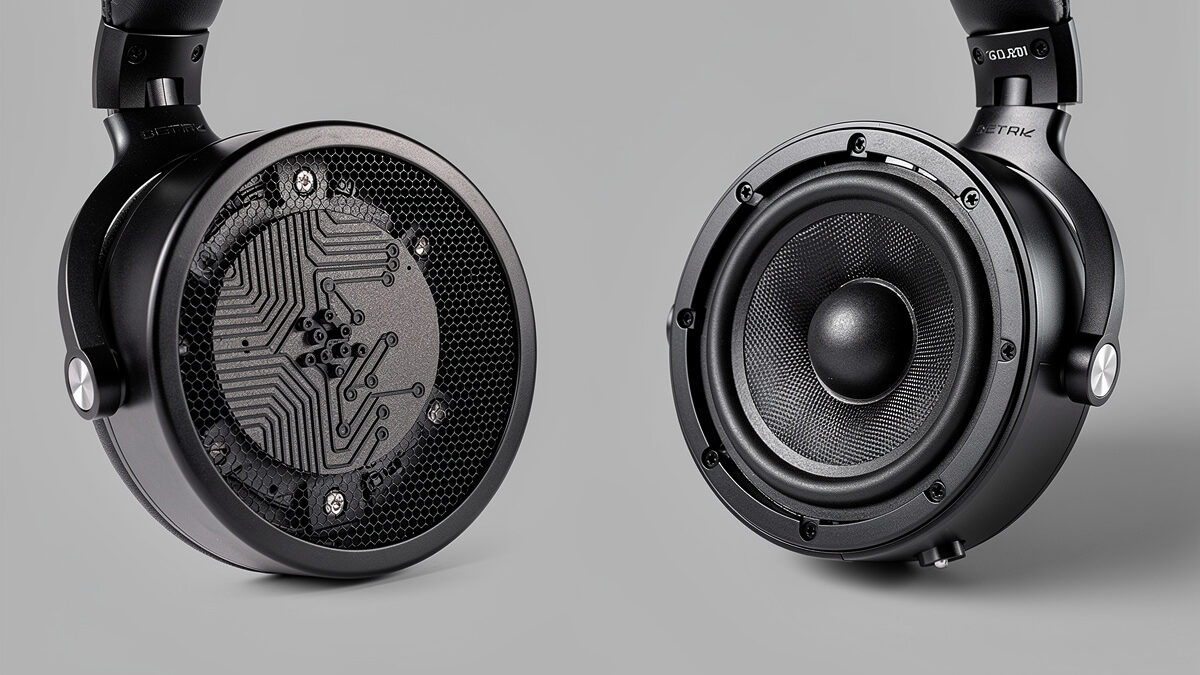
Planar magnetic headphones produce sound by vibrating a flat, ultra-thin diaphragm embedded with conductors between two magnet arrays, while dynamic drivers use a voice coil attached to a cone-shaped diaphragm that pistons in a magnetic gap. Planar designs deliver faster transient response and lower distortion below 500 Hz, but dynamic drivers offer higher efficiency and punchier bass character.
The choice between planar magnetic and dynamic driver headphones comes down to technical priorities and listening preferences. Planar technology excels in bass extension, transient speed, and distortion metrics. Dynamic technology delivers more visceral slam, wider compatibility with portable sources, and a more forgiving presentation with compressed recordings. Both have matured to the point where either technology can satisfy audiophiles at every price tier from $130 to $5,000.
How Dynamic Drivers Produce Sound
Dynamic drivers use a voice coil attached to a circular diaphragm, suspended in the gap of a permanent magnet. When electrical current flows through the voice coil, the resulting electromagnetic field interacts with the permanent magnet, pushing and pulling the diaphragm. This pistoning motion from the center outward creates pressure waves that reproduce sound.
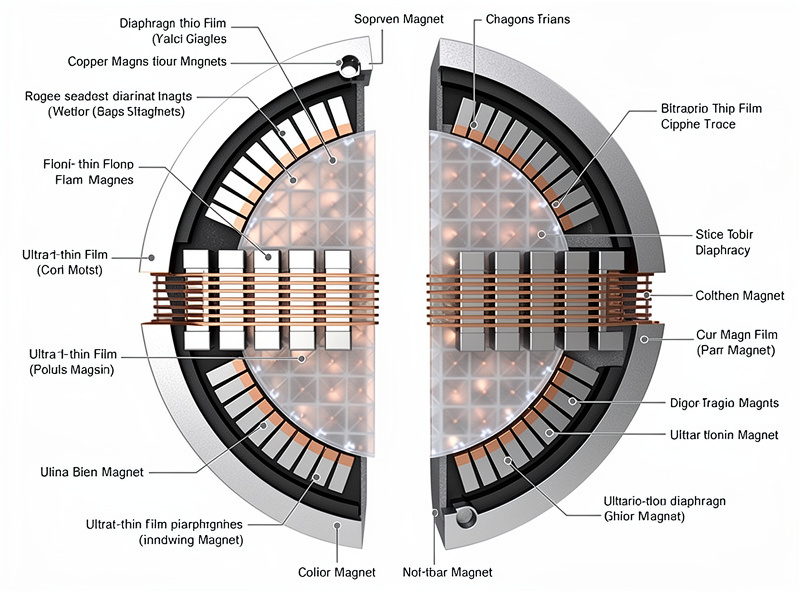
The dynamic driver’s strength lies in its efficiency and transient impact. A 40mm dynamic driver in the Sennheiser HD 600 produces 97 dB/mW, requiring minimal power to reach satisfying volume. The pistoning motion naturally emphasizes the initial transient of each note, creating the “slam” and “punch” that dynamic driver enthusiasts describe. This physical impact is strongest in the 60-200 Hz range where bass drum hits and bass guitar plucks require rapid diaphragm acceleration.
Dynamic driver limitations emerge at higher frequencies and volumes. As frequency increases, the diaphragm must move faster, and the pistoning motion breaks down into breakup modes above 2-5 kHz depending on diaphragm material and diameter. These breakup modes cause frequency response irregularities — peaks and dips of 3-6 dB that color the sound. Larger diaphragms break up at lower frequencies, which is why 53mm drivers often sound less refined in the treble than 40mm drivers.
Diaphragm material significantly affects dynamic driver behavior. Paper and biocellulose diaphragms (used in Fostex and ZMF headphones) produce warm, rich harmonic distortion that many listeners find pleasing. Beryllium-coated diaphragms (Focal) resist breakup to higher frequencies, delivering cleaner treble. Titanium and PET film diaphragms offer stiff, lightweight performance but can sound metallic if not carefully damped. The headphone buying guide covers driver materials in context of overall sound signature.
How Planar Magnetic Drivers Produce Sound
Planar magnetic drivers suspend a flat diaphragm — typically 1-2 microns thick — between two arrays of permanent magnets. Conductive traces printed or embedded on the diaphragm carry the audio signal, creating electromagnetic force across the entire diaphragm surface simultaneously. The entire membrane moves uniformly rather than pistoning from the center.
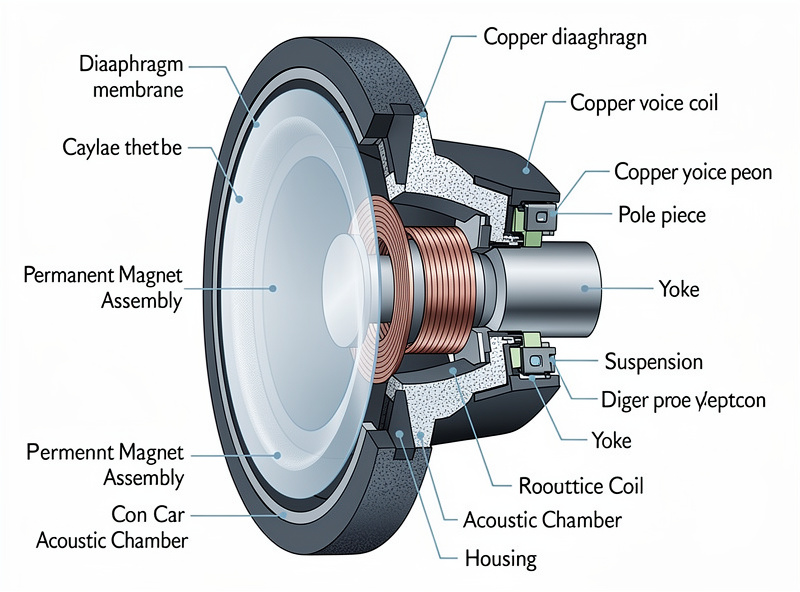
This uniform movement eliminates breakup modes entirely. Because every point on the diaphragm moves in phase at all frequencies, planar drivers produce flat frequency response from 10 Hz to beyond 40 kHz without the irregularities that affect dynamic drivers. The HIFIMAN Sundara measures under 0.5% THD from 20 Hz to 1 kHz at 94 dB SPL, while the Sennheiser HD 600 measures approximately 1.0% THD in the same range.
Planar magnetic bass response extends deeper and stays flatter than dynamic driver bass. The large diaphragm surface area (typically 50-75mm effective diameter) moves more air at low frequencies with less excursion required, producing sub-bass at 20 Hz with under 0.1% distortion. Dynamic drivers must push the diaphragm further to produce equivalent sub-bass levels, increasing distortion and compression at high volumes.
The tradeoff is efficiency. Planar magnetic headphones typically measure 90-95 dB/mW sensitivity, requiring 5-10 times more power than equivalent dynamic drivers to reach the same volume. The HIFIMAN Sundara at 37 ohms and 94 dB/mW needs approximately 25 milliwatts for 110 dB SPL, while the Sennheiser HD 600 at 300 ohms and 97 dB/mW needs only 10 milliwatts. Most planar headphones require a dedicated headphone amplifier for optimal performance.
Bass Response: Speed vs Slam
Planar bass is fast, flat, and extended. Dynamic bass is punchy, warm, and impactful. Planar headphones produce bass with lower distortion and faster decay, while dynamic headphones emphasize the initial transient slam that gives bass its physical sensation. Genre preference determines which approach is preferable.
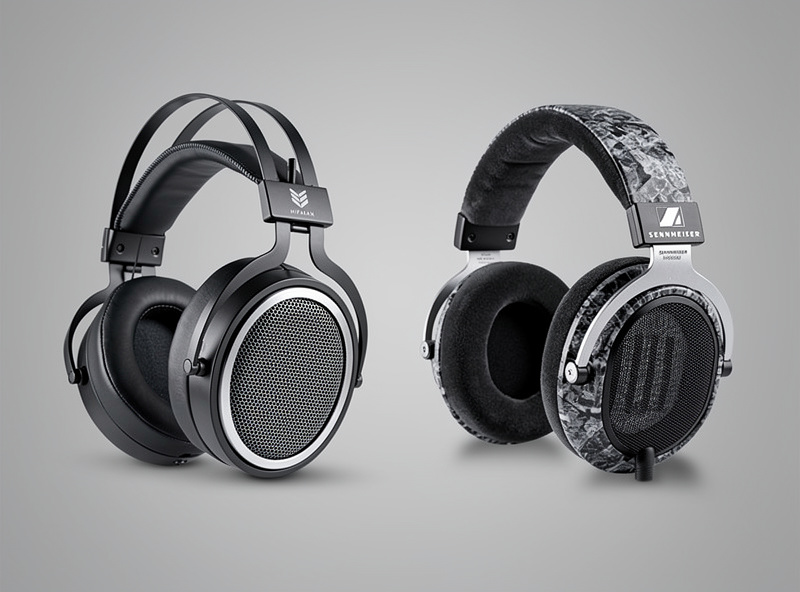
Planar headphones like the Audeze LCD-X reproduce a 30 Hz sine wave with less than 0.1% THD at 94 dB SPL, while the dynamic-driver Focal Clear MG measures approximately 0.5% THD at the same frequency and level. The planar bass decay time is approximately 30% faster than dynamic bass, meaning each bass note stops more quickly after the initial impulse. This creates a “tight” and “controlled” bass character that reveals pitch definition in complex bass lines.
Dynamic driver bass emphasizes the initial transient — the first millisecond of each bass note — creating a sense of physical impact that planar headphones sometimes lack. This “slam” comes from the voice coil’s rapid acceleration in the magnetic gap, which produces a brief pressure spike before settling into the sustained note. The Focal Clear MG’s beryllium driver and the ZMF Auteur’s biocellulose driver both deliver this visceral bass impact that planar designs rarely match.
The choice comes down to musical preference. Electronic music producers and classical listeners who value pitch accuracy and low distortion prefer planar bass. Rock, hip-hop, and pop listeners who enjoy physical impact and warmth often prefer dynamic bass. Some hybrid IEMs attempt to combine both: a dynamic driver handles sub-bass for impact while balanced armatures handle mid-bass and above for speed and detail.
Transient Response and Detail Retrieval
Planar drivers produce 30-50% faster transient response than dynamic drivers of equivalent size. The entire diaphragm surface accelerates simultaneously rather than waiting for the pistoning wave to propagate from the voice coil to the diaphragm edge. This creates crisper attack on plucked strings, sharper percussion transients, and more precise spatial cues.
Transient response is measured as the time for a headphone to reach 90% of its target SPL after receiving an impulse signal. Planar headphones typically achieve this in 0.5-1.0 milliseconds, while dynamic headphones require 1.0-2.0 milliseconds. Faster transients reveal micro-detail in recordings — the rosin on a violin bow, the felt of a piano hammer, the breath before a vocal phrase — that slower transients smear into the background.
However, faster is not always better. Some listeners perceive planar transients as “too fast” or “thin” because the rapid decay removes the natural resonant warmth that dynamic drivers add. The Sennheiser HD 600’s dynamic driver adds approximately 0.5-1.0 dB of harmonic richness in the 200-500 Hz range that gives instruments body and weight. The HIFIMAN Sundara’s planar driver produces the same notes with more precision but less “meat on the bone.”
Detail retrieval depends on more than transient speed. Low distortion, flat frequency response, and proper damping all contribute to how much information a headphone reveals. The Dan Clark Audio Aeon 2 Noire planar headphone retrieves more detail than the Grado SR325x dynamic headphone despite similar prices, primarily because its distortion is 3-5 times lower across the entire frequency range.
Impedance Curves and Amplifier Matching
Dynamic driver impedance varies significantly with frequency due to voice coil inductance — a 300-ohm HD 600 peaks at 500 ohms near its 2 kHz resonance. Planar headphone impedance remains nearly flat across all frequencies because the resistive conductor traces on the diaphragm dominate the impedance. This makes planar headphones easier to predict with amplifiers but often harder to drive due to low impedance and low sensitivity.
The dynamic driver’s impedance peak at its resonant frequency creates a frequency-dependent voltage divider with the amplifier’s output impedance. If the amplifier has high output impedance (like many tube amplifiers at 10-50 ohms), the headphone’s impedance peak causes a corresponding peak in frequency response — a 4 dB peak at 100 Hz is common when pairing high-impedance dynamic headphones with tube amps. This can be desirable for adding warmth or undesirable for accuracy.
Planar headphones with flat impedance curves do not interact with amplifier output impedance in this way. The HIFIMAN Sundara’s impedance stays within 35-40 ohms from 20 Hz to 20 kHz, meaning the amplifier’s output impedance has minimal effect on frequency response. This consistency makes planar headphones predictable across different amplifiers but eliminates the tube amp synergy that dynamic headphone users enjoy.
Most planar headphones require more power than their impedance rating suggests. The Audeze LCD-X at 20 ohms needs approximately 40 milliwatts for 110 dB SPL, but its current-hungry design performs best with amplifiers rated for 1+ watt into 32 ohms. The best headphone amps under $300 include several models with sufficient current delivery for demanding planar loads. Solid-state amplifiers generally pair better with planar headphones due to their low output impedance and high current capability.
Model Comparison: Planar vs Dynamic Head to Head
Direct comparisons at matched price points reveal the practical differences between planar and dynamic designs. The HIFIMAN Sundara ($230) vs Sennheiser HD 600 ($300) represents the entry-level audiophile showdown. The Audeze LCD-X ($1,200) vs Focal Clear MG ($1,300) represents the mid-fi battle. Each pair illustrates the fundamental tradeoffs between the two technologies.
The Sundara vs HD 600 comparison: The Sundara delivers wider soundstage, flatter bass to 20 Hz, and lower distortion below 500 Hz. The HD 600 delivers more engaging midrange warmth, stronger transient slam, and easier amplification requirements. The Sundara needs a headphone amp; the HD 600 sounds acceptable from a quality laptop output. For classical and acoustic music, the Sundara’s precision wins. For rock, pop, and vocal-centric genres, the HD 600’s musicality wins.
The LCD-X vs Clear MG comparison: The LCD-X produces flatter, deeper bass with lower distortion and wider staging. The Clear MG delivers more dynamic impact, more natural timbre on acoustic instruments, and better synergy with tube amplifiers. The LCD-X weighs 600 grams versus 450 grams for the Clear MG, making the Focal significantly more comfortable during extended sessions. Both require quality amplification — pairing either with a budget DAC under $200 leaves performance on the table.
Other notable comparisons include the HIFIMAN Arya ($600) vs ZMF Auteur ($1,600) for mid-range planar vs dynamic, and the Audeze LCD-5 ($4,500) vs Focal Utopia ($4,200) at the flagship tier. At every level, the fundamental tradeoffs remain: planar for technical accuracy and bass extension, dynamic for musicality and slam.
Comparison Table: Planar vs Dynamic Driver Headphones
| Attribute | Planar Magnetic | Dynamic Driver |
|---|---|---|
| Diaphragm Type | Flat, 1-2 microns, full-surface excitation | Cone, voice coil center-drive |
| Frequency Response | 10 Hz – 40 kHz+ (flat) | 15 Hz – 35 kHz (with peaks/dips) |
| Bass Extension | Flat to 15-20 Hz | Rolls off below 30-50 Hz (open) |
| Bass Character | Fast, tight, controlled | Punchy, warm, impactful |
| THD @ 100 Hz | 0.05 – 0.2% | 0.3 – 1.5% |
| Transient Response | 0.5 – 1.0 ms (fast) | 1.0 – 2.0 ms (moderate) |
| Impedance Curve | Flat (resistive) | Peaks at resonance frequency |
| Typical Sensitivity | 90 – 95 dB/mW | 97 – 110 dB/mW |
| Amplification Need | Usually requires amp | Many work from phones |
| Weight Range | 350 – 700g | 200 – 500g |
| Entry Price | $130 | $20 |
| Flagship Example | Audeze LCD-5 ($4,500) | Focal Utopia ($4,200) |
Are planar magnetic headphones better than dynamic?
Planar magnetic headphones measure better in distortion and transient speed, while dynamic drivers deliver more slam and are easier to drive. Neither technology is objectively superior — planar excels in bass extension and detail, dynamic excels in musicality and efficiency. The best choice depends on your music preferences and amplification setup.
Do planar headphones need an amplifier?
Yes. Most planar magnetic headphones measure 90-95 dB/mW sensitivity and require 5-10 times more power than dynamic headphones. A dedicated amplifier delivering 250+ milliwatts into 32 ohms is recommended for models like the HIFIMAN Sundara and Audeze LCD-X. Some planars sound acceptable from powerful laptop outputs but improve significantly with proper amplification.
What is the best planar magnetic headphone under $300?
The HIFIMAN Sundara at $230 is the benchmark planar magnetic headphone under $300. It delivers flat frequency response from 20 Hz to 20 kHz, under 0.5% THD, and soundstage width rivaling headphones costing twice as much. The HIFIMAN HE400se at $130 is the budget entry point for planar technology.
Why do some people prefer dynamic headphones?
Dynamic headphones deliver more transient slam, warmer harmonic richness, and work from a wider range of sources. The pistoning motion of dynamic drivers produces a physical impact that planar designs rarely match. Dynamic headphones also pair better with tube amplifiers due to their variable impedance curves creating synergistic frequency response coloration.
Do planar headphones last longer than dynamic?
Planar headphone longevity depends on diaphragm tension and adhesive quality. Well-built planars from Audeze and Dan Clark Audio last 10+ years. HIFIMAN models have historically had higher failure rates due to thin diaphragm adhesive. Dynamic headphones from Sennheiser, Beyerdynamic, and Focal routinely last 15-20 years with pad replacements.
Can you use planar magnetic headphones with a phone?
Some planar headphones work from phones but sound thin and quiet. The HIFIMAN Sundara at 37 ohms and 94 dB/mW reaches approximately 95 dB SPL from a phone’s 10mW output — enough for quiet environments but insufficient for bass impact. Portable planar headphones like the Oppo PM-3 (discontinued) were designed for phone use at 102 dB/mW sensitivity.