How to Match Headphone Impedance with Your Source
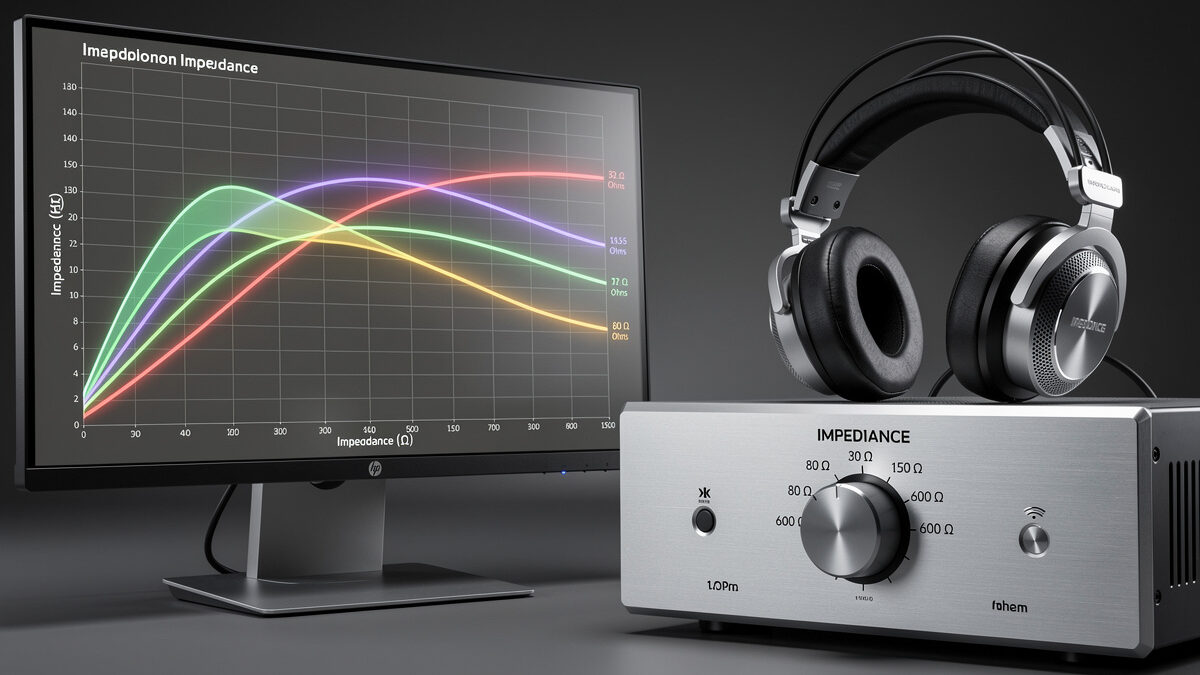
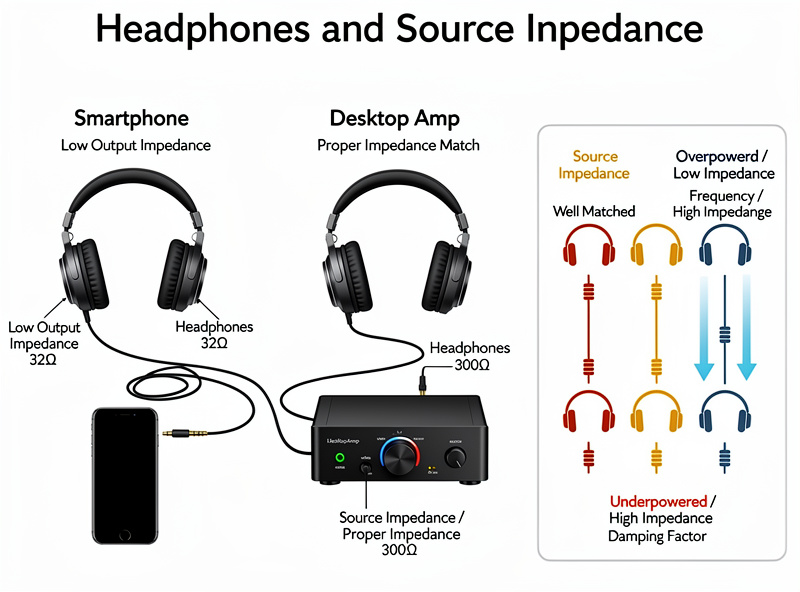
Matching headphone impedance with your source requires maintaining a damping factor above 4:1 — divide headphone impedance by amplifier output impedance. A 300-ohm Sennheiser HD 600 needs an amplifier with output impedance below 75 ohms. A 32-ohm IEM needs output impedance below 8 ohms. Proper matching prevents bass bloom, frequency response deviation, and channel imbalance.
Impedance matching is the most overlooked aspect of headphone setup, yet it directly determines whether your headphones sound their best or deliver a compromised presentation. Mismatched impedance causes measurable frequency response changes, audible bass distortion, and in severe cases, channel imbalance between left and right drivers. Understanding the damping factor, output impedance specifications, and sensitivity ratings eliminates guesswork and prevents expensive pairing mistakes.
What Is Damping Factor and Why It Matters
Damping factor is the ratio of headphone impedance to amplifier output impedance. A damping factor of 4:1 or higher provides adequate driver control for accurate bass reproduction. Below 4:1, the amplifier loses control over the driver’s movement after each transient, causing bass notes to ring longer than intended and frequency response to deviate from the headphone’s native tuning.
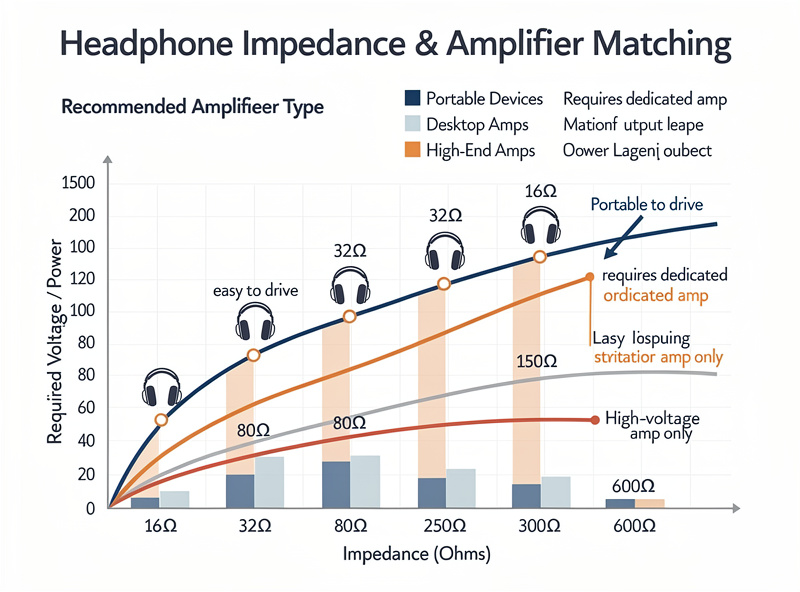
The damping factor concept comes from speaker amplifier design, where values above 20:1 are preferred. Headphones tolerate lower damping factors because their drivers have less mass and higher inherent damping from the ear pad seal. However, the 4:1 minimum threshold still applies — below this point, the amplifier’s output impedance forms a voltage divider with the headphone impedance that varies by frequency, altering the frequency response curve.
Practical example: The Sennheiser HD 600 measures 300 ohms resistive impedance with a 500-ohm peak at 2 kHz due to voice coil inductance. Driven by an amplifier with 10-ohm output impedance, the damping factor at DC is 30:1 (excellent). At the 2 kHz impedance peak, the damping factor drops to 50:1 — still superb. Frequency response deviation is under 0.1 dB across the entire spectrum.
Now take a tube amplifier with 50-ohm output impedance: the DC damping factor drops to 6:1 (acceptable). At the 2 kHz impedance peak, it’s 10:1 (still fine). But at the 80-ohm impedance dip below 100 Hz, the damping factor drops to 1.6:1, causing a measurable 3-4 dB bass boost. Some listeners enjoy this “tube warmth,” but it is objectively a deviation from flat response caused by poor damping.
Amplifier Output Impedance Requirements by Headphone Type
Low-impedance headphones (16-80 ohms) demand amplifiers with output impedance below 2 ohms. Medium-impedance headphones (80-150 ohms) work with output impedance below 20 ohms. High-impedance headphones (150-600 ohms) tolerate output impedance up to 75 ohms. These rules apply to all headphone types — IEMs, over-ear, closed-back, and planar magnetic.
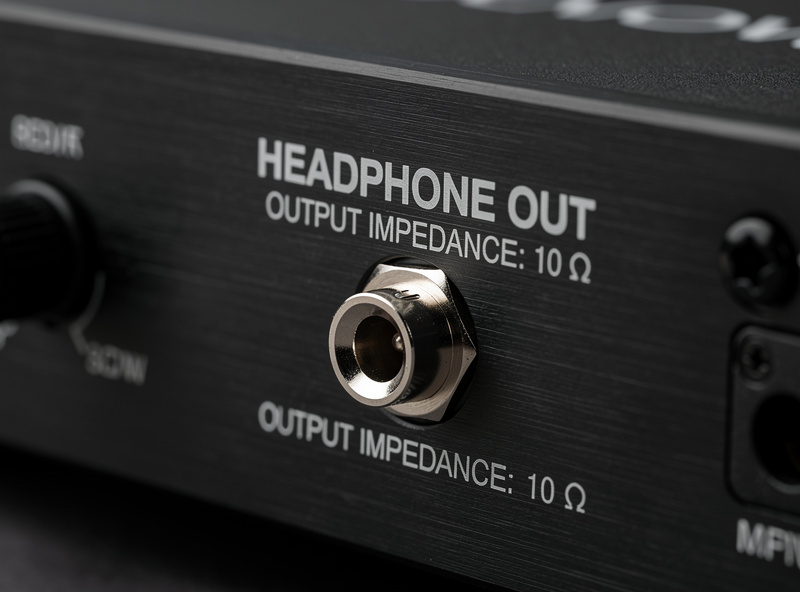
Most solid-state headphone amplifiers measure under 1 ohm output impedance, making them compatible with any headphone. The JDS Labs Atom Amp+ measures 0.1 ohms, the Schiit Magni+ measures 0.2 ohms, and the Topping L30 II measures 0.05 ohms — all well below the threshold for any headphone on the market. This is why solid-state amplifiers are recommended as the default choice for headphone systems.
Tube amplifiers are the primary concern for output impedance. Single-ended triode (SET) tube amps with output transformers typically measure 2-10 ohms output impedance, suitable for headphones above 80 ohms. OTL (output transformerless) tube amps like the Schiit Valhalla 2 and Darkvoice 336SE measure 30-80 ohms output impedance, limiting them to headphones above 150 ohms with resistive impedance curves.
Portable sources vary widely. Dedicated portable DAC/amps like the FiiO BTR7 and iFi Go Bar measure 0.5-1.0 ohm output impedance. Smartphone headphone jacks typically measure 3-10 ohms, which is problematic for low-impedance IEMs. Laptop audio jacks range from 10-50 ohms, making them suitable only for headphones above 80 ohms. Check your source’s output impedance specification before pairing it with any headphone.
Sensitivity Ratings: dB/mW vs dB/V Explained
Sensitivity measures how loud a headphone plays at a given power level. dB/mW measures sound pressure level at 1 milliwatt of input power. dB/V measures SPL at 1 volt RMS. These are not interchangeable — converting between them requires knowing the headphone’s impedance using the formula: dB/V = dB/mW + 10 × log₁₀(1000/Z).
Example: The Sennheiser HD 600 at 300 ohms and 97 dB/mW converts to 97 + 10 × log₁₀(1000/300) = 97 + 5.2 = 102.2 dB/V. The HIFIMAN Sundara at 37 ohms and 94 dB/mW converts to 94 + 10 × log₁₀(1000/37) = 94 + 14.3 = 108.3 dB/V. Despite the Sundara’s lower dB/mW rating, it plays louder per volt than the HD 600 because of its lower impedance drawing more current.
For portable use where voltage swing is limited (phones output 0.7-1.0V max), dB/V is the more relevant specification. A headphone rated at 110 dB/V reaches 110 dB SPL with 1 volt input — easily achievable from any phone. A headphone rated at 95 dB/V reaches only 95 dB with 1 volt, requiring 5.6 times more voltage (11 dB) to reach the same 110 dB level, which exceeds most phone outputs.
For desktop amplifiers where current delivery is ample, dB/mW matters more. A headphone rated at 105 dB/mW reaches 110 dB SPL with just 3.2 milliwatts of power, well within any amplifier’s capability. A headphone rated at 88 dB/mW requires 160 milliwatts for the same level, demanding a powerful amplifier. The best headphone amps under $300 typically deliver 500+ milliwatts into 32 ohms, sufficient for all but the most demanding headphones.
Specific Source and Headphone Pairings
Matching specific sources with headphones removes guesswork from system building. These pairings are validated by damping factor calculations and sensitivity requirements. Each pairing meets the minimum 4:1 damping factor and provides adequate power for 110 dB SPL peaks without clipping.
Smartphone pairing: Apple iPhone 15 (1-ohm output, 1V max) pairs with any IEM under 50 ohms at 100+ dB/V. Best matches: Moondrop Aria 2 (32 ohms, 106 dB/V), Truthear Hexa (24 ohms, 108 dB/V). Avoid: HIFIMAN Sundara (37 ohms, 108 dB/V technically works but sounds thin at 94 dB/mW). Avoid any headphone above 80 ohms.
Laptop pairing: MacBook Pro (3-ohm output, 1.5V max) pairs with headphones under 120 ohms at 95+ dB/mW. Best matches: Audio-Technica ATH-M50x (38 ohms, 99 dB/mW), Sennheiser HD 560S (120 ohms, 110 dB/mW). Acceptable: Sennheiser HD 600 (300 ohms, 97 dB/mW) — reaches 105 dB SPL, adequate for moderate listening but bass impact is reduced.
Desktop DAC/amp stack: Schiit Modi+ / Magni+ (0.2 ohm output, 7V max, 2.5W into 32 ohms) drives every headphone on the market. Best matches for critical listening: HIFIMAN Sundara (37 ohms, 94 dB/mW), Sennheiser HD 600 (300 ohms, 97 dB/mW), Audeze LCD-X (20 ohms, 105 dB/mW). The Magni+’s 0.2-ohm output impedance yields damping factors of 150:1 for the LCD-X and 1,500:1 for the HD 600.
OTL tube amplifier: Schiit Valhalla 2 (14-ohm output, 1.2W into 32 ohms) pairs with high-impedance dynamic headphones above 150 ohms. Best matches: Sennheiser HD 600 (300 ohms, damping factor 21:1), Sennheiser HD 650 (300 ohms), Beyerdynamic DT 880 600-ohm (damping factor 43:1). Avoid: Any headphone under 80 ohms. Avoid: Planar magnetic headphones with flat impedance curves.
Portable DAC/amp: FiiO BTR7 (0.8-ohm output via 4.4mm balanced, 3V max) drives most headphones under 150 ohms. Best matches: Moondrop Blessing 3 (14 ohms, damping factor 17:1), Sennheiser HD 660S2 (30 ohms, damping factor 37:1). The best USB DACs under $200 include several options with sub-1-ohm output impedance.
How Impedance Affects Frequency Response
Dynamic headphone impedance varies with frequency due to voice coil inductance and mechanical resonance. The amplifier’s output impedance interacts with this varying impedance to create frequency-dependent voltage division. This interaction is audible as a change in frequency response — typically a boost at the headphone’s impedance peak frequency.
The Sennheiser HD 600’s impedance peaks at 500 ohms near 100 Hz due to the bass resonance of the enclosed driver. Driven from a 50-ohm tube amplifier, the voltage delivered to the headphone at 100 Hz increases by approximately 4 dB compared to the midrange where impedance is 300 ohms. This is perceived as “tube warmth” — a pleasant bass emphasis that many listeners prefer for jazz and acoustic music.
Planar magnetic headphones like the HIFIMAN Sundara have nearly flat impedance (35-40 ohms from 20 Hz to 20 kHz) because the resistive conductor traces dominate the impedance. This means amplifier output impedance has minimal effect on frequency response — a 50-ohm tube amp and a 0.1-ohm solid-state amp produce nearly identical frequency response with planar headphones. However, the low impedance means the damping factor is low regardless of amplifier choice: 35 ohms / 50 ohms = 0.7:1, which is poor by any standard.
Multi-driver IEMs with crossover networks present complex impedance curves that vary dramatically by frequency. A 4-balanced-armature IEM might measure 16 ohms at 1 kHz but 50 ohms at 50 Hz due to crossover component reactance. Driven from a source with 10-ohm output impedance, this creates a 6 dB bass rolloff — the opposite of what a high source impedance does to dynamic headphones. This is why IEMs demand source impedance below 2 ohms.
Measuring Your Source’s Output Impedance
If your source does not list output impedance in specifications, measure it yourself using a resistor load and voltage comparison. This test requires a digital multimeter and two resistors of known value (33 ohms and 150 ohms work well). The measurement takes 5 minutes and provides the exact output impedance of any headphone output.
Step 1: Play a 1 kHz test tone from your source at a moderate volume. Measure the AC voltage across the 150-ohm resistor connected to the headphone output. Record this as V1. Step 2: Replace the 150-ohm resistor with the 33-ohm resistor. Measure the AC voltage. Record this as V2. Step 3: Calculate output impedance using Zout = (V1 – V2) / (V2/33 – V1/150).
Simplified method: If V2 is less than 70% of V1, the output impedance is above 10 ohms and the source is unsuitable for headphones under 80 ohms. If V2 is above 90% of V1, output impedance is below 3 ohms and the source works with any headphone. Most smartphones achieve V2 above 95% of V1; most laptop jacks achieve 75-85%.
Comparison Table: Source Impedance and Headphone Compatibility
| Source Type | Typical Output Z | Compatible Headphone Z | Min Damping Factor | Best Headphones |
|---|---|---|---|---|
| iPhone 15 | 0.5-1 ohm | 16-80 ohms | 16:1 – 80:1 | IEMs, efficient over-ears |
| Android phone | 1-5 ohms | 16-80 ohms | 3:1 – 80:1 | IEMs, portable headphones |
| Laptop jack | 10-50 ohms | 80-300 ohms | 2:1 – 30:1 | HD 600, DT 880 250-ohm |
| Solid-state amp | 0.05-0.5 ohm | 16-600 ohms | 32:1 – 12,000:1 | Any headphone |
| OTL tube amp | 30-80 ohms | 150-600 ohms | 2:1 – 20:1 | HD 600, HD 650, DT 880 600-ohm |
| Portable DAC/amp | 0.3-2 ohms | 16-150 ohms | 8:1 – 500:1 | IEMs, most over-ears |
| Desktop DAC/amp | 0.05-1 ohm | 16-600 ohms | 16:1 – 12,000:1 | Any headphone |
What happens if headphone impedance does not match the amplifier?
Mismatched impedance causes bass bloom, frequency response deviation, and potential channel imbalance. If amplifier output impedance exceeds 1/4 of headphone impedance (damping factor below 4:1), the amplifier loses control over driver movement, causing bass notes to ring and frequency response to deviate from the headphone’s native tuning by 2-6 dB.
Can I use low-impedance IEMs with a tube amplifier?
No. Tube amplifiers typically have 10-80 ohm output impedance, creating a damping factor below 2:1 with IEMs rated at 16-32 ohms. This causes uncontrolled bass, frequency response peaks of 4-8 dB, and channel imbalance between left and right drivers. Use solid-state amplifiers with sub-2-ohm output impedance for all IEMs.
Is higher headphone impedance better?
Not inherently. Higher impedance (150-600 ohms) requires more voltage to reach the same volume but draws less current, making it suitable for OTL tube amplifiers. Lower impedance (16-80 ohms) requires less voltage but more current, working from phones and portable sources. Impedance is a design choice, not a quality indicator.
How do I find my amplifier’s output impedance?
Check the manufacturer’s specifications first. If unavailable, measure it using a resistor load test: connect a 150-ohm resistor, measure voltage at 1 kHz, replace with 33 ohms, measure again, and calculate Zout using the voltage divider formula. If V2 drops below 70% of V1, output impedance exceeds 10 ohms.
What is the ideal damping factor for headphones?
A damping factor above 4:1 is the minimum for accurate bass reproduction. Above 8:1 provides excellent control with no audible artifacts. Most solid-state amplifiers achieve damping factors above 100:1 with typical headphones, which is overkill but ensures zero frequency response deviation from output impedance interaction.
Do planar magnetic headphones need impedance matching?
Planar headphones have flat impedance curves, so output impedance affects damping but not frequency response. The damping factor still matters — a planar headphone at 35 ohms paired with a 50-ohm tube amp yields 0.7:1 damping, causing loose bass. However, a planar headphone with a solid-state amp at 0.1 ohms achieves 350:1 damping, providing tight control.