Home Theater Speaker Placement Guide: Center, Surround, Atmos
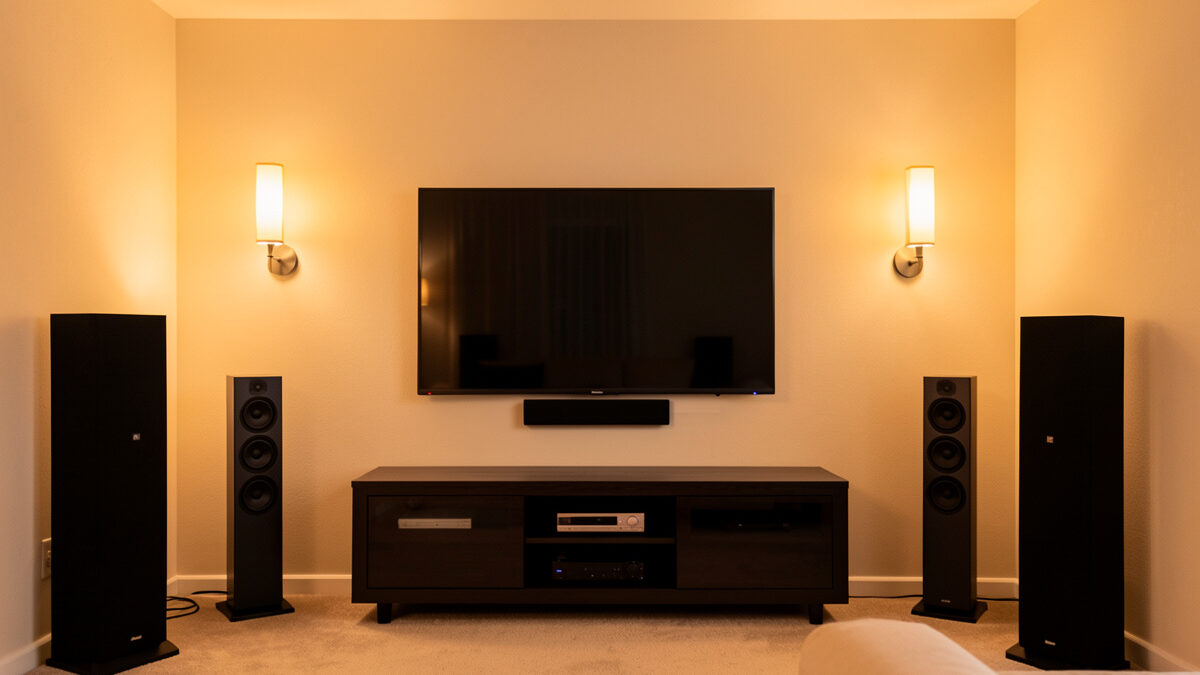
Home theater speaker placement follows a layout standard: the center channel directly below or above the screen at ear height, the front left and right at roughly 22–30 degrees off the central axis, surrounds beside and slightly behind the main seats at 90–110 degrees and about two feet above ear level, and Atmos height speakers in or bounced off the ceiling. The goal is a consistent surround field across every seat, which is a different target from the single-seat precision of stereo placement.
I came to multichannel placement from a stereo background where I obsess over a measured triangle and toe-in for one perfect seat. Home theater forced me to unlearn half of that: a couch holds two or three people, and the layout has to serve all of them, not one. The rules below are the ones that actually changed how my room sounds — getting the center right, spreading the surrounds instead of aiming them, and treating height speakers as a geometry problem rather than a sound-quality one.
Where Does the Center Channel Speaker Go?
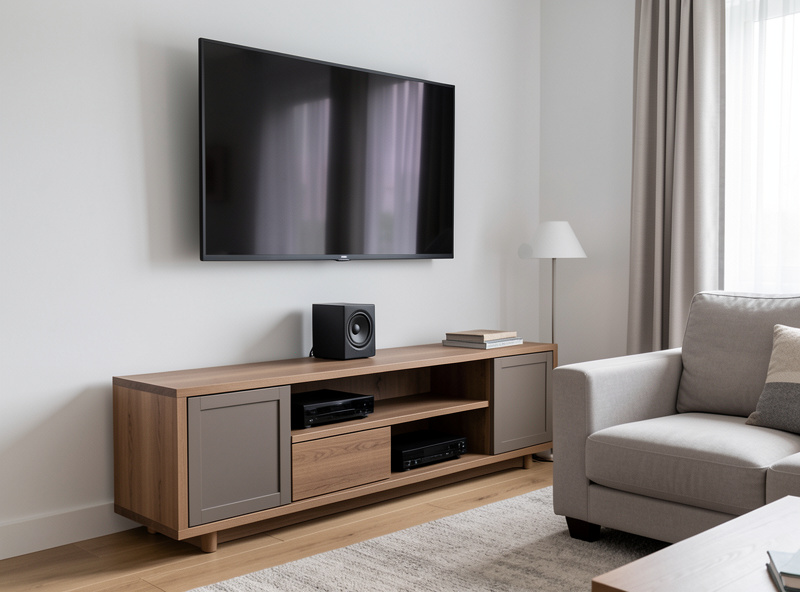
The center channel goes directly below or above the screen, as close to screen height as possible, angled up or down so its output aims at the listeners’ ear height. It carries the majority of a film’s dialogue, so it must be timbre-matched to the front left/right pair — ideally the same brand and tweeter — or voices change tone as they pan across the screen.
This is the speaker people place worst. Shoved deep inside a cabinet, the center sounds boxy and muffled; tilted away from ears, dialogue loses clarity. Pull it to the front edge of the shelf and angle it toward the seats. If it sits well below ear level under a low TV stand, tilt it upward a few degrees. The timbre-match matters because the brain notices instantly when a voice crossing from the left speaker to the center suddenly changes character — the underlying placement geometry for the front three follows my general speaker placement guide, and the full system context is in the home theater audio system guide.
How Far Apart Should the Front Speakers Be?
Place the front left and right speakers so each sits 22–30 degrees from the central listening axis — wide enough for a convincing soundstage but not so wide that the center of the image falls apart. For a typical 10-foot viewing distance that puts them roughly 8–10 feet apart, forming an equilateral-ish triangle with the main seat.
The front pair does double duty: they anchor the left and right of the surround field and they are the speakers your music plays through. So they reward the same care as a stereo setup — a sensible distance from the side walls to control first reflections, a slight toe-in toward the seats, and matched heights. Where home theater differs is that you cannot pull them as far from the wall as a pure music setup might want, because the screen and furniture constrain them. The reflection control that makes them image cleanly is the same physics as my room acoustics treatment work, and a near-field arrangement helps in very small rooms.
Where Should Surround Speakers Be Placed?
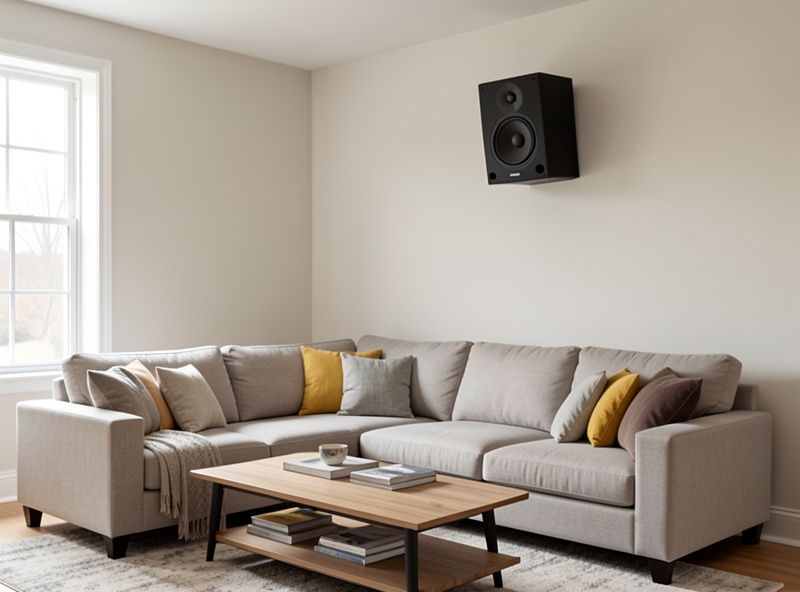
Place surround speakers beside and slightly behind the main seats, at about 90–110 degrees from the front axis, raised roughly two feet above seated ear level. Elevating and angling them spreads the surround field so no single seat hears a speaker “spotlighting” it — the opposite of the pinpoint aiming you want for front-stage imaging.
Surrounds are about envelopment, not localization, which is why bipole or dipole surround speakers exist: they radiate in two directions to diffuse the sound. Direct-radiating speakers work fine too if you aim them slightly above or away from the listeners rather than straight at an ear. In a 7.1 system the rear-surround pair goes behind the seats at 135–150 degrees, but only if there is real distance behind the couch — against a back wall they do little. Raising surrounds above ear height is the single tweak that most improves how seamless the surround field feels across multiple seats.
How Do You Place Dolby Atmos Height Speakers?
Place Atmos height speakers in the ceiling, or use up-firing modules that bounce sound off a flat ceiling, positioned slightly ahead of and behind the main seats. In-ceiling speakers go roughly above the front and surround positions; up-firing modules sit on top of the front and surround speakers and must aim at the ceiling, not at your ears.
Height is the layer where measuring beats listening, because a wrong bounce angle does not sound wrong — it sounds like nothing. The first time I set up an up-firing pair I aimed them at my seat out of instinct and got a flat, localized result; the manual’s bounce-angle diagram and a tape measure fixed it. Up-firing modules need a flat, hard ceiling 8–12 feet high to reflect cleanly; vaulted or heavily absorptive ceilings defeat them, and in-ceiling speakers become the only real option. Treat the ceiling as a mirror, exactly as I treat first-reflection points on the walls.
Common Home Theater Placement Mistakes
Most placement failures I diagnose come from a handful of repeat offenders, none of which need new gear to fix. Knowing them up front saves the frustration of blaming the speakers when the problem is where they sit.
The first is burying the center channel in a cabinet so dialogue muffles. The second is a mismatched center — a different brand or series than the fronts — so voices change tone as they pan. The third is aiming surrounds straight at the nearest listener, spotlighting one seat and starving the others. The fourth is rear-surround speakers crammed against a back wall a foot behind the couch, where they cannot develop a field. The fifth is up-firing Atmos modules aimed at ears instead of the ceiling. Fix the placement first, run the receiver’s auto-calibration to set distances and levels, then verify by ear from each seat. One speaker the layout standard leaves out is the sub, which gets placed by ear-test rather than angle — I cover that in adding a subwoofer to home theater. The whole sequence ties back into the home theater build order, and the front-stage discipline carries straight over from my stereo placement guide.
Frequently Asked Questions
How high should home theater surround speakers be?
Place surround speakers about two feet above seated ear level, roughly 90 to 110 degrees from the front axis, beside and slightly behind the main seats. Elevating them spreads the surround field so no single seat hears a speaker spotlighting it, improving consistency across the couch.
Does the center channel need to match the front speakers?
Yes. The center should be timbre-matched to the front left and right, ideally the same brand and tweeter family. It carries most dialogue, and a mismatched center makes voices change character as they pan across the screen, which the ear notices immediately.
How far apart should front home theater speakers be?
Position the front left and right 22 to 30 degrees from the central listening axis, roughly 8 to 10 feet apart at a 10-foot viewing distance. Wider improves soundstage width but too wide weakens the center image. A slight toe-in toward the seats sharpens focus.
Where do Dolby Atmos height speakers go?
In-ceiling Atmos speakers go above the front and surround positions. Up-firing modules sit on the front and surround speakers and must aim at a flat hard ceiling, not at your ears. Vaulted or absorptive ceilings defeat up-firing modules, so in-ceiling becomes the option.
Can I put surround speakers behind the couch?
Side surrounds belong beside and slightly behind the seats. Rear-surround speakers in a 7.1 system go behind the couch only if there is real distance there, around 135 to 150 degrees. Crammed against a back wall a foot away, rear surrounds add little over side surrounds.