Home Theater Audio System Guide: AV Receivers, Surround, and Calibration
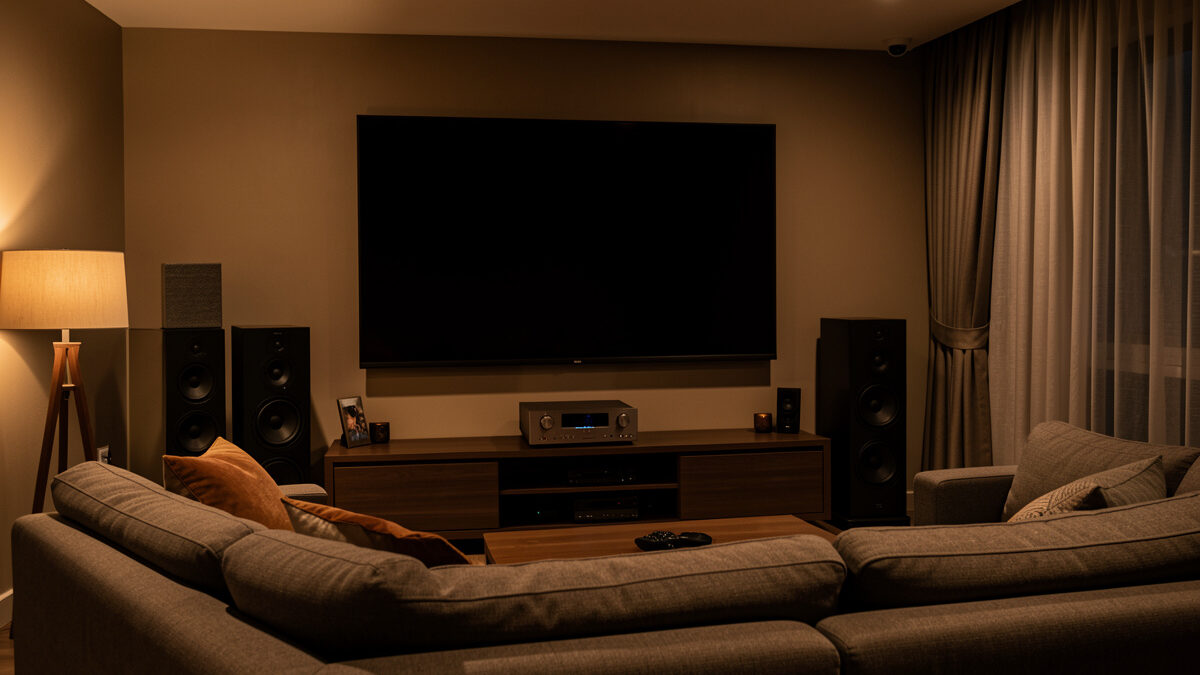
A home theater audio system is a multichannel setup — an AV receiver, three to seven speakers, and at least one subwoofer — built to place sound around and behind you for film, where a 2-channel hi-fi rig is built to image a believable phantom center in front of you for music. The decision that drives everything else is how many channels you actually need: a 5.1 layout (five speakers, one sub) covers the overwhelming majority of rooms, and going to 7.1 or Atmos only pays off when the room is large enough to seat someone behind the listening position.
I came to home theater sideways. My listening room in Sweden was built for stereo — treated first reflections, a measured speaker triangle, a calibrated mic that sweeps the room before I trust anything. When I added a center channel and surrounds to it, I learned fast that the rules I trusted for two channels only half-apply. Multichannel has its own physics: a center channel anchored to a screen, surround dispersion instead of pinpoint imaging, bass management that hands everything below the crossover to a subwoofer, and an auto-calibration routine baked into the receiver that does in ninety seconds what I used to do by hand. This guide is the order of operations I wish I had: decide the channel count, match the receiver to the speakers, integrate the sub, place the surrounds, run the calibration, and then — only then — touch the room. Get the sequence wrong and you spend money fixing problems the previous step created.
Stereo or Surround: Which Home Theater Layout Do You Need?
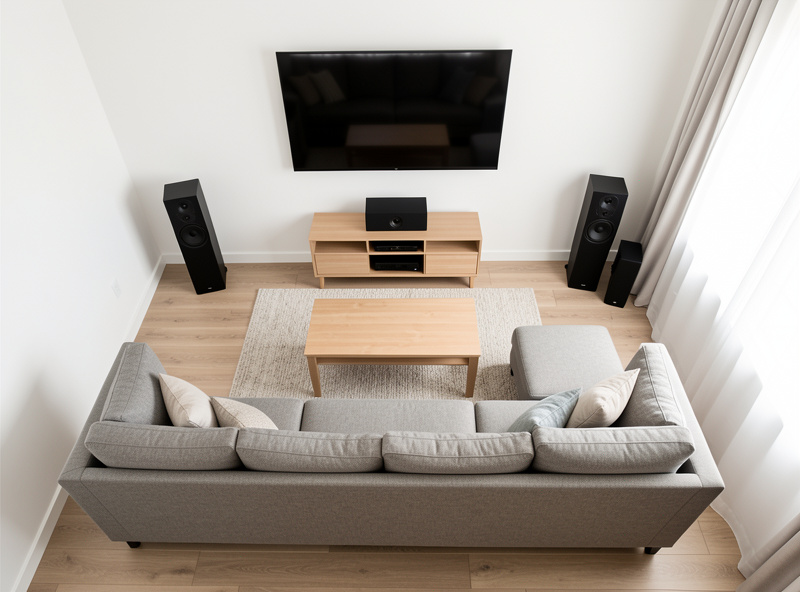
Choose surround (5.1 minimum) if movies are the primary use and you can seat listeners with speakers beside and behind them; choose a good stereo pair plus a sub if 70% of your listening is music. A 5.1 system uses front left/right, a center, two surrounds, and a subwoofer — the center alone fixes the single biggest TV-audio complaint, mumbled dialogue, because it locks voices to the screen instead of floating them as a phantom image that collapses the moment you sit off-axis.
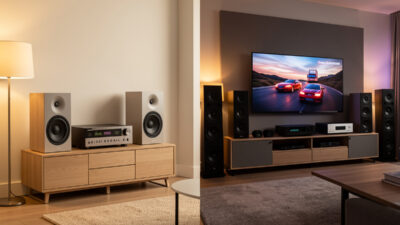
The honest middle ground a lot of people miss is 3.1: front left/right, center, and a sub, no surrounds. In a small living room where you physically cannot put speakers behind the couch without running cable across a doorway, 3.1 gives you 80% of the cinematic benefit — the dialogue lock and the low-end weight — for half the speakers and none of the placement headaches. I ran 3.1 for months before the room earned its surrounds. If you mostly listen to music and watch the occasional film, a quality stereo pair will out-perform a budget 5.1 set on the music, and the receiver’s Dolby surround upmixer still spreads a movie soundtrack convincingly enough. The short version: don’t buy channels you can’t seat people around. I walk the whole 2-channel-versus-multichannel decision in stereo vs surround sound for home theater.
AV Receiver vs Stereo Amplifier: What Actually Drives the Speakers
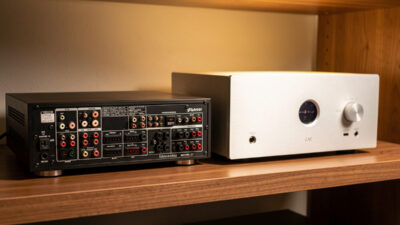
An AV receiver drives a home theater because it decodes Dolby and DTS, switches HDMI video, runs bass management and room calibration, and powers five to eleven channels from one box; a stereo integrated amplifier does none of the multichannel work and powers exactly two channels with no decoding. For movies, the receiver is non-negotiable — it is the brain that splits a 5.1 soundtrack into the right speakers and routes everything below the crossover to the sub.
What trips people up is power. A receiver’s spec sheet says “100 watts x 7,” but that figure is almost always measured with two channels driven, not seven, and at a single frequency. Drive all seven channels hard during a loud scene and the shared power supply sags — real-world output per channel is a fraction of the headline. This is the same continuous-vs-surge reasoning I use for any amplifier, and the matching math is in my speaker sensitivity and amplifier matching guide: a sensitive speaker (88dB and up) makes a modest receiver sound far bigger than a power-hungry 84dB speaker does. If you already own a good 2-channel integrated and want both worlds, the trick is a receiver with pre-outs feeding your stereo amp for the front two channels. The amplifier classes themselves — the tube vs solid-state trade-offs — matter for a 2-channel music chain but are largely moot inside a receiver, which is solid-state Class A/B or Class D by default. On a tighter budget, my best budget amplifiers under $500 roundup names the stereo integrateds I trust for the music side of a hybrid rig. For the full teardown of why one box does the multichannel work the other can’t, see AV receiver vs stereo amplifier.
How Many Channels? 5.1 vs 7.1 vs Dolby Atmos
Run 5.1 unless your seating sits well away from the back wall, in which case 7.1 adds two rear-surround speakers behind the listeners; add Atmos height channels only if your ceiling is flat, 7–12 feet, and you watch enough Atmos content to justify it. The jump from 5.1 to 7.1 is the single most overrated upgrade in home theater — if the couch is against the back wall, the two extra rear speakers fire into a surface a foot away and do almost nothing the side surrounds were not already doing.
Atmos is different because it adds a vertical layer: sound objects placed above you, which the brain reads as genuinely new information rather than more of the same horizontal plane. In-ceiling speakers do it best; up-firing modules that bounce off the ceiling work in rooms with a flat, hard, 8-to-10-foot ceiling and fail in rooms with vaulted or absorptive ceilings — the bounce never returns clean. I treat height channels the way I treat any acoustic reflection: the ceiling is a mirror, and a bad mirror gives you a smeared image. The same first-reflection physics from my room acoustics treatment work applies straight up.
There is a counting convention worth learning before you shop, because the marketing makes it deliberately confusing. A “5.1.2” layout means five ear-level speakers, one sub, and two height channels; “7.2.4” means seven ear-level, two subs, four heights. The first time I set up an up-firing pair I made the classic mistake of aiming them at my seat instead of at the ceiling above and slightly ahead of me — the effect was flat and localized, and it took a tape measure and the manual’s bounce-angle diagram to fix. Heights are the one layer where measuring the geometry beats trusting your ears, because a wrong bounce angle does not sound wrong, it just sounds like nothing at all.
Adding a Subwoofer to Home Theater
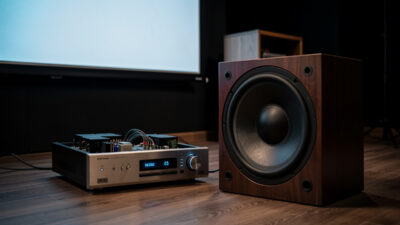
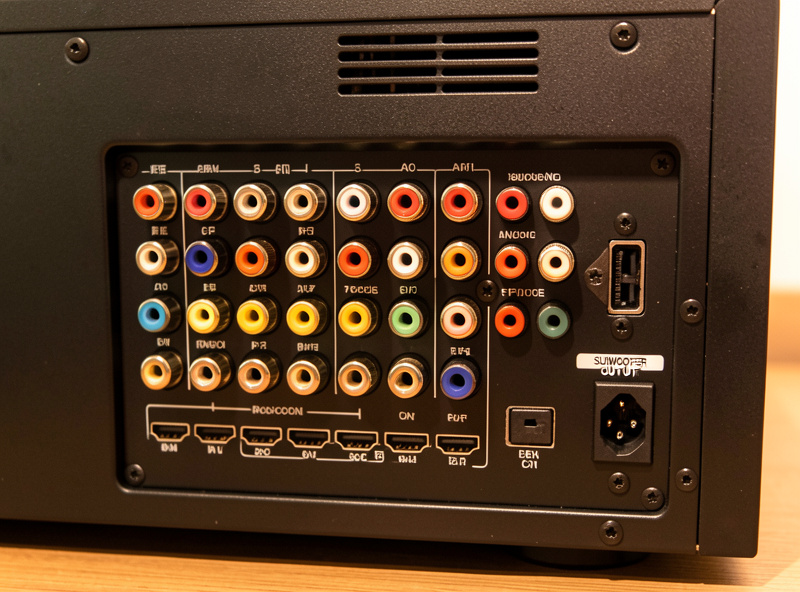
A home theater needs at least one subwoofer because the LFE channel (the “.1” in 5.1) carries dedicated low-frequency effects no satellite speaker can reproduce, and bass management redirects everything below the crossover — typically 80Hz — from every speaker to the sub. This is the channel that makes explosions felt rather than heard, and it is also where most systems are set up wrong.
The mistake is treating home theater sub setup like music sub setup. For music I integrate a sub gently, blending it with full-range speakers around 60–80Hz so it disappears — the method in my subwoofer integration for music guide. For home theater the sub is supposed to be felt, the crossover is usually a flat 80Hz set in the receiver, and the LFE channel can run 10dB hotter than the mains by design. One sub anchored in a corner gets you loud; two subs placed asymmetrically get you even bass across the whole couch, which matters far more once more than one person is watching. The EQ side — taming a single room mode that booms one seat and starves another — is in my subwoofer EQ integration walkthrough.
The crawl test is the one piece of home theater setup I refuse to skip, and it costs nothing. Put the sub up on the couch where your head sits, play a track with steady low bass, then crawl the floor along the front and side walls; wherever the bass sounds loudest and tightest on the floor is where the sub goes, because room behavior is reciprocal. When I did this in my own room the “obvious” front corner turned out to be the worst spot — it boomed at one note and went thin two seats over — and the winning location was a third of the way down the side wall, somewhere I never would have guessed. A capable powered subwoofer in the right spot beats a more expensive one in the wrong spot every single time, which is the same room-first economics I preach for full-range speakers. The complete walkthrough, from crossover to dual-sub placement, is in adding a subwoofer to home theater.
Home Theater Speaker Placement
Place the center directly below or above the screen and angled at ear height, the front left/right at roughly 22–30 degrees off the central axis, and the surrounds beside and slightly behind the seats at 90–110 degrees, raised about two feet above ear level. Home theater placement optimizes for a consistent experience across multiple seats, which is the opposite of the single-seat pinpoint imaging I chase for solo music listening.
The center channel is the one people botch most. It carries the majority of a film’s dialogue and effects, so it has to be timbre-matched to the front pair — ideally the same brand and tweeter — or voices change character as they pan across the screen. Surrounds want wide dispersion, not pinpoint accuracy: bipole or dipole surrounds, or simply aiming direct-radiating speakers slightly away from the listeners, spread the surround field so no single seat hears a speaker spotlighting it. This is a real departure from the precise toe-in of my near-field stereo setup. For the underlying stereo triangle that still governs your front three, the general speaker placement guide is the foundation, and the choice between bookshelf and floorstanding fronts depends on room size as much as budget. Every angle and distance for the full 5.1 layout lives in my home theater speaker placement guide.
Calibrating a Home Theater Audio System
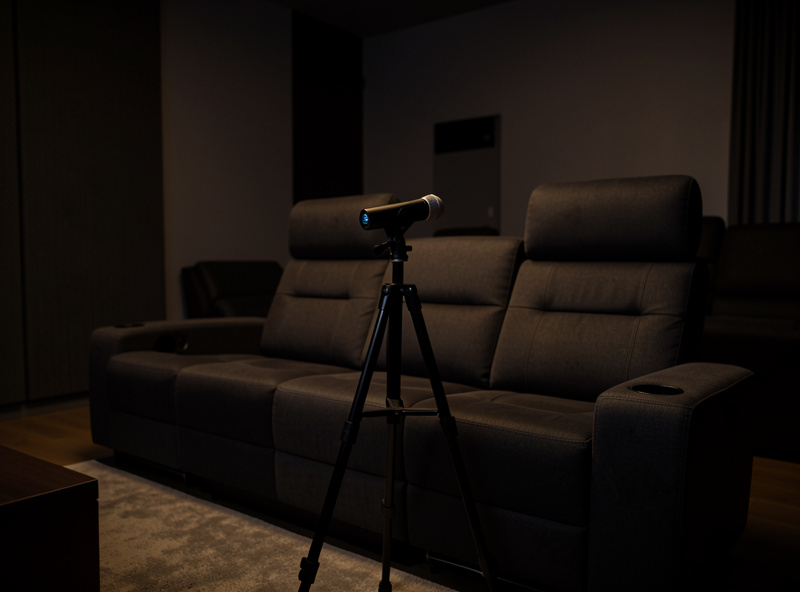
Calibration sets each speaker’s distance (which the receiver converts to a time delay so sound from all channels arrives at your seat together), trim level (so every channel plays at a matched 75dB reference), crossover, and a room-correction filter — and the receiver’s auto-calibration mic does the first pass in under two minutes. Audyssey, YPAO, MCACC, and Dirac are the common systems; you place the bundled mic at ear height in the main seat, run the sweep, and the receiver measures and corrects.
I trust auto-calibration for distances and levels — it measures those better than a tape measure and an SPL meter, every time. Where I intervene is the room-correction curve: most auto systems try to flatten the bass too aggressively and fight room modes they cannot actually win below the Schroeder frequency, exactly the limit I describe in my digital room correction work. After the auto pass I verify with a calibrated mic and REW, then often re-set the sub crossover to a clean 80Hz the auto routine got wrong. For the broader electronic-correction philosophy that underpins all of it, start at my home audio equalizer guide, the room correction basics, and the miniDSP 2×4 setup for hands-on parametric control.
Two mistakes ruin more auto-calibration runs than anything else, and I have made both. The first is running the sweep with the room noisy — a fridge compressor, a fan, traffic through a cracked window — which the mic dutifully measures and the receiver tries to correct, baking the noise floor into your curve. Run it at night, in silence. The second is holding the mic in your hand instead of locking it to a tripod or boom at exactly seated ear height; a few centimeters of height error shifts the measured frequency response enough to matter. After the multi-position sweep, the single most useful manual override is double-checking that every speaker got set to “small” so bass management actually routes to the sub — if the receiver flagged your bookshelves as “large,” they are trying to reproduce 30Hz they physically cannot, and the sub sits half-idle while the mains distort. I take the full auto-then-manual routine step by step in how to calibrate a home theater audio system.
Home Theater in a Small Room
A small room is an advantage for home theater output and a liability for bass: less air to pressurize means a modest receiver and sub hit reference levels easily, but room modes are stronger and seating is forced close to walls and corners. The single best small-room move is a smaller, faster sub placed with the crawl test rather than a big sub jammed in the only corner that fits.
In a small room I lean toward a 3.1 or compact 5.1 with bookshelf-sized speakers — the front pair can be the same budget bookshelf speakers I would recommend for music — rather than floorstanders that overload the space. Surrounds go on the side walls because there is no room behind the couch, and the sub gets a single, well-placed unit with EQ instead of dual subs. Because a small treated room serves double duty, the same space can host a proper 2-channel hi-fi system — or a vinyl front end — routed through the receiver’s stereo bypass, and a smarter powered-vs-passive choice for the fronts can simplify the whole rack. All of my compact-room tactics are collected in home theater tips for small rooms.
Home Theater vs 2-Channel Hi-Fi: Side by Side
The two systems share components but optimize for opposite goals. This is the comparison I run through with anyone deciding whether to build one rig that does both or keep them separate. Both still depend on the same room and speaker acoustics, and a good DAC feeds the receiver’s stereo input just as it would an integrated amp.
| Factor | Home Theater (5.1/Atmos) | 2-Channel Hi-Fi |
|---|---|---|
| Primary goal | Immersive, multi-seat film sound | Accurate stereo imaging, one seat |
| Brain of the system | AV receiver (decoding + bass mgmt) | Integrated amp or pre/power |
| Speaker count | 5 to 11 + subwoofer | 2 (+ optional sub) |
| Subwoofer role | Dedicated LFE channel, felt impact | Blended low-end extension |
| Calibration | Auto (Audyssey/YPAO/Dirac) | Manual placement + measurement |
| Surround placement | Wide dispersion, behind/beside | N/A — front pair only |
| Best for small rooms | 3.1 / compact 5.1 | Near-field stereo pair |
Where to Start
If I were building this from nothing today, I would buy the AV receiver and a timbre-matched front three first, add one well-placed subwoofer, and run the auto-calibration before spending a krona on surrounds or room treatment — because that core delivers the dialogue lock and the low-end weight that make the difference, and everything after it is refinement. Decide your channel count by the seats you can actually use, not the box that has the most outputs, and the rest of this cluster takes each step from there in full depth.
Frequently Asked Questions
Do I need an AV receiver or will a stereo amplifier work for home theater?
You need an AV receiver for true home theater. Only a receiver decodes Dolby and DTS, runs bass management, and powers five or more channels. A stereo amplifier handles two channels with no surround decoding, fine for music but not multichannel film.
Is 5.1 or 7.1 better for a normal living room?
5.1 is better for most living rooms. The two extra rear speakers in 7.1 only help when seating sits well away from the back wall. Against a wall, rear surrounds fire into a surface a foot away and add little over side surrounds.
How many subwoofers does a home theater need?
One subwoofer is the minimum and covers the LFE channel. Two subs placed asymmetrically deliver more even bass across multiple seats, which matters once more than one person watches. Single corner placement is loud but uneven across the couch.
What crossover should I set for home theater speakers?
Start at 80Hz, the standard set by most receivers and the THX reference. It hands everything below 80Hz to the subwoofer, where small satellites cannot reach. Raise it to 100-120Hz only for very small bookshelf or satellite speakers.
Does auto-calibration like Audyssey actually work?
Auto-calibration is excellent for speaker distances and trim levels, better than a tape measure and SPL meter. Its room-correction curve is less reliable below the Schroeder frequency. Run the auto pass, then verify and override the bass with a measurement mic.
Can one system do both home theater and 2-channel hi-fi well?
Yes, with a receiver that has a stereo or pure-direct bypass and quality front speakers. Route music through the front pair with processing off, and movies through full multichannel. A receiver with pre-outs can also feed a dedicated stereo amp.