Stereo Subwoofer Guide: Bass Done Right in 2-Channel Hi-Fi
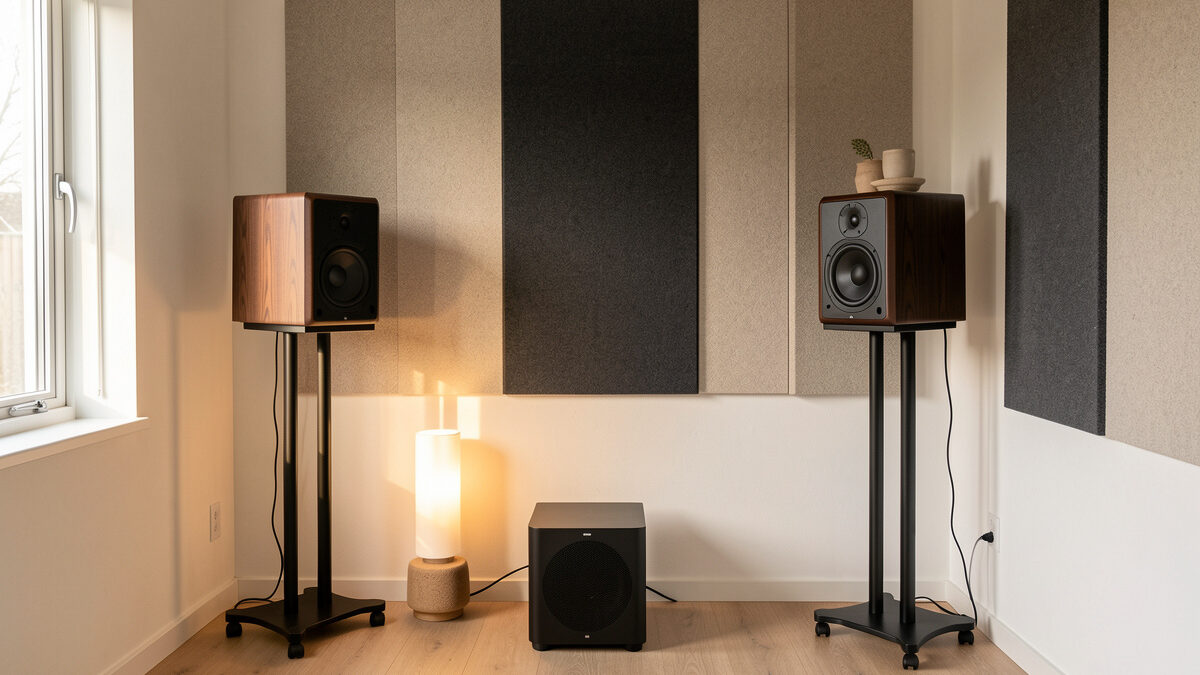
A subwoofer in a two-channel system is not a bass booster. It is a tool for fixing what the room does to the bottom two octaves and for taking the strain off speakers that were never designed to load a room below 40Hz. Done right, it lowers distortion in the midbass and makes the whole system sound calmer, not louder.
That sentence is most of what I have learned after years of swapping subs in and out of one fixed, lightly treated room in Sweden and sweeping every change with a calibrated mic. Most people buy a subwoofer hoping for slam and end up with a one-note hump parked in a corner. This guide is the order of operations I actually trust: understand what a sub fixes, decide how many and what type, then integrate it with measurement rather than mood. The box matters less than where it sits and how you cross it over.
What a Subwoofer Actually Fixes in a Music System
A standmount like the KEF LS50 Meta I use as my imaging benchmark is honest down to roughly 50Hz and then politely gives up. A subwoofer does three things: it extends the bottom octave so kick drums and low synths arrive with weight, it relieves the main speakers of cone excursion in the 40-80Hz region so the midrange cleans up, and — most importantly — it gives you a second bass source you can move independently of your speakers to fight room modes.
That last point is the one nobody sells you. In a small room, the dominant problem below about 200Hz is not your speaker; it is the standing waves between parallel surfaces. When I swept my room the first time, the response between 30 and 80Hz looked like a mountain range — a 12dB peak at one frequency, a deep null a third of an octave away. No amplifier or cable changes that. A second, movable bass source does, which is the whole argument for treating the sub as a room-correction device, not an effects unit. The physics here is the same broadband absorption I use on first reflections in my room acoustics treatment work — absorbers and bass traps do not care what you are listening to.
Room Modes: Why Bass Is a Room Problem First
If you take one idea from this guide, make it this: below the Schroeder frequency — roughly 200Hz in a domestic room — you are not really listening to your subwoofer, you are listening to your room. Every pair of parallel surfaces creates resonances at frequencies set by the dimensions between them. A 4-metre wall spacing produces a fundamental mode around 43Hz, and that mode plus its harmonics define where bass piles up and where it cancels.
This is why two readers with the identical sub get wildly different results, and why forum advice about “the best subwoofer” is mostly noise. In my measurements, the same sealed 12 moved from a corner to a side-wall position changed its in-room response by more than 10dB at the worst mode — a difference no review can predict because it depends on your room, not the box. The practical consequence is an order of operations: get the room and placement right first, then correct the residue with DSP, and only then worry about whether you bought the “right” sub. I treat the sub as the most flexible acoustic tool I own, because unlike my speakers I am free to put it anywhere. For the underlying acoustics, my speaker and room acoustics guide is the companion read.
How Many Subwoofers: Single vs Stereo (Dual)
One good subwoofer, placed and integrated correctly, beats two bad ones. But once you have the basics handled, a second sub is the single most effective bass upgrade available, and it has almost nothing to do with stereo bass. Below roughly 80Hz the ear cannot localise sound, so “stereo bass” in the directional sense is largely a myth. What two subs buy you is smoother modal response across the seating area.
The research on this is well established: multiple subwoofer studies from Harman’s listening labs (the Welti and Devantier work) report that two subs positioned asymmetrically average out the room modes far better than one, and four does better still. I have measured this in my own room — going from one sub in the corner to two on opposite walls flattened a 9dB seat-to-seat swing down to about 3dB. That is a bigger, more audible change than any DAC swap I have ever run. I cover the full trade-off in the dedicated stereo vs single subwoofer comparison, and the practical wiring in adding a subwoofer to a 2-channel system.
Sealed vs Ported: Which Suits Music
For two-channel music in a small-to-medium room, I lean sealed almost every time, and it comes down to group delay and decay, not output. A sealed box rolls off gently at 12dB/octave and has tighter time-domain behaviour — the cone stops when the signal stops. A ported box gains roughly half an octave of extension and several dB of output near tuning, but the port introduces group delay and a steeper 24dB/octave roll-off below tuning, which is what people are hearing when they call ported bass “loose.”
That is a tendency, not a law — a well-designed ported sub with good port geometry can measure beautifully, and in a big room or for home theater the extra output is genuinely useful. But on a music-first bench where I am chasing decay time and integration with a fast standmount, sealed makes my job easier. The full measurement breakdown is in the sealed vs ported subwoofer comparison.
Crossover, Phase, and Level: The Integration That Makes or Breaks It
This is where most subwoofers fail, and none of it is about the box. A subwoofer that is poorly crossed sounds like a separate thing humming in the corner; one that is integrated well is inaudible as a source — you only notice it when you switch it off and the music collapses. The three controls that matter are the low-pass crossover frequency, phase (or delay), and level.
As a starting point, set the low-pass crossover roughly an octave below where your main speakers start dropping off — for a standmount honest to 50Hz, I begin around 70-80Hz and then measure. Match the level so the sub neither announces itself nor disappears; I aim for a smooth in-room slope rather than a flat line, because a flat anechoic target measures bass-light in a real room. Phase is set by measuring at the crossover frequency and choosing the setting that gives the highest summed output — that tells you the sub and mains are arriving in time. I walk through every setting with screenshots in the subwoofer crossover settings guide, and the deeper DSP side in my digital room correction and subwoofer EQ integration articles.
Placement: The Free Upgrade
Where the sub sits changes its in-room response by more than any setting on the back panel. Corners give you maximum output and maximum room-mode excitation; pulling the sub out along a wall trades a few dB of gain for a smoother curve. The “subwoofer crawl” — putting the sub at your listening seat, playing a bass sweep, and crawling the room boundary to hear where it sounds most even — still works as a no-cost first pass, and then I confirm it with a proper sweep in REW.
In my room the best single-sub position was nowhere near where it looked tidy: about a third of the way along the side wall, well off the corner. That one move did more than any EQ I applied afterward. The complete method, including dual-sub positioning, is in the subwoofer placement and positioning guide, and it pairs with my broader speaker placement guide and near-field listening setup.
Connecting a Subwoofer to a Two-Channel Amplifier
Integrated amps are not all built for subs, and the connection you use decides how much control you get. If your amp has a dedicated sub or pre-out, that is the clean path. If it has only speaker terminals, many subs accept high-level (speaker-level) input, which has the side benefit of carrying your amplifier’s tonal signature through to the sub. The most flexible route — and the one I use — is to run the signal through a miniDSP, which lets me apply the crossover, delay, and parametric EQ in the digital domain rather than relying on the sub’s coarse back-panel knobs.
None of these are wrong; they are a trade between simplicity and control. The full wiring diagrams, including what to do when your amp has no pre-out, are in adding a subwoofer to a 2-channel system. If you are going the DSP route, my miniDSP 2×4 HD setup guide and REW measurement guide are the tools I reach for.
A Measurement-First Setup Workflow
Here is the sequence I run every time a sub comes onto the bench, and it has never let me down. First, find placement by ear with the subwoofer crawl, then lock it in with a REW sweep using the UMIK-1 at the listening seat. Second, set the crossover and an approximate level by ear so the handover sounds seamless. Third, sweep again with the sub and mains together and look at the summed response across the crossover region — a dip there means a phase or distance problem, not a level problem.
Fourth, set phase or delay to maximise output at the crossover frequency. Fifth, apply parametric EQ only to the worst peaks below the Schroeder frequency, and resist the urge to fill nulls — you cannot EQ your way out of a cancellation, you can only move the sub or add a second one. Finally, re-measure and live with it for a week before touching anything. I have learned the hard way that the first measurement looks alarming and the tenth looks like music; the discipline is in changing one variable at a time. The tools for this are my REW guide, the miniDSP 2×4 HD setup, and the broader room correction EQ basics.
Common Subwoofer Mistakes I See (and Made)
The most common error is buying for output instead of integration — a huge ported sub that overwhelms a small room and excites every mode at once. The second is leaving the crossover too high, around 120Hz, which makes the sub locatable and smears the midbass. The third is “tuning” by spinning the level knob until the bass sounds impressive in the first ten minutes, then fatiguing within an hour.
I made the placement mistake for years, parking the sub in the corner because it was tidy and because corners are loud. Loud is not even. The fix was not a better sub; it was a measurement mic and the willingness to move a heavy box four times in an afternoon. The other quiet mistake is ignoring gain staging in the chain — if you run a DSP, set its output and the sub’s input so you are not amplifying noise. These are the same disciplines I bring to speaker and amplifier matching: levels and impedance before opinion.
Choosing a Subwoofer: How Much, and What Matters
Driver size and amplifier power matter less than honest extension and clean output at the level you actually listen. For near-field music in a small room, a single 10 or 12-inch sealed sub is plenty; chasing a 15-inch ported monster usually buys you more room-excitation problems, not better music. Spend the money on a sub with a usable phase control or, better, plan to integrate it through DSP. My current shortlist of music-first subs, with the measurement reasoning behind each, is in the best subwoofers for music 2026 roundup.
One more thing on budget: if you have not treated your room or dialled in placement, a second cheaper sub will beat a single expensive one. The order of operations is room, placement, integration, then box quality — in that order. That is the opposite of how the hobby usually spends money, and it is why I keep coming back to the mic before the wallet.
When You Should Not Add a Subwoofer
A sub is not a universal upgrade. If you already run capable floorstanders in a small near-field setup and your main complaint is harshness or a thin midrange, the answer is room treatment and placement, not more bass — adding a sub to an untreated room often makes the modal problems worse, not better. If you listen quietly late at night, the bottom octave you would gain is largely below what you will play at low volume thanks to the ear’s reduced low-frequency sensitivity, which is just the equal-loudness curve at work.
And if you are not willing to measure or at least crawl the room and set a crossover, a sub will probably make your system sound worse than no sub at all — a bloated, disconnected thump is the default result of a box dropped in a corner with the knobs at noon. The honest position, and the one a hype reviewer cannot afford to take, is that a subwoofer rewards effort and punishes laziness. If you will put in the placement and integration work, it is transformative. If you will not, spend the money elsewhere.
Subwoofer Approaches Compared
| Approach | Best For | Bass Smoothness | Relative Cost | My Take |
|---|---|---|---|---|
| Single sealed sub | Small-room music, fast standmounts | Good with careful placement | Low | The sensible starting point |
| Single ported sub | Larger rooms, output priority | Good, more room excitation | Low | Output you may not need for music |
| Dual (stereo) sealed subs | Even bass across the seating area | Best, modes averaged out | Medium | The biggest real-world upgrade |
| Sub plus miniDSP correction | Anyone willing to measure | Best controllable result | Medium | Where I land every time |
| No sub, bigger speakers | Those who dislike extra boxes | Limited below 40Hz in a small room | High | Rarely beats a good sub for the money |
Frequently Asked Questions
Do you really need a subwoofer for two-channel music?
Not always, but most standmount and many floorstanding systems roll off before the bottom octave and excite room modes in the midbass. A well-integrated sub extends low-end reach and relieves the mains, which usually cleans up the midrange more than it adds slam.
Is stereo bass real, or do you only need one subwoofer?
Below about 80Hz the ear cannot localise sound, so true stereo bass is mostly a myth. The reason to run two subs is modal smoothing across the seating area, not channel separation. Harman’s research reports two asymmetric subs flatten seat-to-seat variation far better than one.
Should I choose a sealed or ported subwoofer for music?
For small-to-medium rooms and music, sealed usually integrates more easily thanks to gentler roll-off and lower group delay. Ported subs gain extension and output near tuning, which matters more in large rooms or for home theater.
Where is the best place to put a subwoofer?
Corners give maximum output and maximum room-mode excitation. A position partway along a wall, well off the corner, often measures smoother. Use the subwoofer crawl to find candidate spots, then confirm with a measurement sweep.
What crossover frequency should I set for my subwoofer?
Start about an octave below where your mains roll off. For a standmount honest to 50Hz, begin around 70 to 80Hz, then measure and adjust so there is no dip or hump at the handover. Higher crossovers risk making the sub locatable.
How do I connect a subwoofer if my amplifier has no subwoofer output?
Many subwoofers accept high-level (speaker-level) input wired in parallel with your speaker terminals, which also passes your amp’s character to the sub. Alternatively, run the signal through a miniDSP for full crossover, delay, and EQ control.
Related Guides in This Cluster
- Adding a Subwoofer to a 2-Channel Stereo System
- Stereo (Dual) vs Single Subwoofer: Which You Need
- Subwoofer Placement and Positioning Guide
- Subwoofer Crossover Settings Guide
- Sealed vs Ported Subwoofer Comparison
- Best Subwoofers for Music 2026